 Add to Chrome
 Add to Firefox
 Add to Edge
IIB-LPO: Latent Policy Optimization via Iterative Information Bottleneck
Jan 09, 2026
Recent advances in Reinforcement Learning with Verifiable Rewards (RLVR) for Large Language Model (LLM) reasoning have been hindered by a persistent challenge: exploration collapse. The semantic homogeneity of random rollouts often traps models in narrow, over-optimized behaviors. While existing methods leverage policy entropy to encourage exploration, they face inherent limitations. Global entropy regularization is susceptible to reward hacking, which can induce meaningless verbosity, whereas local token-selective updates struggle with the strong inductive bias of pre-trained models. To address this, we propose Latent Policy Optimization via Iterative Information Bottleneck (IIB-LPO), a novel approach that shifts exploration from statistical perturbation of token distributions to topological branching of reasoning trajectories. IIB-LPO triggers latent branching at high-entropy states to diversify reasoning paths and employs the Information Bottleneck principle both as a trajectory filter and a self-reward mechanism, ensuring concise and informative exploration. Empirical results across four mathematical reasoning benchmarks demonstrate that IIB-LPO achieves state-of-the-art performance, surpassing prior methods by margins of up to 5.3% in accuracy and 7.4% in diversity metrics.

Boosting the Generalization and Reasoning of Vision Language Models with Curriculum Reinforcement Learning
Mar 10, 2025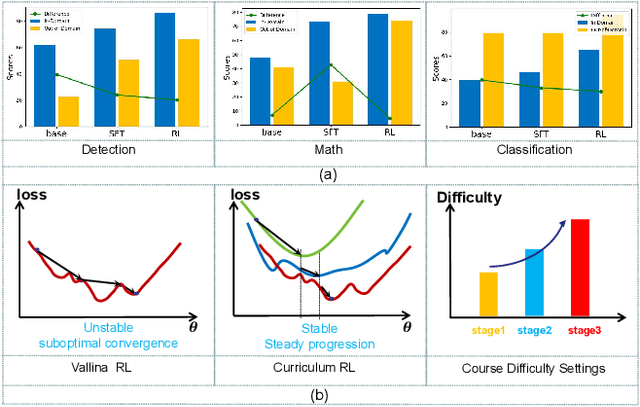
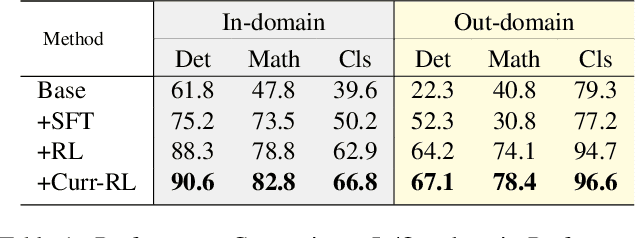
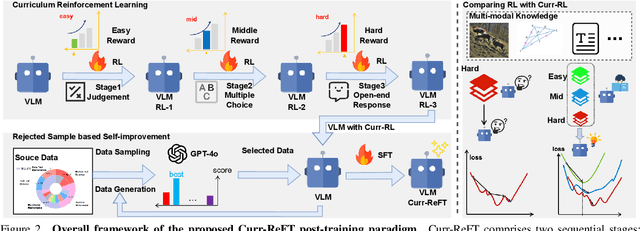
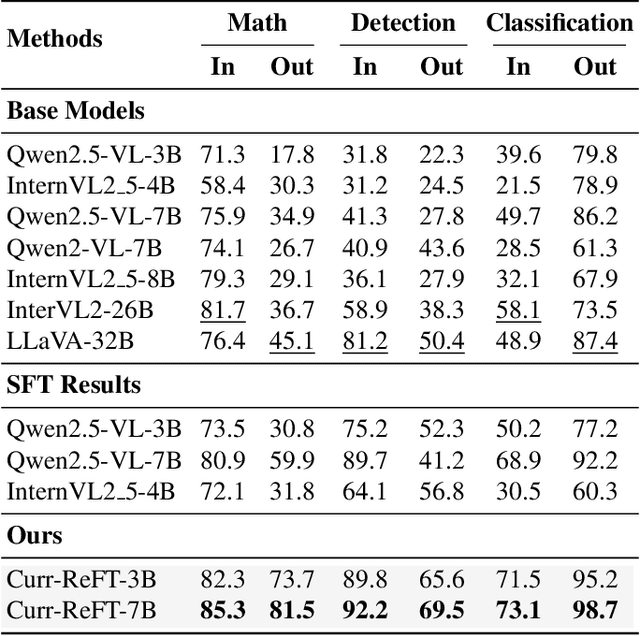
While state-of-the-art vision-language models (VLMs) have demonstrated remarkable capabilities in complex visual-text tasks, their success heavily relies on massive model scaling, limiting their practical deployment. Small-scale VLMs offer a more practical alternative but face significant challenges when trained with traditional supervised fine-tuning (SFT), particularly in two aspects: out-of-domain (OOD) generalization and reasoning abilities, which significantly lags behind the contemporary Large language models (LLMs). To address these challenges, we propose Curriculum Reinforcement Finetuning (Curr-ReFT), a novel post-training paradigm specifically designed for small-scale VLMs. Inspired by the success of reinforcement learning in LLMs, Curr-ReFT comprises two sequential stages: (1) Curriculum Reinforcement Learning, which ensures steady progression of model capabilities through difficulty-aware reward design, transitioning from basic visual perception to complex reasoning tasks; and (2) Rejected Sampling-based Self-improvement, which maintains the fundamental capabilities of VLMs through selective learning from high-quality multimodal and language examples. Extensive experiments demonstrate that models trained with Curr-ReFT paradigm achieve state-of-the-art performance across various visual tasks in both in-domain and out-of-domain settings. Moreover, our Curr-ReFT enhanced 3B model matches the performance of 32B-parameter models, demonstrating that efficient training paradigms can effectively bridge the gap between small and large models.
VMAD: Visual-enhanced Multimodal Large Language Model for Zero-Shot Anomaly Detection
Sep 30, 2024Zero-shot anomaly detection (ZSAD) recognizes and localizes anomalies in previously unseen objects by establishing feature mapping between textual prompts and inspection images, demonstrating excellent research value in flexible industrial manufacturing. However, existing ZSAD methods are limited by closed-world settings, struggling to unseen defects with predefined prompts. Recently, adapting Multimodal Large Language Models (MLLMs) for Industrial Anomaly Detection (IAD) presents a viable solution. Unlike fixed-prompt methods, MLLMs exhibit a generative paradigm with open-ended text interpretation, enabling more adaptive anomaly analysis. However, this adaption faces inherent challenges as anomalies often manifest in fine-grained regions and exhibit minimal visual discrepancies from normal samples. To address these challenges, we propose a novel framework VMAD (Visual-enhanced MLLM Anomaly Detection) that enhances MLLM with visual-based IAD knowledge and fine-grained perception, simultaneously providing precise detection and comprehensive analysis of anomalies. Specifically, we design a Defect-Sensitive Structure Learning scheme that transfers patch-similarities cues from visual branch to our MLLM for improved anomaly discrimination. Besides, we introduce a novel visual projector, Locality-enhanced Token Compression, which mines multi-level features in local contexts to enhance fine-grained detection. Furthermore, we introduce the Real Industrial Anomaly Detection (RIAD), a comprehensive IAD dataset with detailed anomaly descriptions and analyses, offering a valuable resource for MLLM-based IAD development. Extensive experiments on zero-shot benchmarks, including MVTec-AD, Visa, WFDD, and RIAD datasets, demonstrate our superior performance over state-of-the-art methods. The code and dataset will be available soon.