 Add to Chrome
 Add to Firefox
 Add to Edge
Transolver-3: Scaling Up Transformer Solvers to Industrial-Scale Geometries
Feb 04, 2026
Deep learning has emerged as a transformative tool for the neural surrogate modeling of partial differential equations (PDEs), known as neural PDE solvers. However, scaling these solvers to industrial-scale geometries with over $10^8$ cells remains a fundamental challenge due to the prohibitive memory complexity of processing high-resolution meshes. We present Transolver-3, a new member of the Transolver family as a highly scalable framework designed for high-fidelity physics simulations. To bridge the gap between limited GPU capacity and the resolution requirements of complex engineering tasks, we introduce two key architectural optimizations: faster slice and deslice by exploiting matrix multiplication associative property and geometry slice tiling to partition the computation of physical states. Combined with an amortized training strategy by learning on random subsets of original high-resolution meshes and a physical state caching technique during inference, Transolver-3 enables high-fidelity field prediction on industrial-scale meshes. Extensive experiments demonstrate that Transolver-3 is capable of handling meshes with over 160 million cells, achieving impressive performance across three challenging simulation benchmarks, including aircraft and automotive design tasks.

ProPINN: Demystifying Propagation Failures in Physics-Informed Neural Networks
Feb 02, 2025
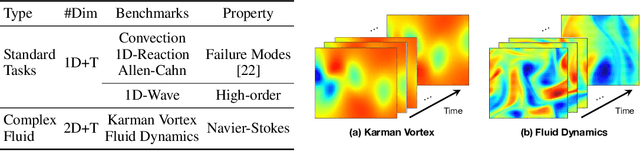
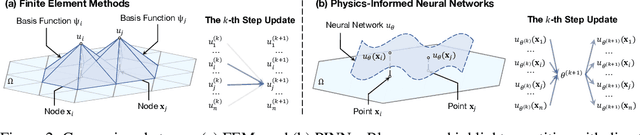
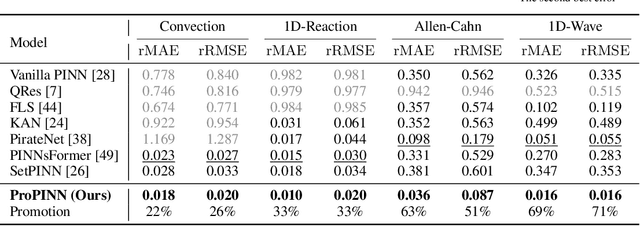
Physics-informed neural networks (PINNs) have earned high expectations in solving partial differential equations (PDEs), but their optimization usually faces thorny challenges due to the unique derivative-dependent loss function. By analyzing the loss distribution, previous research observed the propagation failure phenomenon of PINNs, intuitively described as the correct supervision for model outputs cannot ``propagate'' from initial states or boundaries to the interior domain. Going beyond intuitive understanding, this paper provides the first formal and in-depth study of propagation failure and its root cause. Based on a detailed comparison with classical finite element methods, we ascribe the failure to the conventional single-point-processing architecture of PINNs and further prove that propagation failure is essentially caused by the lower gradient correlation of PINN models on nearby collocation points. Compared to superficial loss maps, this new perspective provides a more precise quantitative criterion to identify where and why PINN fails. The theoretical finding also inspires us to present a new PINN architecture, named ProPINN, which can effectively unite the gradient of region points for better propagation. ProPINN can reliably resolve PINN failure modes and significantly surpass advanced Transformer-based models with 46% relative promotion.