 Add to Chrome
 Add to Firefox
 Add to Edge
Fisheye Stereo Vision: Depth and Range Error
Feb 03, 2026
This study derives analytical expressions for the depth and range error of fisheye stereo vision systems as a function of object distance, specifically accounting for accuracy at large angles.

High-Definition 5MP Stereo Vision Sensing for Robotics
Jan 30, 2026High-resolution (5MP+) stereo vision systems are essential for advancing robotic capabilities, enabling operation over longer ranges and generating significantly denser and accurate 3D point clouds. However, realizing the full potential of high-angular-resolution sensors requires a commensurately higher level of calibration accuracy and faster processing -- requirements often unmet by conventional methods. This study addresses that critical gap by processing 5MP camera imagery using a novel, advanced frame-to-frame calibration and stereo matching methodology designed to achieve both high accuracy and speed. Furthermore, we introduce a new approach to evaluate real-time performance by comparing real-time disparity maps with ground-truth disparity maps derived from more computationally intensive stereo matching algorithms. Crucially, the research demonstrates that high-pixel-count cameras yield high-quality point clouds only through the implementation of high-accuracy calibration.
SEAGLE: Sparsity-Driven Image Reconstruction under Multiple Scattering
May 05, 2017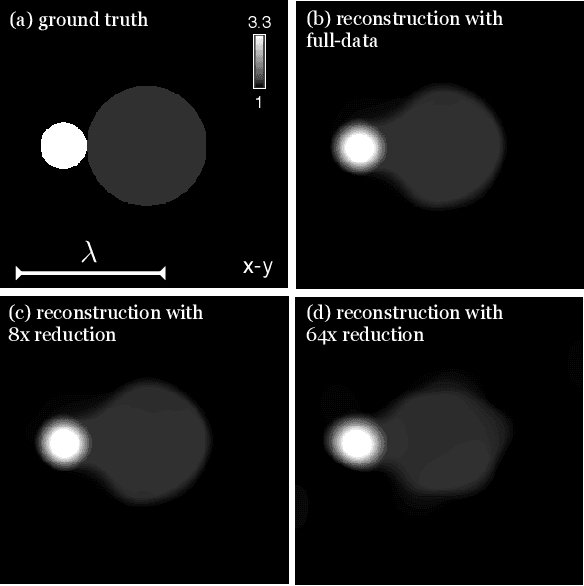
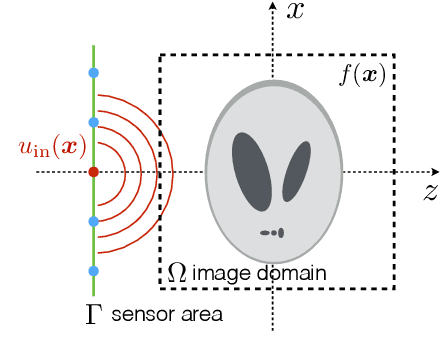
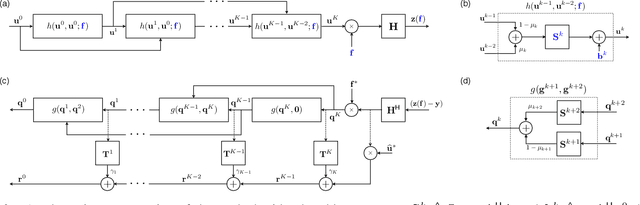
Multiple scattering of an electromagnetic wave as it passes through an object is a fundamental problem that limits the performance of current imaging systems. In this paper, we describe a new technique-called Series Expansion with Accelerated Gradient Descent on Lippmann-Schwinger Equation (SEAGLE)-for robust imaging under multiple scattering based on a combination of a new nonlinear forward model and a total variation (TV) regularizer. The proposed forward model can account for multiple scattering, which makes it advantageous in applications where linear models are inaccurate. Specifically, it corresponds to a series expansion of the scattered wave with an accelerated-gradient method. This expansion guarantees the convergence even for strongly scattering objects. One of our key insights is that it is possible to obtain an explicit formula for computing the gradient of our nonlinear forward model with respect to the unknown object, thus enabling fast image reconstruction with the state-of-the-art fast iterative shrinkage/thresholding algorithm (FISTA). The proposed method is validated on both simulated and experimentally measured data.
Compressive Imaging with Iterative Forward Models
Oct 05, 2016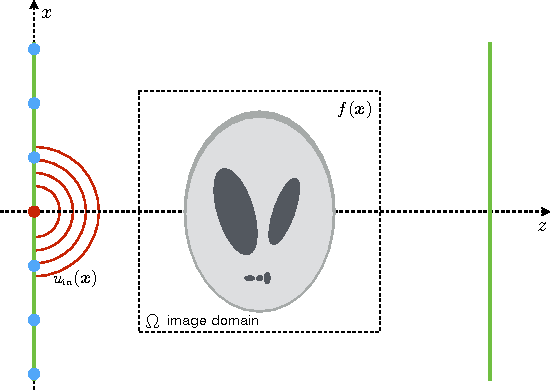
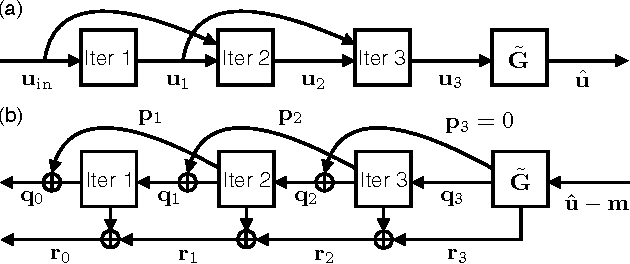
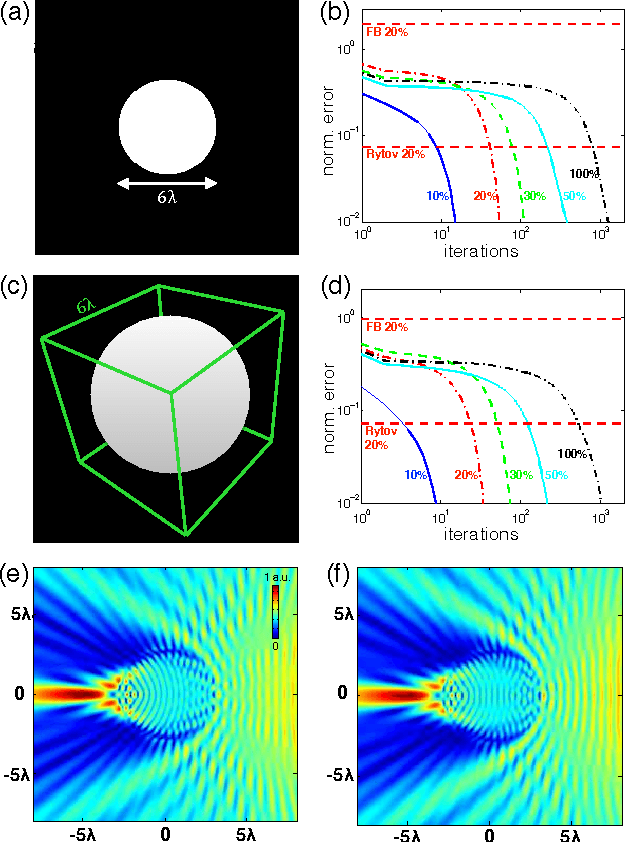
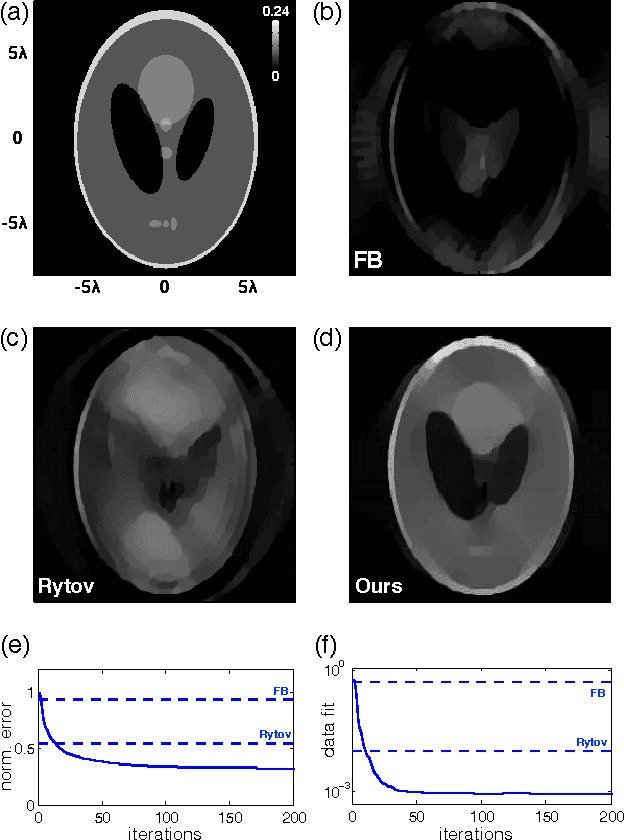
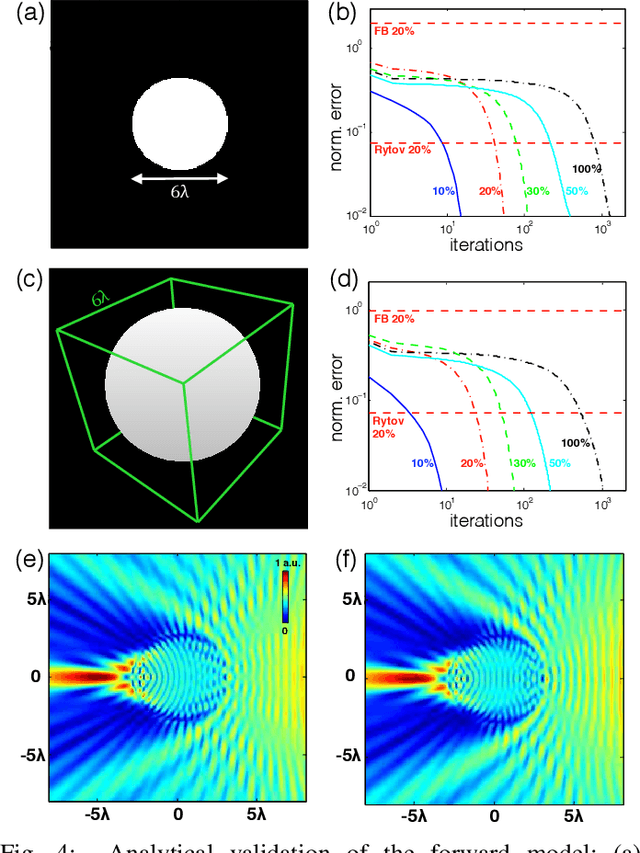
We propose a new compressive imaging method for reconstructing 2D or 3D objects from their scattered wave-field measurements. Our method relies on a novel, nonlinear measurement model that can account for the multiple scattering phenomenon, which makes the method preferable in applications where linear measurement models are inaccurate. We construct the measurement model by expanding the scattered wave-field with an accelerated-gradient method, which is guaranteed to converge and is suitable for large-scale problems. We provide explicit formulas for computing the gradient of our measurement model with respect to the unknown image, which enables image formation with a sparsity- driven numerical optimization algorithm. We validate the method both analytically and with numerical simulations.