 Add to Chrome
 Add to Firefox
 Add to Edge
Diffusion LMs Can Approximate Optimal Infilling Lengths Implicitly
Jan 31, 2026
Diffusion language models (DLMs) provide a bidirectional generation framework naturally suited for infilling, yet their performance is constrained by the pre-specified infilling length. In this paper, we reveal that DLMs possess an inherent ability to discover the correct infilling length. We identify two key statistical phenomena in the first-step denoising confidence: a local \textit{Oracle Peak} that emerges near the ground-truth length and a systematic \textit{Length Bias} that often obscures this signal. By leveraging this signal and calibrating the bias, our training-free method \textbf{CAL} (\textbf{C}alibrated \textbf{A}daptive \textbf{L}ength) enables DLMs to approximate the optimal length through an efficient search before formal decoding. Empirical evaluations demonstrate that CAL improves Pass@1 by up to 47.7\% over fixed-length baselines and 40.5\% over chat-based adaptive methods in code infilling, while boosting BLEU-2 and ROUGE-L by up to 8.5\% and 9.9\% in text infilling. These results demonstrate that CAL paves the way for robust DLM infilling without requiring any specialized training. Code is available at https://github.com/NiuHechang/Calibrated_Adaptive_Length.

RiskOracle: A Minute-level Citywide Traffic Accident Forecasting Framework
Feb 19, 2020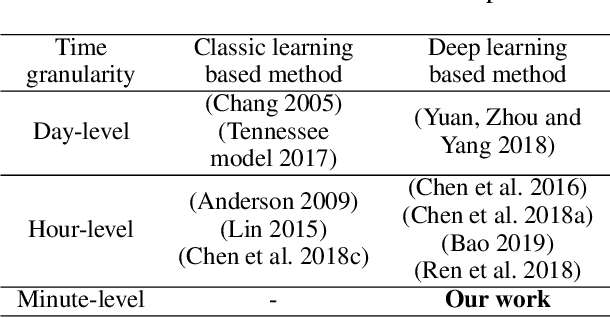
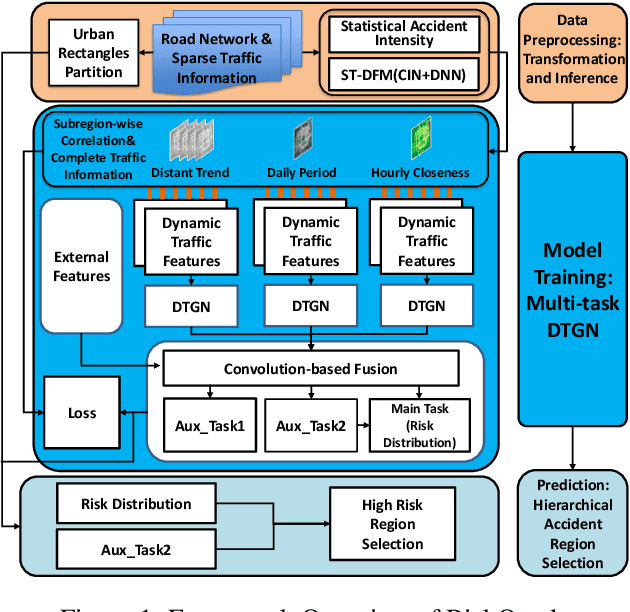
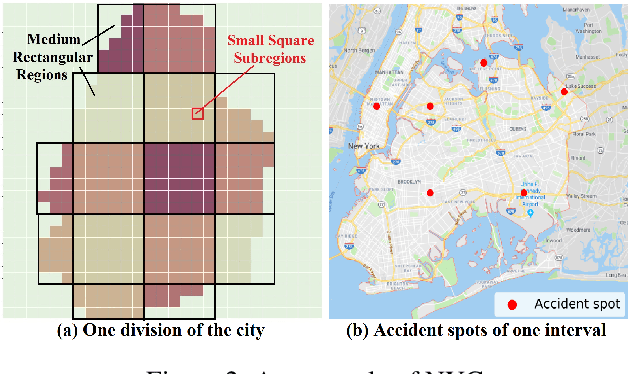
Real-time traffic accident forecasting is increasingly important for public safety and urban management (e.g., real-time safe route planning and emergency response deployment). Previous works on accident forecasting are often performed on hour levels, utilizing existed neural networks with static region-wise correlations taken into account. However, it is still challenging when the granularity of forecasting step improves as the highly dynamic nature of road network and inherent rareness of accident records in one training sample, which leads to biased results and zero-inflated issue. In this work, we propose a novel framework RiskOracle, to improve the prediction granularity to minute levels. Specifically, we first transform the zero-risk values in labels to fit the training network. Then, we propose the Differential Time-varying Graph neural network (DTGN) to capture the immediate changes of traffic status and dynamic inter-subregion correlations. Furthermore, we adopt multi-task and region selection schemes to highlight citywide most-likely accident subregions, bridging the gap between biased risk values and sporadic accident distribution. Extensive experiments on two real-world datasets demonstrate the effectiveness and scalability of our RiskOracle framework.