 Add to Chrome
 Add to Firefox
 Add to Edge
Audio Deepfake Detection at the First Greeting: "Hi!"
Jan 27, 2026
This paper focuses on audio deepfake detection under real-world communication degradations, with an emphasis on ultra-short inputs (0.5-2.0s), targeting the capability to detect synthetic speech at a conversation opening, e.g., when a scammer says "Hi." We propose Short-MGAA (S-MGAA), a novel lightweight extension of Multi-Granularity Adaptive Time-Frequency Attention, designed to enhance discriminative representation learning for short, degraded inputs subjected to communication processing and perturbations. The S-MGAA integrates two tailored modules: a Pixel-Channel Enhanced Module (PCEM) that amplifies fine-grained time-frequency saliency, and a Frequency Compensation Enhanced Module (FCEM) to supplement limited temporal evidence via multi-scale frequency modeling and adaptive frequency-temporal interaction. Extensive experiments demonstrate that S-MGAA consistently surpasses nine state-of-the-art baselines while achieving strong robustness to degradations and favorable efficiency-accuracy trade-offs, including low RTF, competitive GFLOPs, compact parameters, and reduced training cost, highlighting its strong potential for real-time deployment in communication systems and edge devices.

Benchmarking Audio Deepfake Detection Robustness in Real-world Communication Scenarios
Apr 16, 2025Existing Audio Deepfake Detection (ADD) systems often struggle to generalise effectively due to the significantly degraded audio quality caused by audio codec compression and channel transmission effects in real-world communication scenarios. To address this challenge, we developed a rigorous benchmark to evaluate ADD system performance under such scenarios. We introduced ADD-C, a new test dataset to evaluate the robustness of ADD systems under diverse communication conditions, including different combinations of audio codecs for compression and Packet Loss Rates (PLR). Benchmarking on three baseline ADD models with the ADD-C dataset demonstrated a significant decline in robustness under such conditions. A novel data augmentation strategy was proposed to improve the robustness of ADD systems. Experimental results demonstrated that the proposed approach increases the performance of ADD systems significantly with the proposed ADD-C dataset. Our benchmark can assist future efforts towards building practical and robustly generalisable ADD systems.
Rethinking the Upsampling Layer in Hyperspectral Image Super Resolution
Jan 30, 2025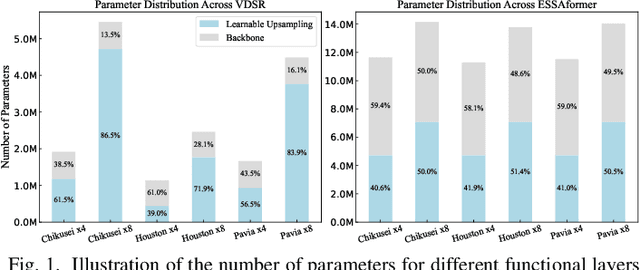
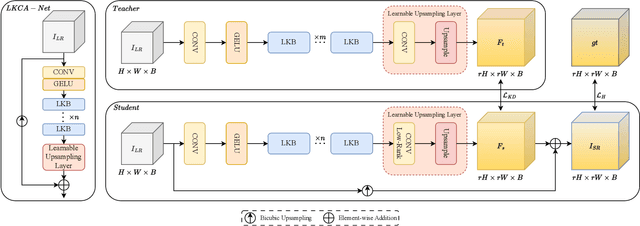
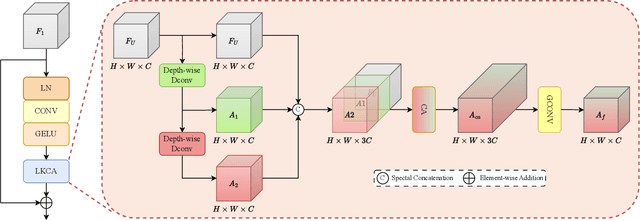
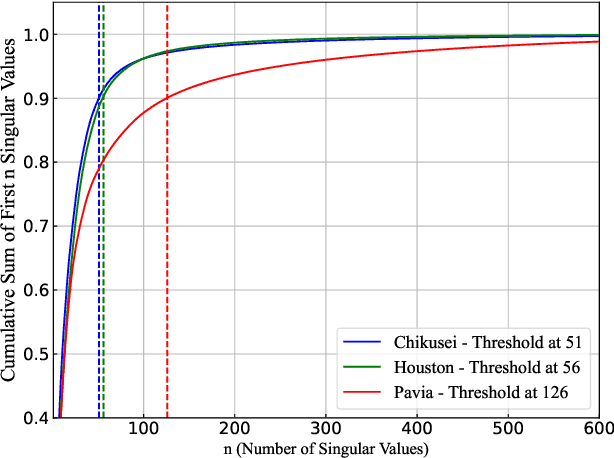
Deep learning has achieved significant success in single hyperspectral image super-resolution (SHSR); however, the high spectral dimensionality leads to a heavy computational burden, thus making it difficult to deploy in real-time scenarios. To address this issue, this paper proposes a novel lightweight SHSR network, i.e., LKCA-Net, that incorporates channel attention to calibrate multi-scale channel features of hyperspectral images. Furthermore, we demonstrate, for the first time, that the low-rank property of the learnable upsampling layer is a key bottleneck in lightweight SHSR methods. To address this, we employ the low-rank approximation strategy to optimize the parameter redundancy of the learnable upsampling layer. Additionally, we introduce a knowledge distillation-based feature alignment technique to ensure the low-rank approximated network retains the same feature representation capacity as the original. We conducted extensive experiments on the Chikusei, Houston 2018, and Pavia Center datasets compared to some SOTAs. The results demonstrate that our method is competitive in performance while achieving speedups of several dozen to even hundreds of times compared to other well-performing SHSR methods.