 Add to Chrome
 Add to Firefox
 Add to Edge
Surgery: Mitigating Harmful Fine-Tuning for Large Language Models via Attention Sink
Feb 05, 2026
Harmful fine-tuning can invalidate safety alignment of large language models, exposing significant safety risks. In this paper, we utilize the attention sink mechanism to mitigate harmful fine-tuning. Specifically, we first measure a statistic named \emph{sink divergence} for each attention head and observe that \emph{different attention heads exhibit two different signs of sink divergence}. To understand its safety implications, we conduct experiments and find that the number of attention heads of positive sink divergence increases along with the increase of the model's harmfulness when undergoing harmful fine-tuning. Based on this finding, we propose a separable sink divergence hypothesis -- \emph{attention heads associating with learning harmful patterns during fine-tuning are separable by their sign of sink divergence}. Based on the hypothesis, we propose a fine-tuning-stage defense, dubbed Surgery. Surgery utilizes a regularizer for sink divergence suppression, which steers attention heads toward the negative sink divergence group, thereby reducing the model's tendency to learn and amplify harmful patterns. Extensive experiments demonstrate that Surgery improves defense performance by 5.90\%, 11.25\%, and 9.55\% on the BeaverTails, HarmBench, and SorryBench benchmarks, respectively. Source code is available on https://github.com/Lslland/Surgery.

Targeted Vaccine: Safety Alignment for Large Language Models against Harmful Fine-Tuning via Layer-wise Perturbation
Oct 13, 2024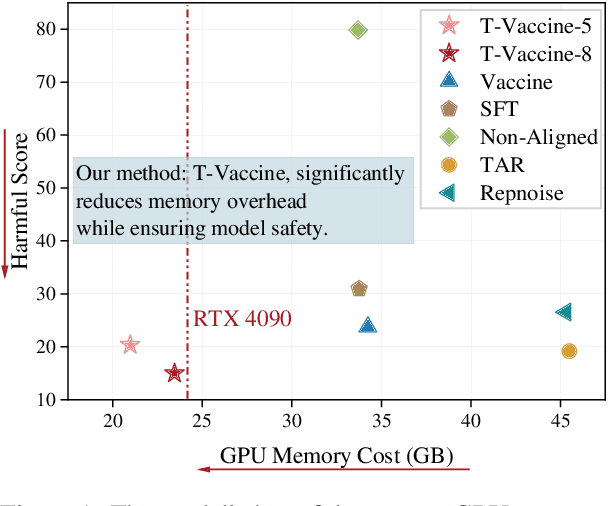
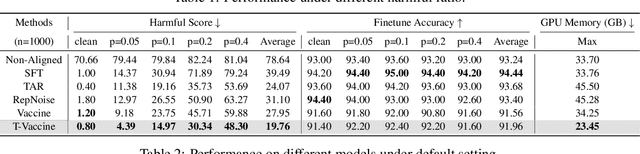
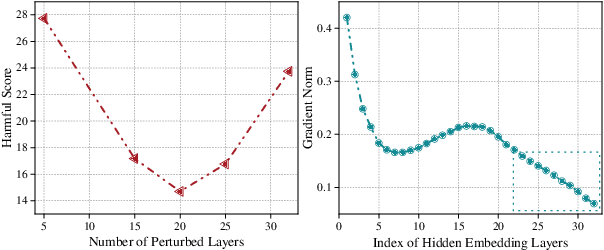
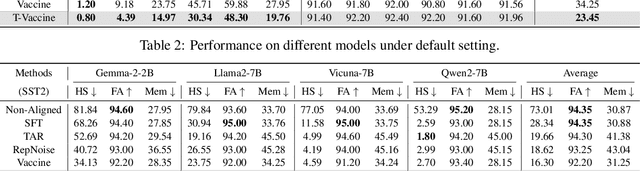
Harmful fine-tuning attack poses a serious threat to the online fine-tuning service. Vaccine, a recent alignment-stage defense, applies uniform perturbation to all layers of embedding to make the model robust to the simulated embedding drift. However, applying layer-wise uniform perturbation may lead to excess perturbations for some particular safety-irrelevant layers, resulting in defense performance degradation and unnecessary memory consumption. To address this limitation, we propose Targeted Vaccine (T-Vaccine), a memory-efficient safety alignment method that applies perturbation to only selected layers of the model. T-Vaccine follows two core steps: First, it uses gradient norm as a statistical metric to identify the safety-critical layers. Second, instead of applying uniform perturbation across all layers, T-Vaccine only applies perturbation to the safety-critical layers while keeping other layers frozen during training. Results show that T-Vaccine outperforms Vaccine in terms of both defense effectiveness and resource efficiency. Comparison with other defense baselines, e.g., RepNoise and TAR also demonstrate the superiority of T-Vaccine. Notably, T-Vaccine is the first defense that can address harmful fine-tuning issues for a 7B pre-trained models trained on consumer GPUs with limited memory (e.g., RTX 4090). Our code is available at https://github.com/Lslland/T-Vaccine.