 Add to Chrome
 Add to Firefox
 Add to Edge
Persona-Aware Alignment Framework for Personalized Dialogue Generation
Nov 13, 2025
Personalized dialogue generation aims to leverage persona profiles and dialogue history to generate persona-relevant and consistent responses. Mainstream models typically rely on token-level language model training with persona dialogue data, such as Next Token Prediction, to implicitly achieve personalization, making these methods tend to neglect the given personas and generate generic responses. To address this issue, we propose a novel Persona-Aware Alignment Framework (PAL), which directly treats persona alignment as the training objective of dialogue generation. Specifically, PAL employs a two-stage training method including Persona-aware Learning and Persona Alignment, equipped with an easy-to-use inference strategy Select then Generate, to improve persona sensitivity and generate more persona-relevant responses at the semantics level. Through extensive experiments, we demonstrate that our framework outperforms many state-of-the-art personalized dialogue methods and large language models.

Counterfactual Language Reasoning for Explainable Recommendation Systems
Mar 11, 2025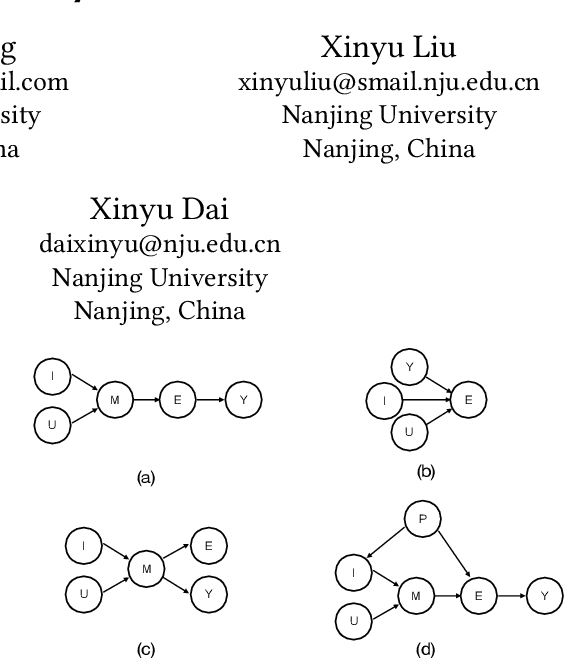
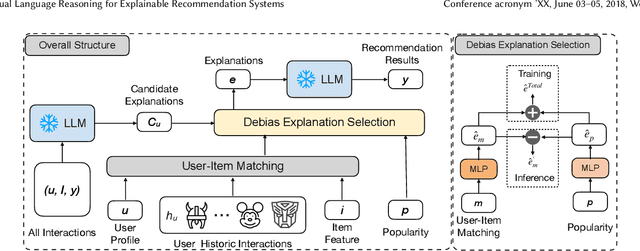

Explainable recommendation systems leverage transparent reasoning to foster user trust and improve decision-making processes. Current approaches typically decouple recommendation generation from explanation creation, violating causal precedence principles where explanatory factors should logically precede outcomes. This paper introduces a novel framework integrating structural causal models with large language models to establish causal consistency in recommendation pipelines. Our methodology enforces explanation factors as causal antecedents to recommendation predictions through causal graph construction and counterfactual adjustment. We particularly address the confounding effect of item popularity that distorts personalization signals in explanations, developing a debiasing mechanism that disentangles genuine user preferences from conformity bias. Through comprehensive experiments across multiple recommendation scenarios, we demonstrate that CausalX achieves superior performance in recommendation accuracy, explanation plausibility, and bias mitigation compared to baselines.