 Add to Chrome
 Add to Firefox
 Add to Edge
Variable Search Stepsize for Randomized Local Search in Multi-Objective Combinatorial Optimization
Feb 05, 2026
Over the past two decades, research in evolutionary multi-objective optimization has predominantly focused on continuous domains, with comparatively limited attention given to multi-objective combinatorial optimization problems (MOCOPs). Combinatorial problems differ significantly from continuous ones in terms of problem structure and landscape. Recent studies have shown that on MOCOPs multi-objective evolutionary algorithms (MOEAs) can even be outperformed by simple randomised local search. Starting with a randomly sampled solution in search space, randomised local search iteratively draws a random solution (from an archive) to perform local variation within its neighbourhood. However, in most existing methods, the local variation relies on a fixed neighbourhood, which limits exploration and makes the search easy to get trapped in local optima. In this paper, we present a simple yet effective local search method, called variable stepsize randomized local search (VS-RLS), which adjusts the stepsize during the search. VS-RLS transitions gradually from a broad, exploratory search in the early phases to a more focused, fine-grained search as the search progresses. We demonstrate the effectiveness and generalizability of VS-RLS through extensive evaluations against local search and MOEAs methods on diverse MOCOPs.

A differential evolution-based optimization tool for interplanetary transfer trajectory design
Nov 17, 2020

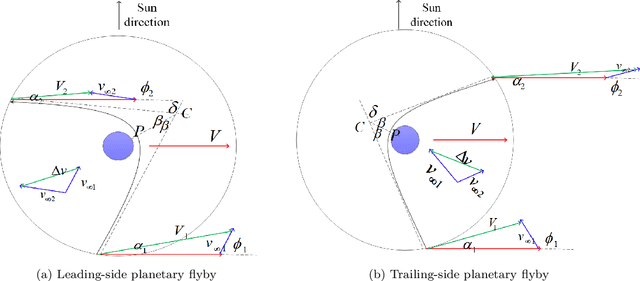

The extremely sensitive and highly nonlinear search space of interplanetary transfer trajectory design bring about big challenges on global optimization. As a representative, the current known best solution of the global trajectory optimization problem (GTOP) designed by the European space agency (ESA) is very hard to be found. To deal with this difficulty, a powerful differential evolution-based optimization tool named COoperative Differential Evolution (CODE) is proposed in this paper. CODE employs a two-stage evolutionary process, which concentrates on learning global structure in the earlier process, and tends to self-adaptively learn the structures of different local spaces. Besides, considering the spatial distribution of global optimum on different problems and the gradient information on different variables, a multiple boundary check technique has been employed. Also, Covariance Matrix Adaptation Evolutionary Strategies (CMA-ES) is used as a local optimizer. The previous studies have shown that a specific swarm intelligent optimization algorithm usually can solve only one or two GTOP problems. However, the experimental test results show that CODE can find the current known best solutions of Cassini1 and Sagas directly, and the cooperation with CMA-ES can solve Cassini2, GTOC1, Messenger (reduced) and Rosetta. For the most complicated Messenger (full) problem, even though CODE cannot find the current known best solution, the found best solution with objective function equaling to 3.38 km/s is still a level that other swarm intelligent algorithms cannot easily reach.