 Add to Chrome
 Add to Firefox
 Add to Edge
Sequential Group Composition: A Window into the Mechanics of Deep Learning
Feb 03, 2026
How do neural networks trained over sequences acquire the ability to perform structured operations, such as arithmetic, geometric, and algorithmic computation? To gain insight into this question, we introduce the sequential group composition task. In this task, networks receive a sequence of elements from a finite group encoded in a real vector space and must predict their cumulative product. The task can be order-sensitive and requires a nonlinear architecture to be learned. Our analysis isolates the roles of the group structure, encoding statistics, and sequence length in shaping learning. We prove that two-layer networks learn this task one irreducible representation of the group at a time in an order determined by the Fourier statistics of the encoding. These networks can perfectly learn the task, but doing so requires a hidden width exponential in the sequence length $k$. In contrast, we show how deeper models exploit the associativity of the task to dramatically improve this scaling: recurrent neural networks compose elements sequentially in $k$ steps, while multilayer networks compose adjacent pairs in parallel in $\log k$ layers. Overall, the sequential group composition task offers a tractable window into the mechanics of deep learning.

Identifying Interpretable Visual Features in Artificial and Biological Neural Systems
Oct 18, 2023

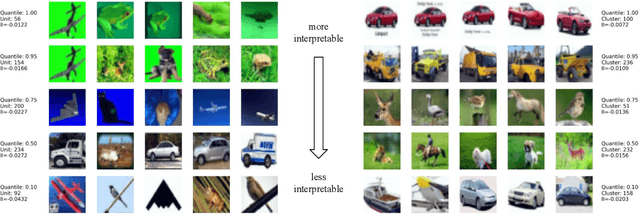
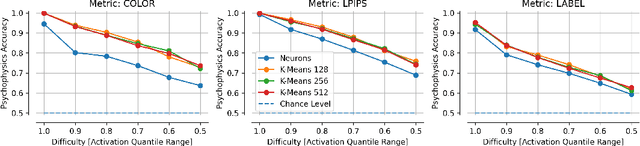
Single neurons in neural networks are often interpretable in that they represent individual, intuitively meaningful features. However, many neurons exhibit $\textit{mixed selectivity}$, i.e., they represent multiple unrelated features. A recent hypothesis proposes that features in deep networks may be represented in $\textit{superposition}$, i.e., on non-orthogonal axes by multiple neurons, since the number of possible interpretable features in natural data is generally larger than the number of neurons in a given network. Accordingly, we should be able to find meaningful directions in activation space that are not aligned with individual neurons. Here, we propose (1) an automated method for quantifying visual interpretability that is validated against a large database of human psychophysics judgments of neuron interpretability, and (2) an approach for finding meaningful directions in network activation space. We leverage these methods to discover directions in convolutional neural networks that are more intuitively meaningful than individual neurons, as we confirm and investigate in a series of analyses. Moreover, we apply the same method to three recent datasets of visual neural responses in the brain and find that our conclusions largely transfer to real neural data, suggesting that superposition might be deployed by the brain. This also provides a link with disentanglement and raises fundamental questions about robust, efficient and factorized representations in both artificial and biological neural systems.