 Add to Chrome
 Add to Firefox
 Add to Edge
SLIM-Diff: Shared Latent Image-Mask Diffusion with Lp loss for Data-Scarce Epilepsy FLAIR MRI
Feb 03, 2026
Focal cortical dysplasia (FCD) lesions in epilepsy FLAIR MRI are subtle and scarce, making joint image--mask generative modeling prone to instability and memorization. We propose SLIM-Diff, a compact joint diffusion model whose main contributions are (i) a single shared-bottleneck U-Net that enforces tight coupling between anatomy and lesion geometry from a 2-channel image+mask representation, and (ii) loss-geometry tuning via a tunable $L_p$ objective. As an internal baseline, we include the canonical DDPM-style objective ($ε$-prediction with $L_2$ loss) and isolate the effect of prediction parameterization and $L_p$ geometry under a matched setup. Experiments show that $x_0$-prediction is consistently the strongest choice for joint synthesis, and that fractional sub-quadratic penalties ($L_{1.5}$) improve image fidelity while $L_2$ better preserves lesion mask morphology. Our code and model weights are available in https://github.com/MarioPasc/slim-diff

Radial basis function kernel optimization for Support Vector Machine classifiers
Jul 16, 2020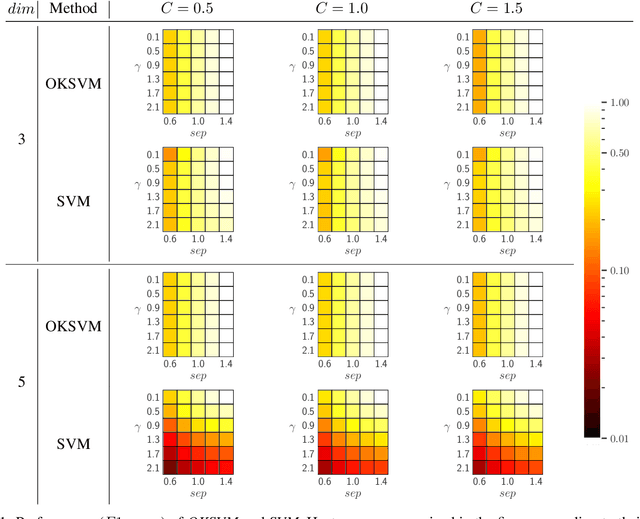
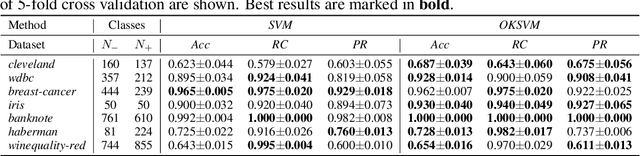

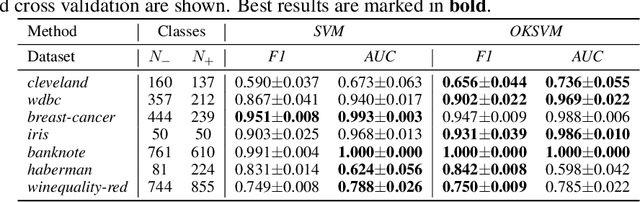
Support Vector Machines (SVMs) are still one of the most popular and precise classifiers. The Radial Basis Function (RBF) kernel has been used in SVMs to separate among classes with considerable success. However, there is an intrinsic dependence on the initial value of the kernel hyperparameter. In this work, we propose OKSVM, an algorithm that automatically learns the RBF kernel hyperparameter and adjusts the SVM weights simultaneously. The proposed optimization technique is based on a gradient descent method. We analyze the performance of our approach with respect to the classical SVM for classification on synthetic and real data. Experimental results show that OKSVM performs better irrespective of the initial values of the RBF hyperparameter.