 Add to Chrome
 Add to Firefox
 Add to Edge
Best-of-Q: Improving VLM agents with Q-function Action Ranking at Inference
Jan 30, 2026
Vision-Language Models (VLMs) have become powerful backbones for agents to autonomously operate in digital environments like the web and operating systems. However, these models suffer from inadaptability to fast-changing environments like the web, which can be alleviated by fine-tuning requiring expansive model training and data collection. In this work, we introduce a novel paradigm for enhancing agentic VLM policies at inference without policy retraining. Fundamentally, our approach decouples the VLM's role as a high-capacity action proposer from the final action selection mechanism. We keep the VLM policy frozen and use it to generate a set of candidate actions for a given state. Then, a lightweight, offline-trained Q-function reranks these candidates, and the agent executes the action with the highest estimated value. The main contribution is to apply the Q-function directly during inference for immediate policy improvement, and not offline to relabel data for policy retraining. We demonstrate on the academic WebVoyager benchmark that our method significantly boosts agent success rates, improving a Qwen2.5-VL-7B agent from 38.8% to 55.7% and a proprietary GPT-4.1 agent from 82.4% to 88.8%.

Efficient Active Imitation Learning with Random Network Distillation
Nov 04, 2024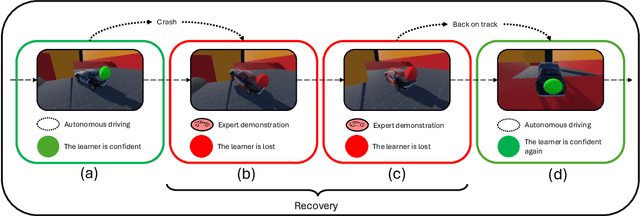
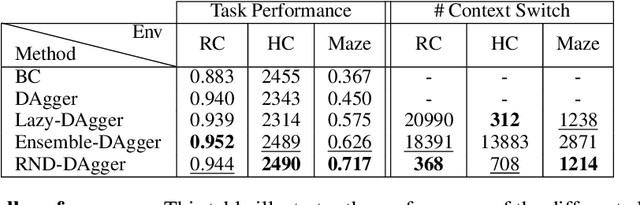
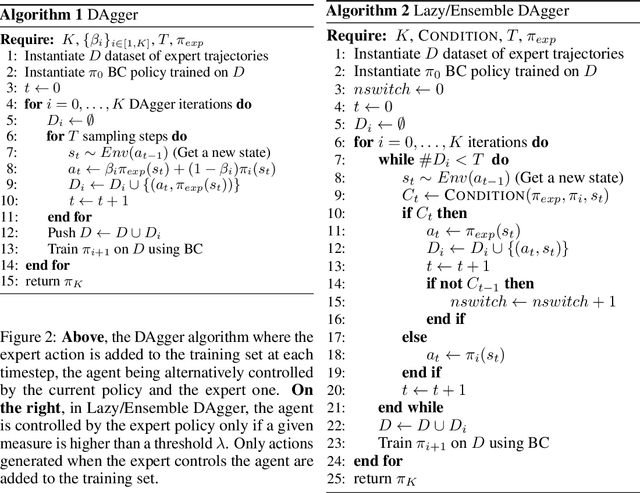
Developing agents for complex and underspecified tasks, where no clear objective exists, remains challenging but offers many opportunities. This is especially true in video games, where simulated players (bots) need to play realistically, and there is no clear reward to evaluate them. While imitation learning has shown promise in such domains, these methods often fail when agents encounter out-of-distribution scenarios during deployment. Expanding the training dataset is a common solution, but it becomes impractical or costly when relying on human demonstrations. This article addresses active imitation learning, aiming to trigger expert intervention only when necessary, reducing the need for constant expert input along training. We introduce Random Network Distillation DAgger (RND-DAgger), a new active imitation learning method that limits expert querying by using a learned state-based out-of-distribution measure to trigger interventions. This approach avoids frequent expert-agent action comparisons, thus making the expert intervene only when it is useful. We evaluate RND-DAgger against traditional imitation learning and other active approaches in 3D video games (racing and third-person navigation) and in a robotic locomotion task and show that RND-DAgger surpasses previous methods by reducing expert queries. https://sites.google.com/view/rnd-dagger