 Add to Chrome
 Add to Firefox
 Add to Edge
Revati: Transparent GPU-Free Time-Warp Emulation for LLM Serving
Jan 01, 2026
Deploying LLMs efficiently requires testing hundreds of serving configurations, but evaluating each one on a GPU cluster takes hours and costs thousands of dollars. Discrete-event simulators are faster and cheaper, but they require re-implementing the serving system's control logic -- a burden that compounds as frameworks evolve. We present Revati, a time-warp emulator that enables performance modeling by directly executing real serving system code at simulation-like speed. The system intercepts CUDA API calls to virtualize device management, allowing serving frameworks to run without physical GPUs. Instead of executing GPU kernels, it performs time jumps -- fast-forwarding virtual time by predicted kernel durations. We propose a coordination protocol that synchronizes these jumps across distributed processes while preserving causality. On vLLM and SGLang, Revati achieves less than 5% prediction error across multiple models and parallelism configurations, while running 5-17x faster than real GPU execution.

Maya: Optimizing Deep Learning Training Workloads using Emulated Virtual Accelerators
Mar 26, 2025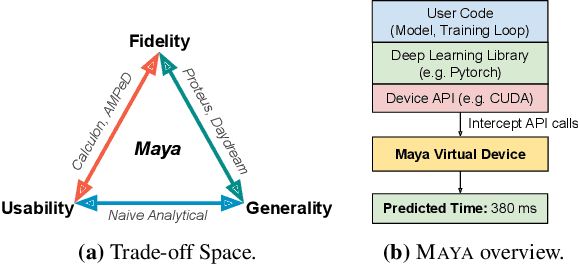
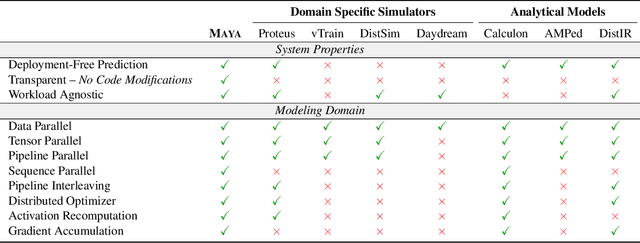
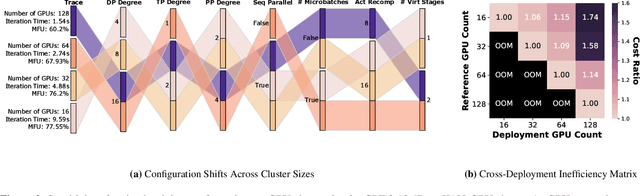
Training large foundation models costs hundreds of millions of dollars, making deployment optimization critical. Current approaches require machine learning engineers to manually craft training recipes through error-prone trial-and-error on expensive compute clusters. To enable efficient exploration of training configurations, researchers have developed performance modeling systems. However, these systems force users to translate their workloads into custom specification languages, introducing a fundamental semantic gap between the actual workload and its representation. This gap creates an inherent tradeoff: systems must either support a narrow set of workloads to maintain usability, require complex specifications that limit practical adoption, or compromise prediction accuracy with simplified models. We present Maya, a performance modeling system that eliminates these tradeoffs through transparent device emulation. By operating at the narrow interface between training frameworks and accelerator devices, Maya can capture complete workload behavior without requiring code modifications or translations. Maya intercepts device API calls from unmodified training code to directly observe low-level operations, enabling accurate performance prediction while maintaining both ease of use and generality. Our evaluation shows Maya achieves less than 5% prediction error across diverse models and optimization strategies, identifying configurations that reduce training costs by up to 56% compared to existing approaches.