 Add to Chrome
 Add to Firefox
 Add to Edge
Zero2Text: Zero-Training Cross-Domain Inversion Attacks on Textual Embeddings
Feb 03, 2026
The proliferation of retrieval-augmented generation (RAG) has established vector databases as critical infrastructure, yet they introduce severe privacy risks via embedding inversion attacks. Existing paradigms face a fundamental trade-off: optimization-based methods require computationally prohibitive queries, while alignment-based approaches hinge on the unrealistic assumption of accessible in-domain training data. These constraints render them ineffective in strict black-box and cross-domain settings. To dismantle these barriers, we introduce Zero2Text, a novel training-free framework based on recursive online alignment. Unlike methods relying on static datasets, Zero2Text synergizes LLM priors with a dynamic ridge regression mechanism to iteratively align generation to the target embedding on-the-fly. We further demonstrate that standard defenses, such as differential privacy, fail to effectively mitigate this adaptive threat. Extensive experiments across diverse benchmarks validate Zero2Text; notably, on MS MARCO against the OpenAI victim model, it achieves 1.8x higher ROUGE-L and 6.4x higher BLEU-2 scores compared to baselines, recovering sentences from unknown domains without a single leaked data pair.

Model Reduction in Chemical Reaction Networks: A Data-Driven Sparse-Learning Approach
Dec 22, 2017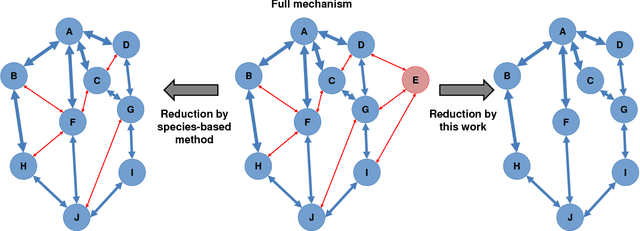
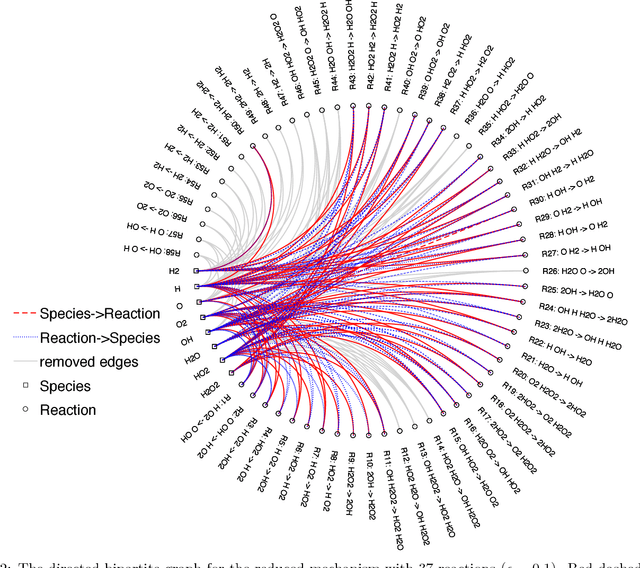
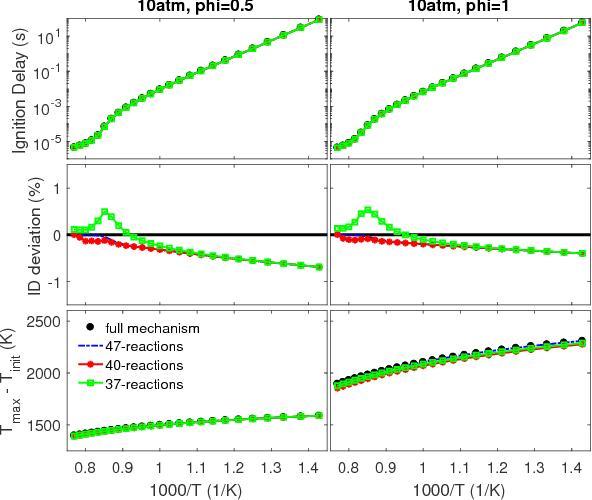
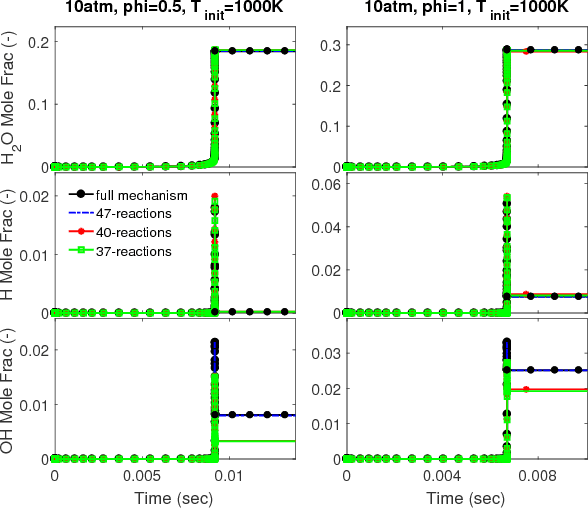
The reduction of large kinetic mechanisms is a crucial step for fluid dynamics simulations of com- bustion systems. In this paper, we introduce a novel approach for mechanism reduction that presents unique features. We propose an unbiased reaction-based method that exploits an optimization-based sparse-learning approach to identify the set of most influential reactions in a chemical reaction network. The problem is first formulated as a mixed-integer linear program, and then a relaxation method is leveraged to reduce its computational complexity. Not only this method calculates the minimal set of reactions subject to the user-specified error tolerance bounds, but it also incorporates a bound on the propagation of error over a time horizon caused by reducing the mechanism. The method is unbiased toward the optimization of any characteristic of the system, such as ignition delay, since it is assembled based on the identification of a reduced mechanism that fits the species concentrations and reaction rate generated by the full mechanisms. Qualitative and quantitative validations of the sparse encoding approach demonstrate that the reduced model captures important network structural properties.