 Add to Chrome
 Add to Firefox
 Add to Edge
Identifying Good and Bad Neurons for Task-Level Controllable LLMs
Jan 08, 2026
Large Language Models have demonstrated remarkable capabilities on multiple-choice question answering benchmarks, but the complex mechanisms underlying their large-scale neurons remain opaque, posing significant challenges for understanding and steering LLMs. While recent studies made progress on identifying responsible neurons for certain abilities, these ability-specific methods are infeasible for task-focused scenarios requiring coordinated use of multiple abilities. Moreover, these approaches focus only on supportive neurons that correlate positively with task completion, while neglecting neurons with other roles-such as inhibitive roles-and misled neuron attribution due to fortuitous behaviors in LLMs (i.e., correctly answer the questions by chance rather than genuine understanding). To address these challenges, we propose NeuronLLM, a novel task-level LLM understanding framework that adopts the biological principle of functional antagonism for LLM neuron identification. The key insight is that task performance is jointly determined by neurons with two opposing roles: good neurons that facilitate task completion and bad neurons that inhibit it. NeuronLLM achieves a holistic modeling of neurons via contrastive learning of good and bad neurons, while leveraging augmented question sets to mitigate the fortuitous behaviors in LLMs. Comprehensive experiments on LLMs of different sizes and families show the superiority of NeuronLLM over existing methods in four NLP tasks, providing new insights into LLM functional organization.

Towards Secure Program Partitioning for Smart Contracts with LLM's In-Context Learning
Feb 20, 2025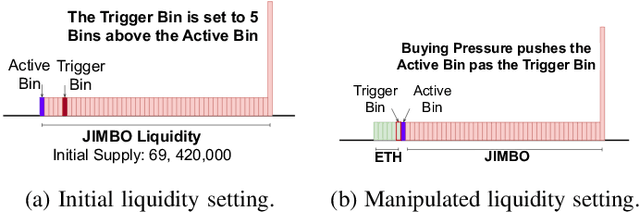
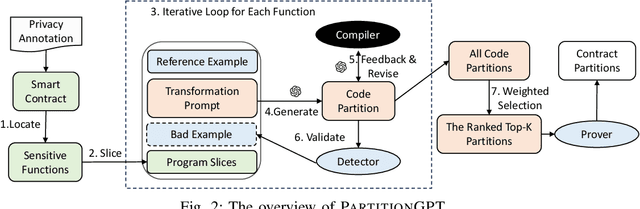
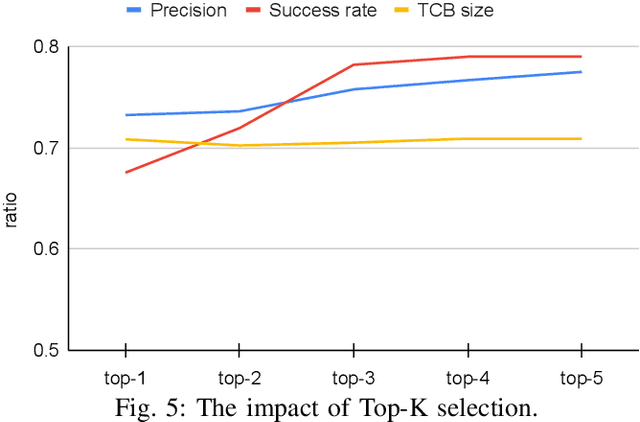
Smart contracts are highly susceptible to manipulation attacks due to the leakage of sensitive information. Addressing manipulation vulnerabilities is particularly challenging because they stem from inherent data confidentiality issues rather than straightforward implementation bugs. To tackle this by preventing sensitive information leakage, we present PartitionGPT, the first LLM-driven approach that combines static analysis with the in-context learning capabilities of large language models (LLMs) to partition smart contracts into privileged and normal codebases, guided by a few annotated sensitive data variables. We evaluated PartitionGPT on 18 annotated smart contracts containing 99 sensitive functions. The results demonstrate that PartitionGPT successfully generates compilable, and verified partitions for 78% of the sensitive functions while reducing approximately 30% code compared to function-level partitioning approach. Furthermore, we evaluated PartitionGPT on nine real-world manipulation attacks that lead to a total loss of 25 million dollars, PartitionGPT effectively prevents eight cases, highlighting its potential for broad applicability and the necessity for secure program partitioning during smart contract development to diminish manipulation vulnerabilities.