 Add to Chrome
 Add to Firefox
 Add to Edge
EntWorld: A Holistic Environment and Benchmark for Verifiable Enterprise GUI Agents
Jan 25, 2026
Recent advances in Multimodal Large Language Models (MLLMs) have enabled agents to operate in open-ended web and operating system environments. However, existing benchmarks predominantly target consumer-oriented scenarios (e.g., e-commerce and travel booking), failing to capture the complexity and rigor of professional enterprise workflows. Enterprise systems pose distinct challenges, including high-density user interfaces, strict business logic constraints, and a strong reliance on precise, state-consistent information retrieval-settings in which current generalist agents often struggle. To address this gap, we introduce EntWorld, a large-scale benchmark consisting of 1,756 tasks across six representative enterprise domains, including customer relationship management (CRM), information technology infrastructure library (ITIL), and enterprise resource planning (ERP) systems. Unlike previous datasets that depend on fragile execution traces or extensive manual annotation, EntWorld adopts a schema-grounded task generation framework that directly reverse-engineers business logic from underlying database schemas, enabling the synthesis of realistic, long-horizon workflows. Moreover, we propose a SQL-based deterministic verification mechanism in building datasets that replaces ambiguous visual matching with rigorous state-transition validation. Experimental results demonstrate that state-of-the-art models (e.g., GPT-4.1) achieve 47.61% success rate on EntWorld, substantially lower than the human performance, highlighting a pronounced enterprise gap in current agentic capabilities and the necessity of developing domain-specific agents. We release EntWorld as a rigorous testbed to facilitate the development and evaluation of the next generation of enterprise-ready digital agents.

An Empirical Study of NetOps Capability of Pre-Trained Large Language Models
Sep 19, 2023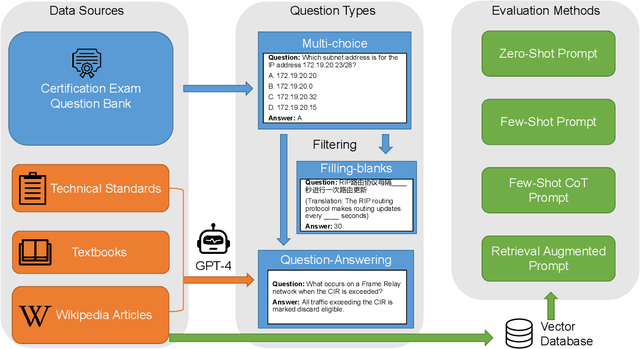
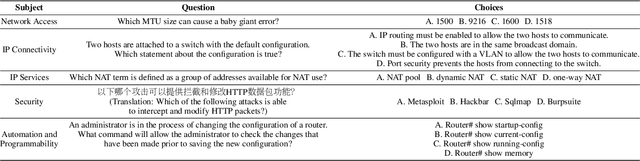
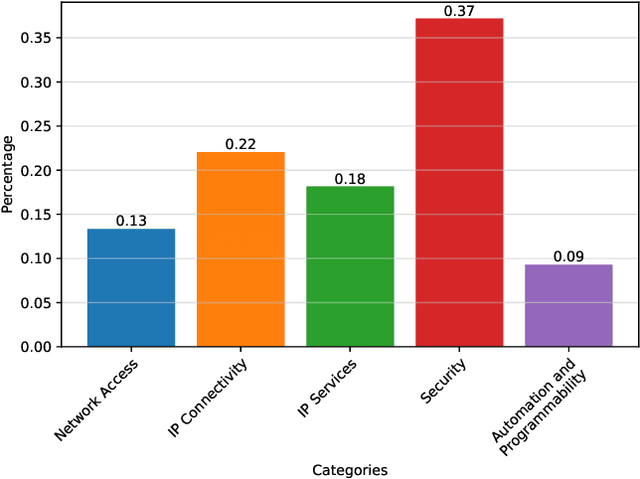
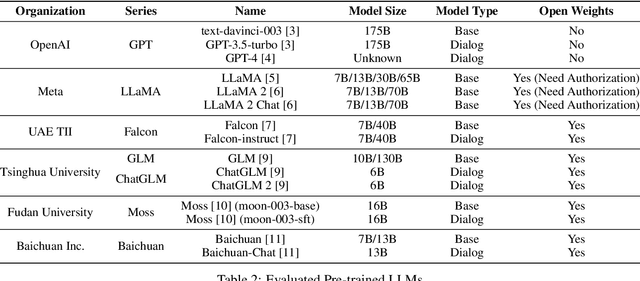
Nowadays, the versatile capabilities of Pre-trained Large Language Models (LLMs) have attracted much attention from the industry. However, some vertical domains are more interested in the in-domain capabilities of LLMs. For the Networks domain, we present NetEval, an evaluation set for measuring the comprehensive capabilities of LLMs in Network Operations (NetOps). NetEval is designed for evaluating the commonsense knowledge and inference ability in NetOps in a multi-lingual context. NetEval consists of 5,732 questions about NetOps, covering five different sub-domains of NetOps. With NetEval, we systematically evaluate the NetOps capability of 26 publicly available LLMs. The results show that only GPT-4 can achieve a performance competitive to humans. However, some open models like LLaMA 2 demonstrate significant potential.