 Add to Chrome
 Add to Firefox
 Add to Edge
The Strategic Foresight of LLMs: Evidence from a Fully Prospective Venture Tournament
Feb 02, 2026
Can artificial intelligence outperform humans at strategic foresight -- the capacity to form accurate judgments about uncertain, high-stakes outcomes before they unfold? We address this question through a fully prospective prediction tournament using live Kickstarter crowdfunding projects. Thirty U.S.-based technology ventures, launched after the training cutoffs of all models studied, were evaluated while fundraising remained in progress and outcomes were unknown. A diverse suite of frontier and open-weight large language models (LLMs) completed 870 pairwise comparisons, producing complete rankings of predicted fundraising success. We benchmarked these forecasts against 346 experienced managers recruited via Prolific and three MBA-trained investors working under monitored conditions. The results are striking: human evaluators achieved rank correlations with actual outcomes between 0.04 and 0.45, while several frontier LLMs exceeded 0.60, with the best (Gemini 2.5 Pro) reaching 0.74 -- correctly ordering nearly four of every five venture pairs. These differences persist across multiple performance metrics and robustness checks. Neither wisdom-of-the-crowd ensembles nor human-AI hybrid teams outperformed the best standalone model.

3D face reconstruction with dense landmarks
Apr 06, 2022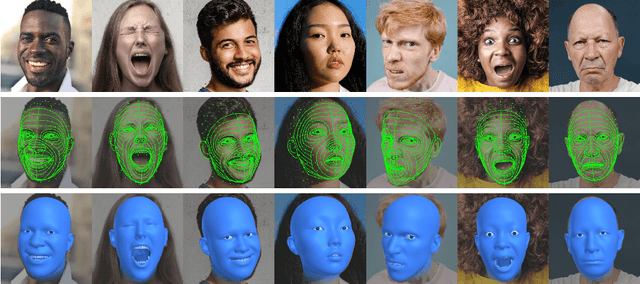

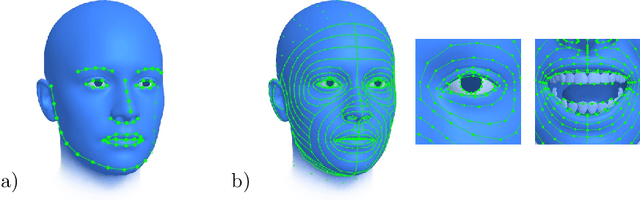
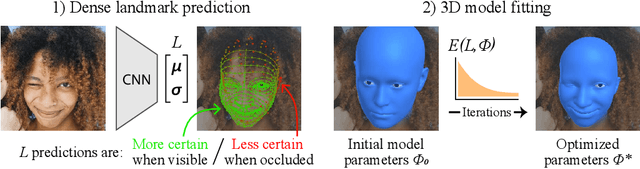
Landmarks often play a key role in face analysis, but many aspects of identity or expression cannot be represented by sparse landmarks alone. Thus, in order to reconstruct faces more accurately, landmarks are often combined with additional signals like depth images or techniques like differentiable rendering. Can we keep things simple by just using more landmarks? In answer, we present the first method that accurately predicts 10x as many landmarks as usual, covering the whole head, including the eyes and teeth. This is accomplished using synthetic training data, which guarantees perfect landmark annotations. By fitting a morphable model to these dense landmarks, we achieve state-of-the-art results for monocular 3D face reconstruction in the wild. We show that dense landmarks are an ideal signal for integrating face shape information across frames by demonstrating accurate and expressive facial performance capture in both monocular and multi-view scenarios. This approach is also highly efficient: we can predict dense landmarks and fit our 3D face model at over 150FPS on a single CPU thread.