 Add to Chrome
 Add to Firefox
 Add to Edge
Stagewise Reinforcement Learning and the Geometry of the Regret Landscape
Jan 12, 2026
Singular learning theory characterizes Bayesian learning as an evolving tradeoff between accuracy and complexity, with transitions between qualitatively different solutions as sample size increases. We extend this theory to deep reinforcement learning, proving that the concentration of the generalized posterior over policies is governed by the local learning coefficient (LLC), an invariant of the geometry of the regret function. This theory predicts that Bayesian phase transitions in reinforcement learning should proceed from simple policies with high regret to complex policies with low regret. We verify this prediction empirically in a gridworld environment exhibiting stagewise policy development: phase transitions over SGD training manifest as "opposing staircases" where regret decreases sharply while the LLC increases. Notably, the LLC detects phase transitions even when estimated on a subset of states where the policies appear identical in terms of regret, suggesting it captures changes in the underlying algorithm rather than just performance.

Predicting Mycotoxin Contamination in Irish Oats Using Deep and Transfer Learning
Dec 23, 2025Mycotoxin contamination poses a significant risk to cereal crop quality, food safety, and agricultural productivity. Accurate prediction of mycotoxin levels can support early intervention strategies and reduce economic losses. This study investigates the use of neural networks and transfer learning models to predict mycotoxin contamination in Irish oat crops as a multi-response prediction task. Our dataset comprises oat samples collected in Ireland, containing a mix of environmental, agronomic, and geographical predictors. Five modelling approaches were evaluated: a baseline multilayer perceptron (MLP), an MLP with pre-training, and three transfer learning models; TabPFN, TabNet, and FT-Transformer. Model performance was evaluated using regression (RMSE, $R^2$) and classification (AUC, F1) metrics, with results reported per toxin and on average. Additionally, permutation-based variable importance analysis was conducted to identify the most influential predictors across both prediction tasks. The transfer learning approach TabPFN provided the overall best performance, followed by the baseline MLP. Our variable importance analysis revealed that weather history patterns in the 90-day pre-harvest period were the most important predictors, alongside seed moisture content.
Colour alignment for relative colour constancy via non-standard references
Dec 30, 2021
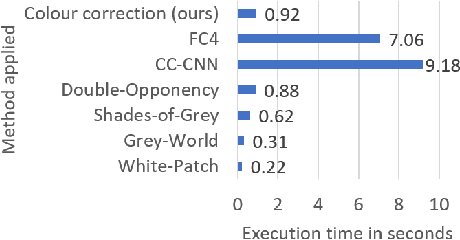
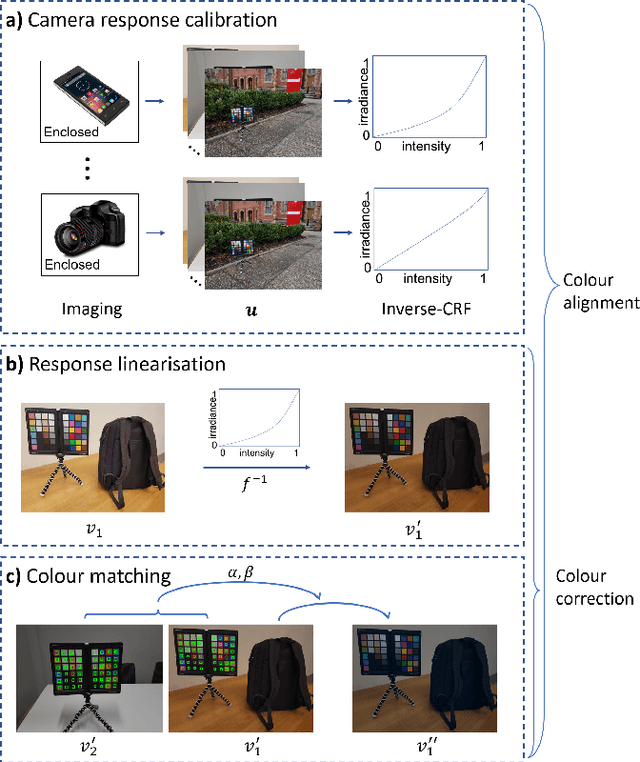
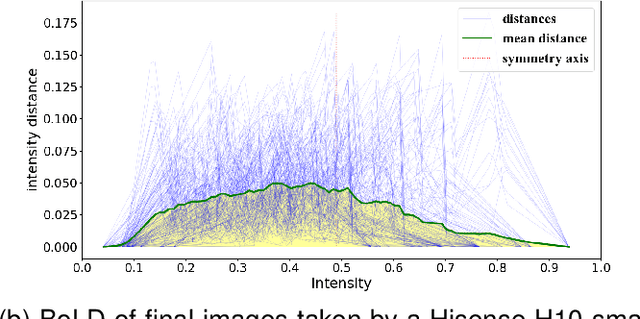
Relative colour constancy is an essential requirement for many scientific imaging applications. However, most digital cameras differ in their image formations and native sensor output is usually inaccessible, e.g., in smartphone camera applications. This makes it hard to achieve consistent colour assessment across a range of devices, and that undermines the performance of computer vision algorithms. To resolve this issue, we propose a colour alignment model that considers the camera image formation as a black-box and formulates colour alignment as a three-step process: camera response calibration, response linearisation, and colour matching. The proposed model works with non-standard colour references, i.e., colour patches without knowing the true colour values, by utilising a novel balance-of-linear-distances feature. It is equivalent to determining the camera parameters through an unsupervised process. It also works with a minimum number of corresponding colour patches across the images to be colour aligned to deliver the applicable processing. Two challenging image datasets collected by multiple cameras under various illumination and exposure conditions were used to evaluate the model. Performance benchmarks demonstrated that our model achieved superior performance compared to other popular and state-of-the-art methods.