 Add to Chrome
 Add to Firefox
 Add to Edge
Approximation Algorithm for Constrained $k$-Center Clustering: A Local Search Approach
Jan 17, 2026
Clustering is a long-standing research problem and a fundamental tool in AI and data analysis. The traditional k-center problem, a fundamental theoretical challenge in clustering, has a best possible approximation ratio of 2, and any improvement to a ratio of 2 - ε would imply P = NP. In this work, we study the constrained k-center clustering problem, where instance-level cannot-link (CL) and must-link (ML) constraints are incorporated as background knowledge. Although general CL constraints significantly increase the hardness of approximation, previous work has shown that disjoint CL sets permit constant-factor approximations. However, whether local search can achieve such a guarantee in this setting remains an open question. To this end, we propose a novel local search framework based on a transformation to a dominating matching set problem, achieving the best possible approximation ratio of 2. The experimental results on both real-world and synthetic datasets demonstrate that our algorithm outperforms baselines in solution quality.

Optimized Algorithms for Text Clustering with LLM-Generated Constraints
Jan 16, 2026Clustering is a fundamental tool that has garnered significant interest across a wide range of applications including text analysis. To improve clustering accuracy, many researchers have incorporated background knowledge, typically in the form of must-link and cannot-link constraints, to guide the clustering process. With the recent advent of large language models (LLMs), there is growing interest in improving clustering quality through LLM-based automatic constraint generation. In this paper, we propose a novel constraint-generation approach that reduces resource consumption by generating constraint sets rather than using traditional pairwise constraints. This approach improves both query efficiency and constraint accuracy compared to state-of-the-art methods. We further introduce a constrained clustering algorithm tailored to the characteristics of LLM-generated constraints. Our method incorporates a confidence threshold and a penalty mechanism to address potentially inaccurate constraints. We evaluate our approach on five text datasets, considering both the cost of constraint generation and the overall clustering performance. The results show that our method achieves clustering accuracy comparable to the state-of-the-art algorithms while reducing the number of LLM queries by more than 20 times.
Efficient Constrained $k$-Center Clustering with Background Knowledge
Jan 23, 2024
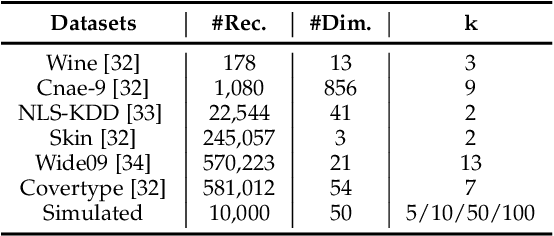
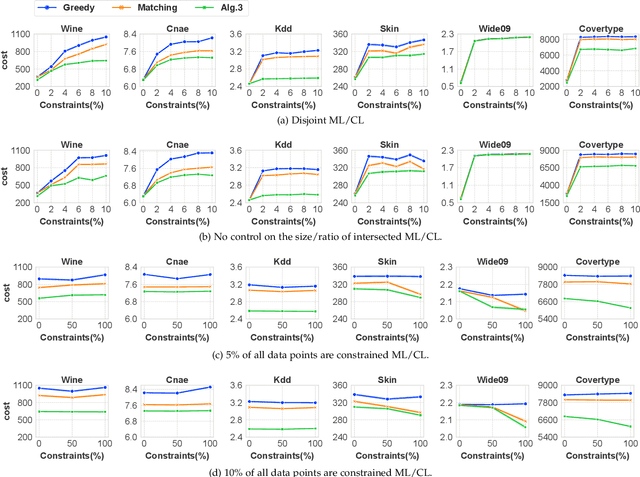
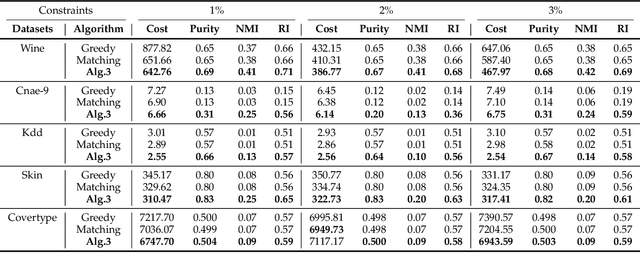
Center-based clustering has attracted significant research interest from both theory and practice. In many practical applications, input data often contain background knowledge that can be used to improve clustering results. In this work, we build on widely adopted $k$-center clustering and model its input background knowledge as must-link (ML) and cannot-link (CL) constraint sets. However, most clustering problems including $k$-center are inherently $\mathcal{NP}$-hard, while the more complex constrained variants are known to suffer severer approximation and computation barriers that significantly limit their applicability. By employing a suite of techniques including reverse dominating sets, linear programming (LP) integral polyhedron, and LP duality, we arrive at the first efficient approximation algorithm for constrained $k$-center with the best possible ratio of 2. We also construct competitive baseline algorithms and empirically evaluate our approximation algorithm against them on a variety of real datasets. The results validate our theoretical findings and demonstrate the great advantages of our algorithm in terms of clustering cost, clustering quality, and running time.