 Add to Chrome
 Add to Firefox
 Add to Edge
Shifting the Breaking Point of Flow Matching for Multi-Instance Editing
Feb 09, 2026
Flow matching models have recently emerged as an efficient alternative to diffusion, especially for text-guided image generation and editing, offering faster inference through continuous-time dynamics. However, existing flow-based editors predominantly support global or single-instruction edits and struggle with multi-instance scenarios, where multiple parts of a reference input must be edited independently without semantic interference. We identify this limitation as a consequence of globally conditioned velocity fields and joint attention mechanisms, which entangle concurrent edits. To address this issue, we introduce Instance-Disentangled Attention, a mechanism that partitions joint attention operations, enforcing binding between instance-specific textual instructions and spatial regions during velocity field estimation. We evaluate our approach on both natural image editing and a newly introduced benchmark of text-dense infographics with region-level editing instructions. Experimental results demonstrate that our approach promotes edit disentanglement and locality while preserving global output coherence, enabling single-pass, instance-level editing.

μgat: Improving Single-Page Document Parsing by Providing Multi-Page Context
Aug 28, 2024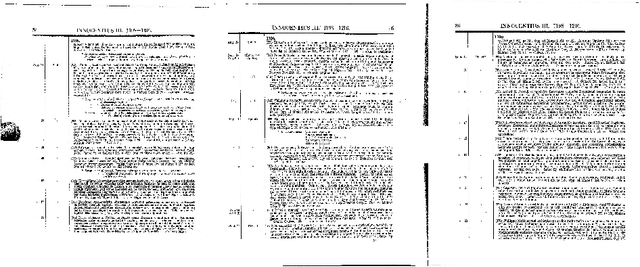
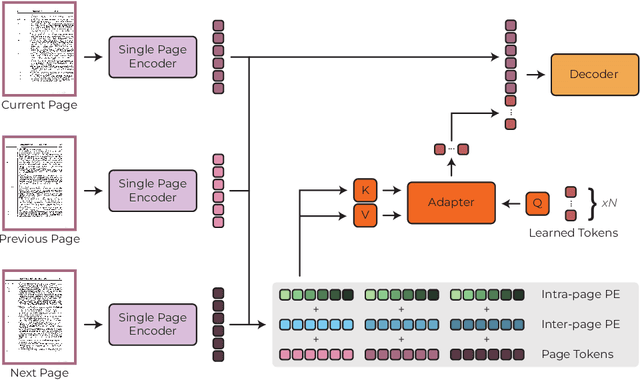

Regesta are catalogs of summaries of other documents and, in some cases, are the only source of information about the content of such full-length documents. For this reason, they are of great interest to scholars in many social and humanities fields. In this work, we focus on Regesta Pontificum Romanum, a large collection of papal registers. Regesta are visually rich documents, where the layout is as important as the text content to convey the contained information through the structure, and are inherently multi-page documents. Among Digital Humanities techniques that can help scholars efficiently exploit regesta and other documental sources in the form of scanned documents, Document Parsing has emerged as a task to process document images and convert them into machine-readable structured representations, usually markup language. However, current models focus on scientific and business documents, and most of them consider only single-paged documents. To overcome this limitation, in this work, we propose {\mu}gat, an extension of the recently proposed Document parsing Nougat architecture, which can handle elements spanning over the single page limits. Specifically, we adapt Nougat to process a larger, multi-page context, consisting of the previous and the following page, while parsing the current page. Experimental results, both qualitative and quantitative, demonstrate the effectiveness of our proposed approach also in the case of the challenging Regesta Pontificum Romanorum.