 Add to Chrome
 Add to Firefox
 Add to Edge
A Cherry-Picking Approach to Large Load Shaping for More Effective Carbon Reduction
Jan 25, 2026
Shaping multi-megawatt loads, such as data centers, impacts generator dispatch on the electric grid, which in turn affects system CO2 emissions and energy cost. Substantiating the effectiveness of prevalent load shaping strategies, such as those based on grid-level average carbon intensity, locational marginal price, or marginal emissions, is challenging due to the lack of detailed counterfactual data required for accurate attribution. This study uses a series of calibrated granular ERCOT day-ahead direct current optimal power flow (DC-OPF) simulations for counterfactual analysis of a broad set of load shaping strategies on grid CO2 emissions and cost of electricity. In terms of annual grid level CO2 emissions reductions, LMP-based shaping outperforms other common strategies, but can be significantly improved upon. Examining the performance of practicable strategies under different grid conditions motivates a more effective load shaping approach: one that "cherry-picks" a daily strategy based on observable grid signals and historical data. The cherry-picking approach to power load shaping is applicable to any large flexible consumer on the electricity grid, such as data centers, distributed energy resources and Virtual Power Plants (VPPs).

Power Modeling for Effective Datacenter Planning and Compute Management
Mar 22, 2021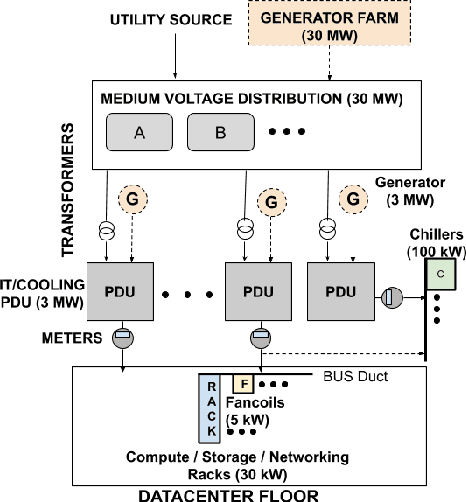
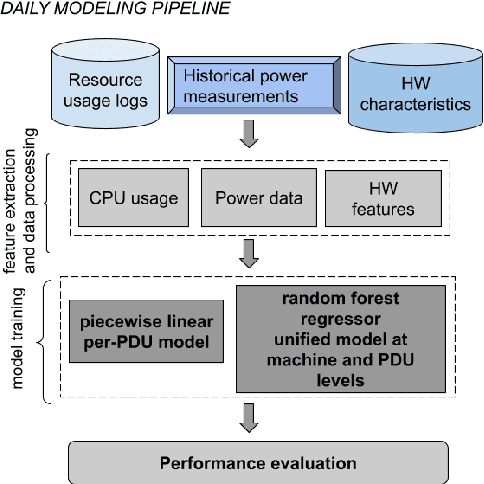
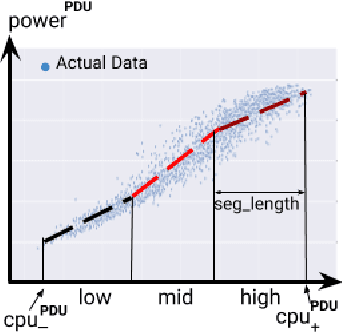
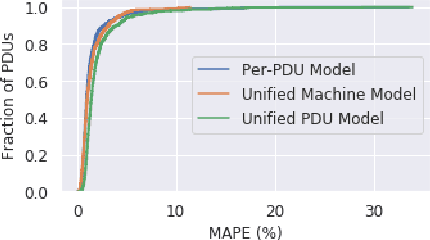
Datacenter power demand has been continuously growing and is the key driver of its cost. An accurate mapping of compute resources (CPU, RAM, etc.) and hardware types (servers, accelerators, etc.) to power consumption has emerged as a critical requirement for major Web and cloud service providers. With the global growth in datacenter capacity and associated power consumption, such models are essential for important decisions around datacenter design and operation. In this paper, we discuss two classes of statistical power models designed and validated to be accurate, simple, interpretable and applicable to all hardware configurations and workloads across hyperscale datacenters of Google fleet. To the best of our knowledge, this is the largest scale power modeling study of this kind, in both the scope of diverse datacenter planning and real-time management use cases, as well as the variety of hardware configurations and workload types used for modeling and validation. We demonstrate that the proposed statistical modeling techniques, while simple and scalable, predict power with less than 5% Mean Absolute Percent Error (MAPE) for more than 95% diverse Power Distribution Units (more than 2000) using only 4 features. This performance matches the reported accuracy of the previous started-of-the-art methods, while using significantly less features and covering a wider range of use cases.