 Add to Chrome
 Add to Firefox
 Add to Edge
LatentMoE: Toward Optimal Accuracy per FLOP and Parameter in Mixture of Experts
Jan 26, 2026
Mixture of Experts (MoEs) have become a central component of many state-of-the-art open-source and proprietary large language models. Despite their widespread adoption, it remains unclear how close existing MoE architectures are to optimal with respect to inference cost, as measured by accuracy per floating-point operation and per parameter. In this work, we revisit MoE design from a hardware-software co-design perspective, grounded in empirical and theoretical considerations. We characterize key performance bottlenecks across diverse deployment regimes, spanning offline high-throughput execution and online, latency-critical inference. Guided by these insights, we introduce LatentMoE, a new model architecture resulting from systematic design exploration and optimized for maximal accuracy per unit of compute. Empirical design space exploration at scales of up to 95B parameters and over a 1T-token training horizon, together with supporting theoretical analysis, shows that LatentMoE consistently outperforms standard MoE architectures in terms of accuracy per FLOP and per parameter. Given its strong performance, the LatentMoE architecture has been adopted by the flagship Nemotron-3 Super and Ultra models and scaled to substantially larger regimes, including longer token horizons and larger model sizes, as reported in Nvidia et al. (arXiv:2512.20856).

Shared Microexponents: A Little Shifting Goes a Long Way
Feb 16, 2023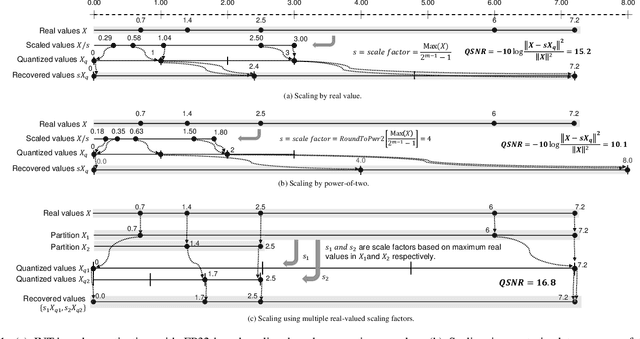
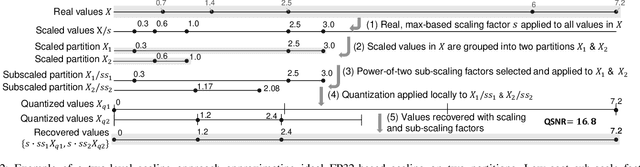
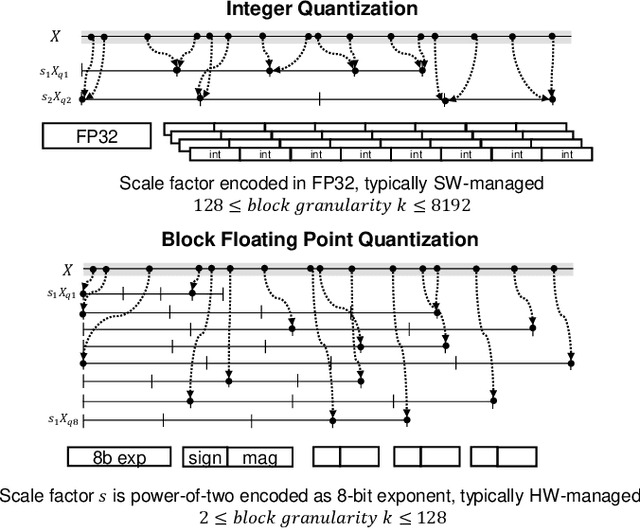
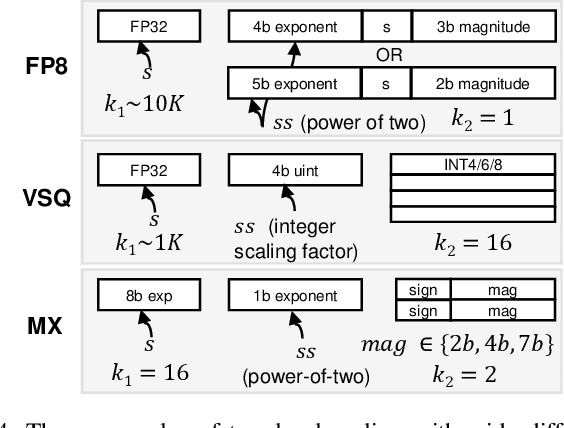
This paper introduces Block Data Representations (BDR), a framework for exploring and evaluating a wide spectrum of narrow-precision formats for deep learning. It enables comparison of popular quantization standards, and through BDR, new formats based on shared microexponents (MX) are identified, which outperform other state-of-the-art quantization approaches, including narrow-precision floating-point and block floating-point. MX utilizes multiple levels of quantization scaling with ultra-fine scaling factors based on shared microexponents in the hardware. The effectiveness of MX is demonstrated on real-world models including large-scale generative pretraining and inferencing, and production-scale recommendation systems.