 Add to Chrome
 Add to Firefox
 Add to Edge
S^2F-Net:A Robust Spatial-Spectral Fusion Framework for Cross-Model AIGC Detection
Jan 18, 2026
The rapid development of generative models has imposed an urgent demand for detection schemes with strong generalization capabilities. However, existing detection methods generally suffer from overfitting to specific source models, leading to significant performance degradation when confronted with unseen generative architectures. To address these challenges, this paper proposes a cross-model detection framework called S 2 F-Net, whose core lies in exploring and leveraging the inherent spectral discrepancies between real and synthetic textures. Considering that upsampling operations leave unique and distinguishable frequency fingerprints in both texture-poor and texture-rich regions, we focus our research on the detection of frequency-domain artifacts, aiming to fundamentally improve the generalization performance of the model. Specifically, we introduce a learnable frequency attention module that adaptively weights and enhances discriminative frequency bands by synergizing spatial texture analysis and spectral dependencies.On the AIGCDetectBenchmark, which includes 17 categories of generative models, S 2 F-Net achieves a detection accuracy of 90.49%, significantly outperforming various existing baseline methods in cross-domain detection scenarios.

Wasserstein Distance-Weighted Adversarial Network for Cross-Domain Credit Risk Assessment
Sep 27, 2024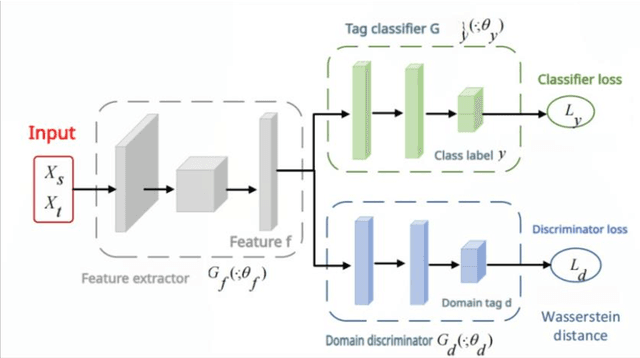
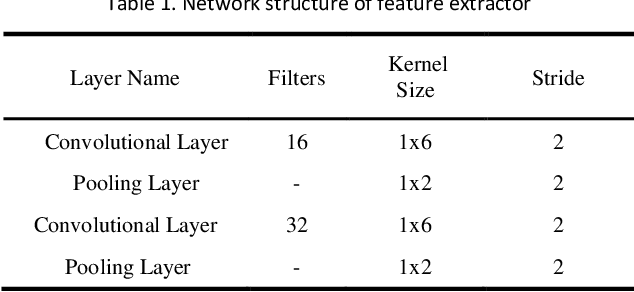
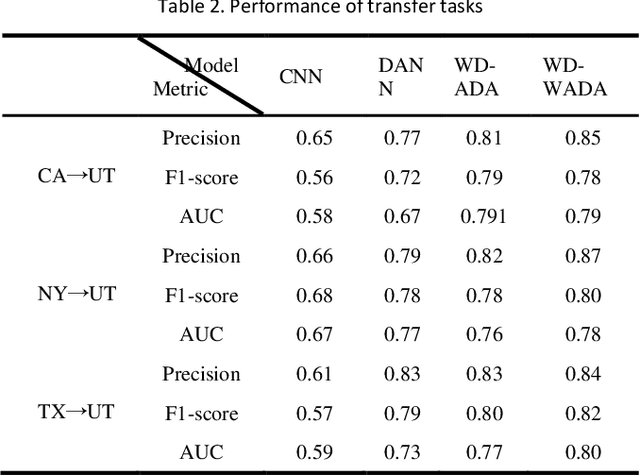
This paper delves into the application of adversarial domain adaptation (ADA) for enhancing credit risk assessment in financial institutions. It addresses two critical challenges: the cold start problem, where historical lending data is scarce, and the data imbalance issue, where high-risk transactions are underrepresented. The paper introduces an improved ADA framework, the Wasserstein Distance Weighted Adversarial Domain Adaptation Network (WD-WADA), which leverages the Wasserstein distance to align source and target domains effectively. The proposed method includes an innovative weighted strategy to tackle data imbalance, adjusting for both the class distribution and the difficulty level of predictions. The paper demonstrates that WD-WADA not only mitigates the cold start problem but also provides a more accurate measure of domain differences, leading to improved cross-domain credit risk assessment. Extensive experiments on real-world credit datasets validate the model's effectiveness, showcasing superior performance in cross-domain learning, classification accuracy, and model stability compared to traditional methods.