 Add to Chrome
 Add to Firefox
 Add to Edge
Residual Learning for Neural Ambisonics Encoders
Jan 26, 2026
Emerging wearable devices such as smartglasses and extended reality headsets demand high-quality spatial audio capture from compact, head-worn microphone arrays. Ambisonics provides a device-agnostic spatial audio representation by mapping array signals to spherical harmonic (SH) coefficients. In practice, however, accurate encoding remains challenging. While traditional linear encoders are signal-independent and robust, they amplify low-frequency noise and suffer from high-frequency spatial aliasing. On the other hand, neural network approaches can outperform linear encoders but they often assume idealized microphones and may perform inconsistently in real-world scenarios. To leverage their complementary strengths, we introduce a residual-learning framework that refines a linear encoder with corrections from a neural network. Using measured array transfer functions from smartglasses, we compare a UNet-based encoder from the literature with a new recurrent attention model. Our analysis reveals that both neural encoders only consistently outperform the linear baseline when integrated within the residual learning framework. In the residual configuration, both neural models achieve consistent and significant improvements across all tested metrics for in-domain data and moderate gains for out-of-domain data. Yet, coherence analysis indicates that all neural encoder configurations continue to struggle with directionally accurate high-frequency encoding.

Towards Reliable Objective Evaluation Metrics for Generative Singing Voice Separation Models
Jul 15, 2025Traditional Blind Source Separation Evaluation (BSS-Eval) metrics were originally designed to evaluate linear audio source separation models based on methods such as time-frequency masking. However, recent generative models may introduce nonlinear relationships between the separated and reference signals, limiting the reliability of these metrics for objective evaluation. To address this issue, we conduct a Degradation Category Rating listening test and analyze correlations between the obtained degradation mean opinion scores (DMOS) and a set of objective audio quality metrics for the task of singing voice separation. We evaluate three state-of-the-art discriminative models and two new competitive generative models. For both discriminative and generative models, intrusive embedding-based metrics show higher correlations with DMOS than conventional intrusive metrics such as BSS-Eval. For discriminative models, the highest correlation is achieved by the MSE computed on Music2Latent embeddings. When it comes to the evaluation of generative models, the strongest correlations are evident for the multi-resolution STFT loss and the MSE calculated on MERT-L12 embeddings, with the latter also providing the most balanced correlation across both model types. Our results highlight the limitations of BSS-Eval metrics for evaluating generative singing voice separation models and emphasize the need for careful selection and validation of alternative evaluation metrics for the task of singing voice separation.
Distillation and Pruning for Scalable Self-Supervised Representation-Based Speech Quality Assessment
Feb 07, 2025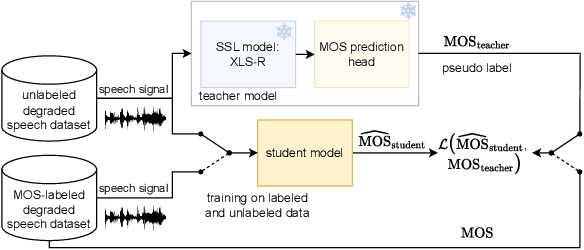
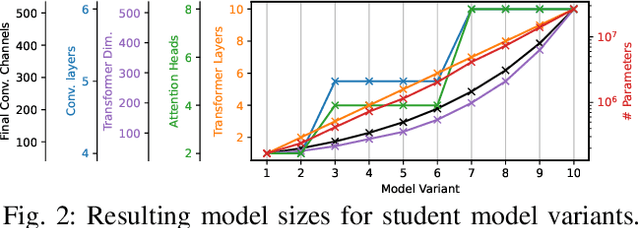
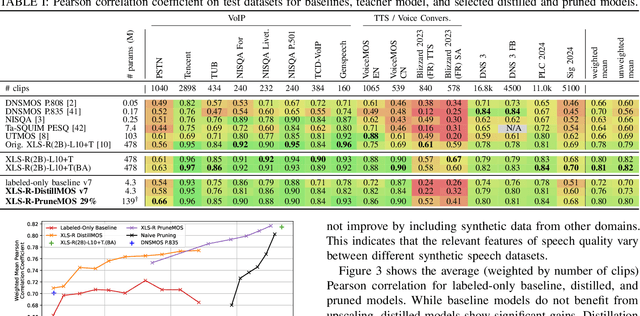
In this paper, we investigate distillation and pruning methods to reduce model size for non-intrusive speech quality assessment based on self-supervised representations. Our experiments build on XLS-R-SQA, a speech quality assessment model using wav2vec 2.0 XLS-R embeddings. We retrain this model on a large compilation of mean opinion score datasets, encompassing over 100,000 labeled clips. For distillation, using this model as a teacher, we generate pseudo-labels on unlabeled degraded speech signals and train student models of varying sizes. For pruning, we use a data-driven strategy. While data-driven pruning performs better at larger model sizes, distillation on unlabeled data is more effective for smaller model sizes. Distillation can halve the gap between the baseline's correlation with ground-truth MOS labels and that of the XLS-R-based teacher model, while reducing model size by two orders of magnitude compared to the teacher model.