 Add to Chrome
 Add to Firefox
 Add to Edge
Minimizing Layerwise Activation Norm Improves Generalization in Federated Learning
Dec 09, 2025
Federated Learning (FL) is an emerging machine learning framework that enables multiple clients (coordinated by a server) to collaboratively train a global model by aggregating the locally trained models without sharing any client's training data. It has been observed in recent works that learning in a federated manner may lead the aggregated global model to converge to a 'sharp minimum' thereby adversely affecting the generalizability of this FL-trained model. Therefore, in this work, we aim to improve the generalization performance of models trained in a federated setup by introducing a 'flatness' constrained FL optimization problem. This flatness constraint is imposed on the top eigenvalue of the Hessian computed from the training loss. As each client trains a model on its local data, we further re-formulate this complex problem utilizing the client loss functions and propose a new computationally efficient regularization technique, dubbed 'MAN,' which Minimizes Activation's Norm of each layer on client-side models. We also theoretically show that minimizing the activation norm reduces the top eigenvalue of the layer-wise Hessian of the client's loss, which in turn decreases the overall Hessian's top eigenvalue, ensuring convergence to a flat minimum. We apply our proposed flatness-constrained optimization to the existing FL techniques and obtain significant improvements, thereby establishing new state-of-the-art.

Federated Learning on Heterogeneous Data via Adaptive Self-Distillation
May 31, 2023
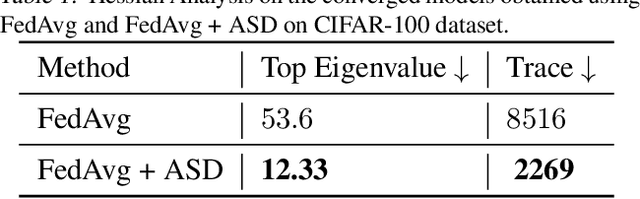
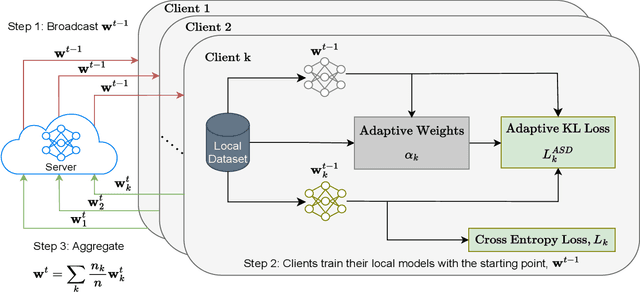
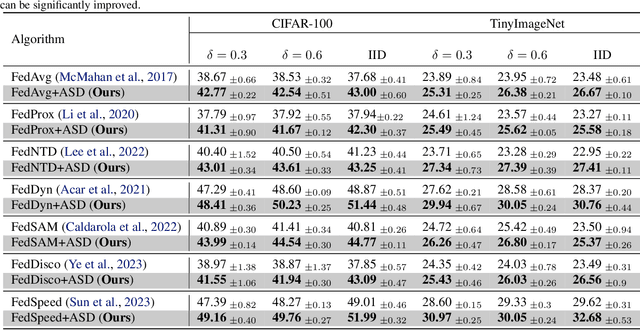
Federated Learning (FL) is a machine learning paradigm that enables clients to jointly train a global model by aggregating the locally trained models without sharing any local training data. In practice, there can often be substantial heterogeneity (e.g., class imbalance) across the local data distributions observed by each of these clients. Under such non-iid data distributions across clients, FL suffers from the 'client-drift' problem where every client converges to its own local optimum. This results in slower convergence and poor performance of the aggregated model. To address this limitation, we propose a novel regularization technique based on adaptive self-distillation (ASD) for training models on the client side. Our regularization scheme adaptively adjusts to the client's training data based on: (1) the closeness of the local model's predictions with that of the global model and (2) the client's label distribution. The proposed regularization can be easily integrated atop existing, state-of-the-art FL algorithms leading to a further boost in the performance of these off-the-shelf methods. We demonstrate the efficacy of our proposed FL approach through extensive experiments on multiple real-world benchmarks (including datasets with common corruptions and perturbations) and show substantial gains in performance over the state-of-the-art methods.