 Add to Chrome
 Add to Firefox
 Add to Edge
MiniLingua: A Small Open-Source LLM for European Languages
Dec 15, 2025
Large language models are powerful but often limited by high computational cost, privacy concerns, and English-centric training. Recent progress demonstrates that small, efficient models with around one billion parameters can deliver strong results and enable on-device use. This paper introduces MiniLingua, a multilingual open-source LLM of one billion parameters trained from scratch for 13 European languages, designed to balance coverage and instruction-following capabilities. Based on evaluation results, the instruction-tuned version of MiniLingua outperforms EuroLLM, a model with a similar training approach but a larger training budget, on summarization, classification and both open- and closed-book question answering. Moreover, it remains competitive with more advanced state-of-the-art models on open-ended generation tasks. We release model weights, tokenizer and source code used for data processing and model training.

RuDSI: graph-based word sense induction dataset for Russian
Sep 28, 2022

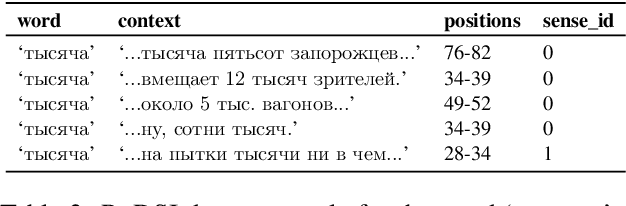

We present RuDSI, a new benchmark for word sense induction (WSI) in Russian. The dataset was created using manual annotation and semi-automatic clustering of Word Usage Graphs (WUGs). Unlike prior WSI datasets for Russian, RuDSI is completely data-driven (based on texts from Russian National Corpus), with no external word senses imposed on annotators. Depending on the parameters of graph clustering, different derivative datasets can be produced from raw annotation. We report the performance that several baseline WSI methods obtain on RuDSI and discuss possibilities for improving these scores.