 Add to Chrome
 Add to Firefox
 Add to Edge
Fisher-Orthogonal Projected Natural Gradient Descent for Continual Learning
Jan 19, 2026
Continual learning aims to enable neural networks to acquire new knowledge on sequential tasks. However, the key challenge in such settings is to learn new tasks without catastrophically forgetting previously learned tasks. We propose the Fisher-Orthogonal Projected Natural Gradient Descent (FOPNG) optimizer, which enforces Fisher-orthogonal constraints on parameter updates to preserve old task performance while learning new tasks. Unlike existing methods that operate in Euclidean parameter space, FOPNG projects gradients onto the Fisher-orthogonal complement of previous task gradients. This approach unifies natural gradient descent with orthogonal gradient methods within an information-geometric framework. The resulting update direction is invariant under reparameterization, guarantees descent in the Fisher metric, and helps preserve prior task outputs. We provide theoretical analysis establishing the properties of the projected update, describe efficient and practical implementations using the diagonal Fisher, and demonstrate strong results on standard continual learning benchmarks such as Permuted-MNIST, Split-MNIST, Rotated-MNIST, Split-CIFAR10, and Split-CIFAR100.

Efficient Online Reinforcement Learning Fine-Tuning Need Not Retain Offline Data
Dec 10, 2024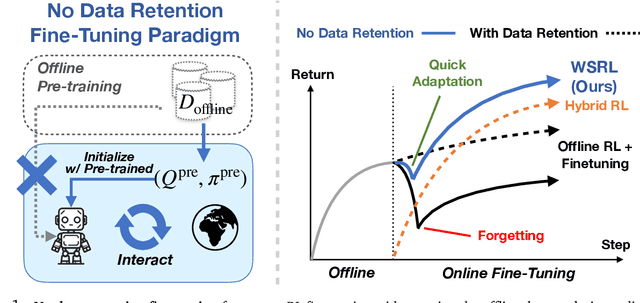
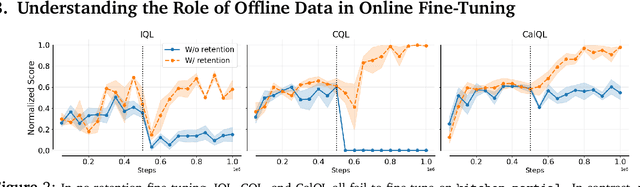
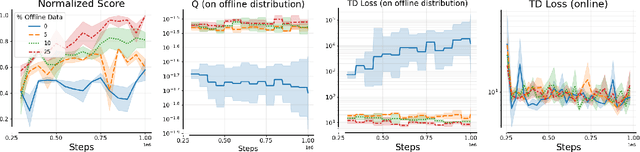
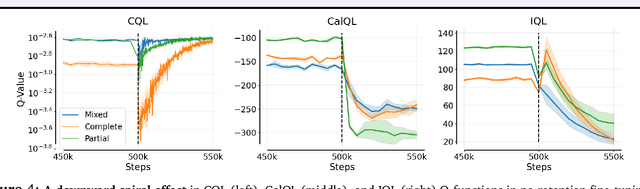
The modern paradigm in machine learning involves pre-training on diverse data, followed by task-specific fine-tuning. In reinforcement learning (RL), this translates to learning via offline RL on a diverse historical dataset, followed by rapid online RL fine-tuning using interaction data. Most RL fine-tuning methods require continued training on offline data for stability and performance. However, this is undesirable because training on diverse offline data is slow and expensive for large datasets, and in principle, also limit the performance improvement possible because of constraints or pessimism on offline data. In this paper, we show that retaining offline data is unnecessary as long as we use a properly-designed online RL approach for fine-tuning offline RL initializations. To build this approach, we start by analyzing the role of retaining offline data in online fine-tuning. We find that continued training on offline data is mostly useful for preventing a sudden divergence in the value function at the onset of fine-tuning, caused by a distribution mismatch between the offline data and online rollouts. This divergence typically results in unlearning and forgetting the benefits of offline pre-training. Our approach, Warm-start RL (WSRL), mitigates the catastrophic forgetting of pre-trained initializations using a very simple idea. WSRL employs a warmup phase that seeds the online RL run with a very small number of rollouts from the pre-trained policy to do fast online RL. The data collected during warmup helps ``recalibrate'' the offline Q-function to the online distribution, allowing us to completely discard offline data without destabilizing the online RL fine-tuning. We show that WSRL is able to fine-tune without retaining any offline data, and is able to learn faster and attains higher performance than existing algorithms irrespective of whether they retain offline data or not.