 Add to Chrome
 Add to Firefox
 Add to Edge
MAESTRO: Multi-Agent Evaluation Suite for Testing, Reliability, and Observability
Jan 01, 2026
We present MAESTRO, an evaluation suite for the testing, reliability, and observability of LLM-based MAS. MAESTRO standardizes MAS configuration and execution through a unified interface, supports integrating both native and third-party MAS via a repository of examples and lightweight adapters, and exports framework-agnostic execution traces together with system-level signals (e.g., latency, cost, and failures). We instantiate MAESTRO with 12 representative MAS spanning popular agentic frameworks and interaction patterns, and conduct controlled experiments across repeated runs, backend models, and tool configurations. Our case studies show that MAS executions can be structurally stable yet temporally variable, leading to substantial run-to-run variance in performance and reliability. We further find that MAS architecture is the dominant driver of resource profiles, reproducibility, and cost-latency-accuracy trade-off, often outweighing changes in backend models or tool settings. Overall, MAESTRO enables systematic evaluation and provides empirical guidance for designing and optimizing agentic systems.

Where is the Testbed for my Federated Learning Research?
Jul 19, 2024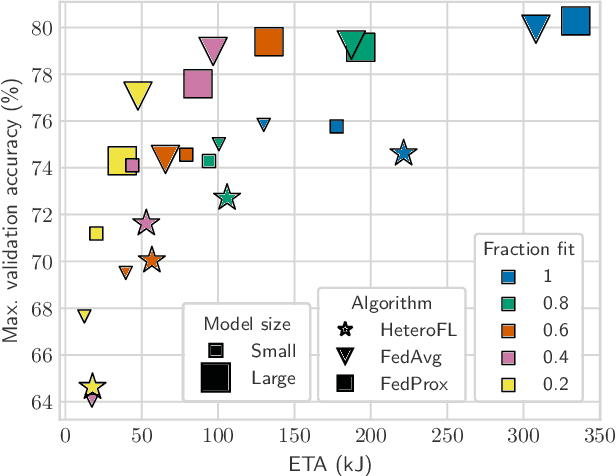
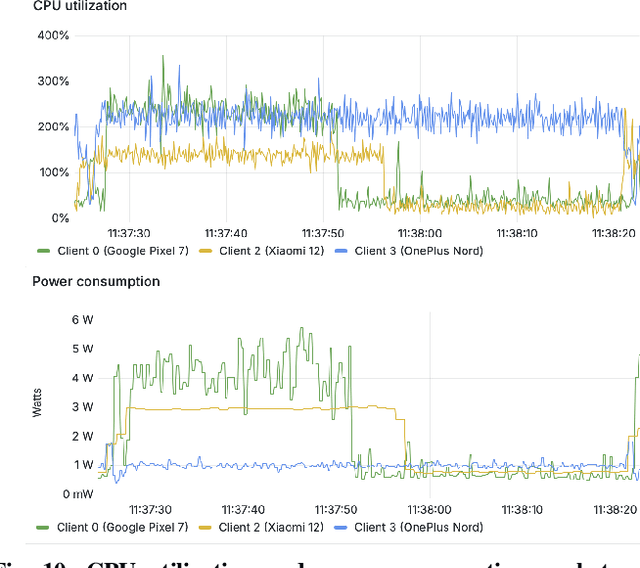
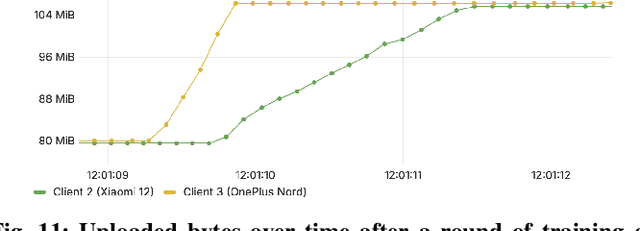
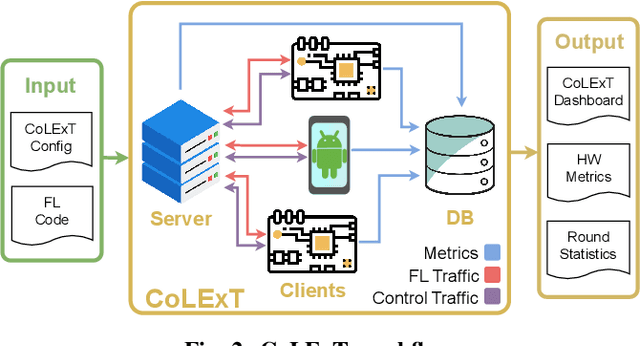
Progressing beyond centralized AI is of paramount importance, yet, distributed AI solutions, in particular various federated learning (FL) algorithms, are often not comprehensively assessed, which prevents the research community from identifying the most promising approaches and practitioners from being convinced that a certain solution is deployment-ready. The largest hurdle towards FL algorithm evaluation is the difficulty of conducting real-world experiments over a variety of FL client devices and different platforms, with different datasets and data distribution, all while assessing various dimensions of algorithm performance, such as inference accuracy, energy consumption, and time to convergence, to name a few. In this paper, we present CoLExT, a real-world testbed for FL research. CoLExT is designed to streamline experimentation with custom FL algorithms in a rich testbed configuration space, with a large number of heterogeneous edge devices, ranging from single-board computers to smartphones, and provides real-time collection and visualization of a variety of metrics through automatic instrumentation. According to our evaluation, porting FL algorithms to CoLExT requires minimal involvement from the developer, and the instrumentation introduces minimal resource usage overhead. Furthermore, through an initial investigation involving popular FL algorithms running on CoLExT, we reveal previously unknown trade-offs, inefficiencies, and programming bugs.