 Add to Chrome
 Add to Firefox
 Add to Edge
QEDBENCH: Quantifying the Alignment Gap in Automated Evaluation of University-Level Mathematical Proofs
Feb 24, 2026
As Large Language Models (LLMs) saturate elementary benchmarks, the research frontier has shifted from generation to the reliability of automated evaluation. We demonstrate that standard "LLM-as-a-Judge" protocols suffer from a systematic Alignment Gap when applied to upper-undergraduate to early graduate level mathematics. To quantify this, we introduce QEDBench, the first large-scale dual-rubric alignment benchmark to systematically measure alignment with human experts on university-level math proofs by contrasting course-specific rubrics against expert common knowledge criteria. By deploying a dual-evaluation matrix (7 judges x 5 solvers) against 1,000+ hours of human evaluation, we reveal that certain frontier evaluators like Claude Opus 4.5, DeepSeek-V3, Qwen 2.5 Max, and Llama 4 Maverick exhibit significant positive bias (up to +0.18, +0.20, +0.30, +0.36 mean score inflation, respectively). Furthermore, we uncover a critical reasoning gap in the discrete domain: while Gemini 3.0 Pro achieves state-of-the-art performance (0.91 average human evaluation score), other reasoning models like GPT-5 Pro and Claude Sonnet 4.5 see their performance significantly degrade in discrete domains. Specifically, their average human evaluation scores drop to 0.72 and 0.63 in Discrete Math, and to 0.74 and 0.50 in Graph Theory. In addition to these research results, we also release QEDBench as a public benchmark for evaluating and improving AI judges. Our benchmark is publicly published at https://github.com/qqliu/Yale-QEDBench.

Multi-Turn Multi-Modal Question Clarification for Enhanced Conversational Understanding
Feb 17, 2025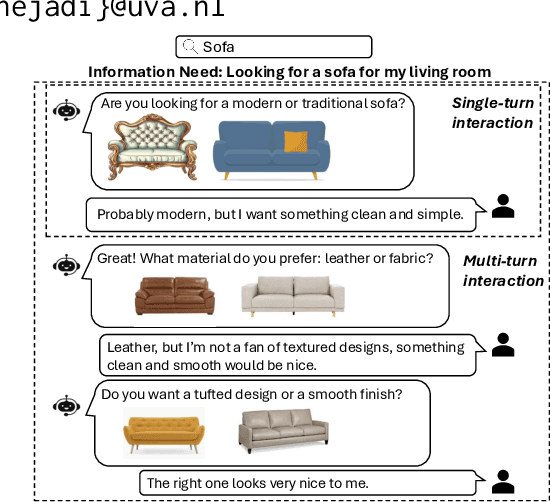
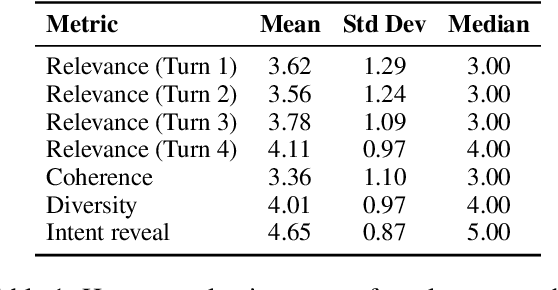
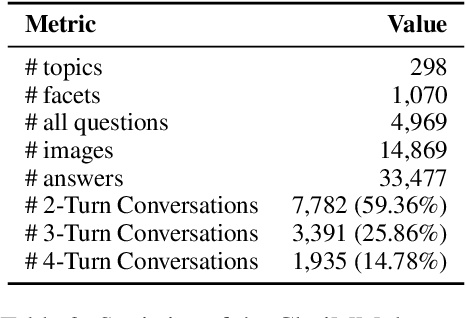
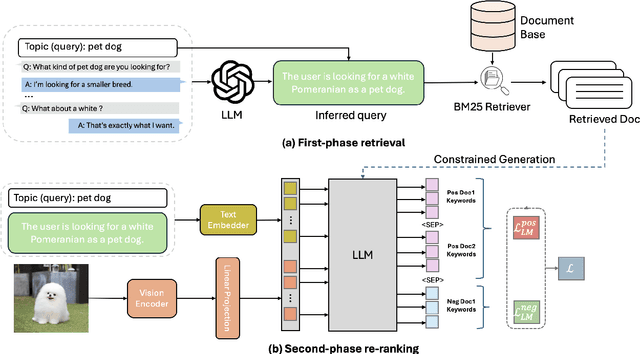
Conversational query clarification enables users to refine their search queries through interactive dialogue, improving search effectiveness. Traditional approaches rely on text-based clarifying questions, which often fail to capture complex user preferences, particularly those involving visual attributes. While recent work has explored single-turn multi-modal clarification with images alongside text, such methods do not fully support the progressive nature of user intent refinement over multiple turns. Motivated by this, we introduce the Multi-turn Multi-modal Clarifying Questions (MMCQ) task, which combines text and visual modalities to refine user queries in a multi-turn conversation. To facilitate this task, we create a large-scale dataset named ClariMM comprising over 13k multi-turn interactions and 33k question-answer pairs containing multi-modal clarifying questions. We propose Mario, a retrieval framework that employs a two-phase ranking strategy: initial retrieval with BM25, followed by a multi-modal generative re-ranking model that integrates textual and visual information from conversational history. Our experiments show that multi-turn multi-modal clarification outperforms uni-modal and single-turn approaches, improving MRR by 12.88%. The gains are most significant in longer interactions, demonstrating the value of progressive refinement for complex queries.