 Add to Chrome
 Add to Firefox
 Add to Edge
Optimization Trade-offs in Asynchronous Federated Learning: A Stochastic Networks Approach
Mar 27, 2026
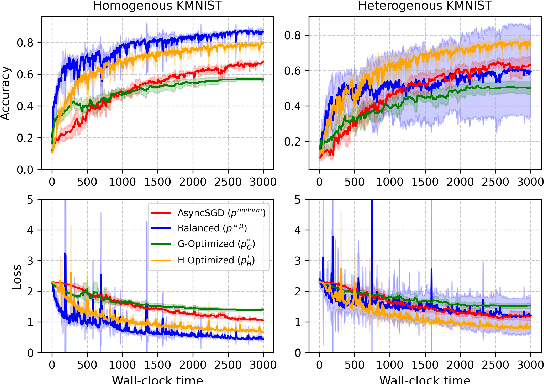
Synchronous federated learning scales poorly due to the straggler effect. Asynchronous algorithms increase the update throughput by processing updates upon arrival, but they introduce two fundamental challenges: gradient staleness, which degrades convergence, and bias toward faster clients under heterogeneous data distributions. Although algorithms such as AsyncSGD and Generalized AsyncSGD mitigate this bias via client-side task queues, most existing analyses neglect the underlying queueing dynamics and lack closed-form characterizations of the update throughput and gradient staleness. To close this gap, we develop a stochastic queueing-network framework for Generalized AsyncSGD that jointly models random computation times at the clients and the central server, as well as random uplink and downlink communication delays. Leveraging product-form network theory, we derive a closed-form expression for the update throughput, alongside closed-form upper bounds for both the communication round complexity and the expected wall-clock time required to reach an $ε$-stationary point. These results formally characterize the trade-off between gradient staleness and wall-clock convergence speed. We further extend the framework to quantify energy consumption under stochastic timing, revealing an additional trade-off between convergence speed and energy efficiency. Building on these analytical results, we propose gradient-based optimization strategies to jointly optimize routing and concurrency. Experiments on EMNIST demonstrate reductions of 29%--46% in convergence time and 36%--49% in energy consumption compared to AsyncSGD.

Optimizing Asynchronous Federated Learning: A Delicate Trade-Off Between Model-Parameter Staleness and Update Frequency
Feb 12, 2025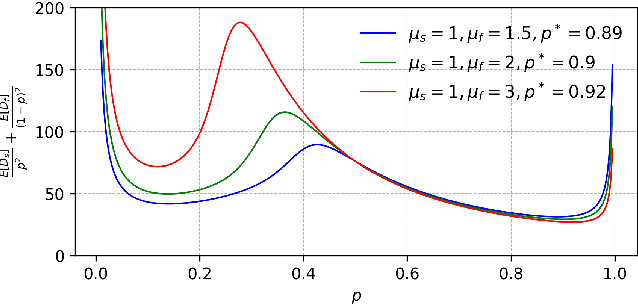
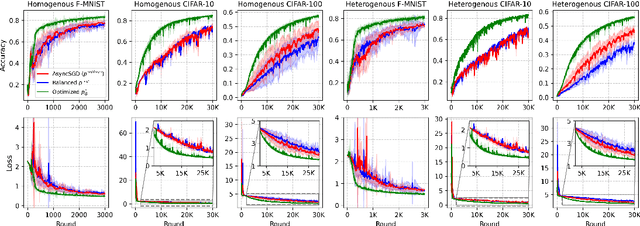
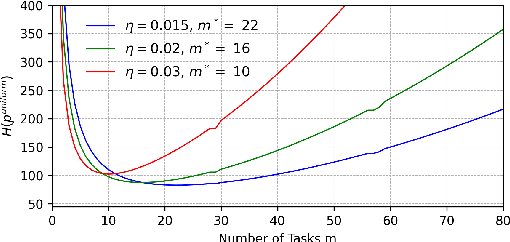
Synchronous federated learning (FL) scales poorly with the number of clients due to the straggler effect. Algorithms like FedAsync and GeneralizedFedAsync address this limitation by enabling asynchronous communication between clients and the central server. In this work, we rely on stochastic modeling to better understand the impact of design choices in asynchronous FL algorithms, such as the concurrency level and routing probabilities, and we leverage this knowledge to optimize loss. We characterize in particular a fundamental trade-off for optimizing asynchronous FL: minimizing gradient estimation errors by avoiding model parameter staleness, while also speeding up the system by increasing the throughput of model updates. Our two main contributions can be summarized as follows. First, we prove a discrete variant of Little's law to derive a closed-form expression for relative delay, a metric that quantifies staleness. This allows us to efficiently minimize the average loss per model update, which has been the gold standard in literature to date. Second, we observe that naively optimizing this metric leads us to slow down the system drastically by overemphazing staleness at the detriment of throughput. This motivates us to introduce an alternative metric that also takes system speed into account, for which we derive a tractable upper-bound that can be minimized numerically. Extensive numerical results show that these optimizations enhance accuracy by 10% to 30%.
Open data for Moroccan license plates for OCR applications : data collection, labeling, and model construction
Apr 16, 2021
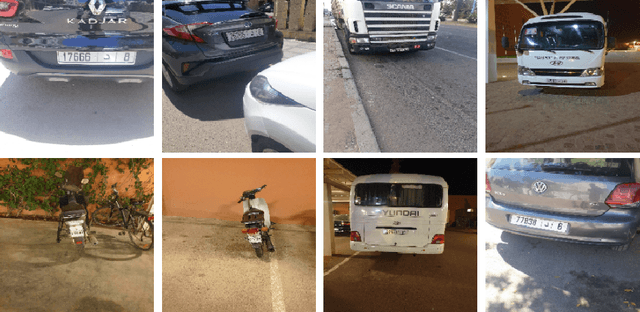
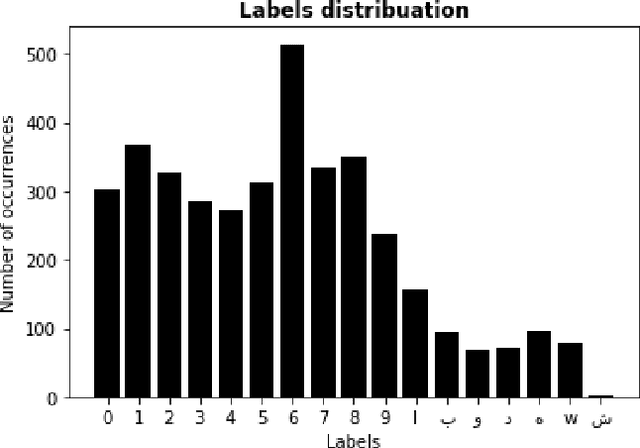

Significant number of researches have been developed recently around intelligent system for traffic management, especially, OCR based license plate recognition, as it is considered as a main step for any automatic traffic management system. Good quality data sets are increasingly needed and produced by the research community to improve the performance of those algorithms. Furthermore, a special need of data is noted for countries having special characters on their licence plates, like Morocco, where Arabic Alphabet is used. In this work, we present a labeled open data set of circulation plates taken in Morocco, for different type of vehicles, namely cars, trucks and motorcycles. This data was collected manually and consists of 705 unique and different images. Furthermore this data was labeled for plate segmentation and for matriculation number OCR. Also, As we show in this paper, the data can be enriched using data augmentation techniques to create training sets with few thousands of images for different machine leaning and AI applications. We present and compare a set of models built on this data. Also, we publish this data as an open access data to encourage innovation and applications in the field of OCR and image processing for traffic control and other applications for transportation and heterogeneous vehicle management.