 Add to Chrome
 Add to Firefox
 Add to Edge
Optimal Transport-Induced Samples against Out-of-Distribution Overconfidence
Jan 29, 2026
Deep neural networks (DNNs) often produce overconfident predictions on out-of-distribution (OOD) inputs, undermining their reliability in open-world environments. Singularities in semi-discrete optimal transport (OT) mark regions of semantic ambiguity, where classifiers are particularly prone to unwarranted high-confidence predictions. Motivated by this observation, we propose a principled framework to mitigate OOD overconfidence by leveraging the geometry of OT-induced singular boundaries. Specifically, we formulate an OT problem between a continuous base distribution and the latent embeddings of training data, and identify the resulting singular boundaries. By sampling near these boundaries, we construct a class of OOD inputs, termed optimal transport-induced OOD samples (OTIS), which are geometrically grounded and inherently semantically ambiguous. During training, a confidence suppression loss is applied to OTIS to guide the model toward more calibrated predictions in structurally uncertain regions. Extensive experiments show that our method significantly alleviates OOD overconfidence and outperforms state-of-the-art methods.

Imperceptible Adversarial Attacks on Point Clouds Guided by Point-to-Surface Field
Dec 26, 2024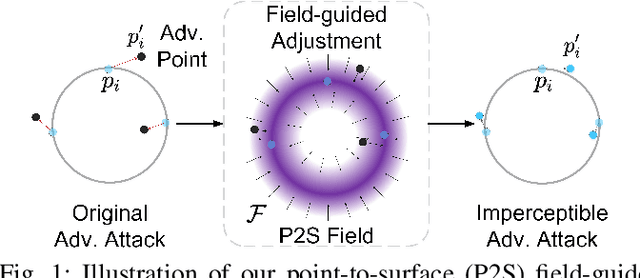
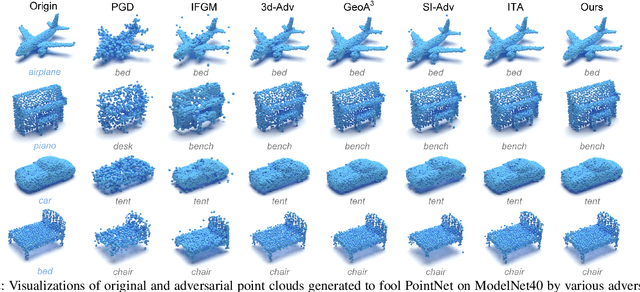
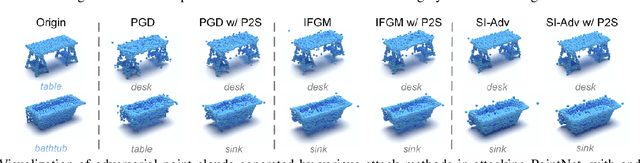
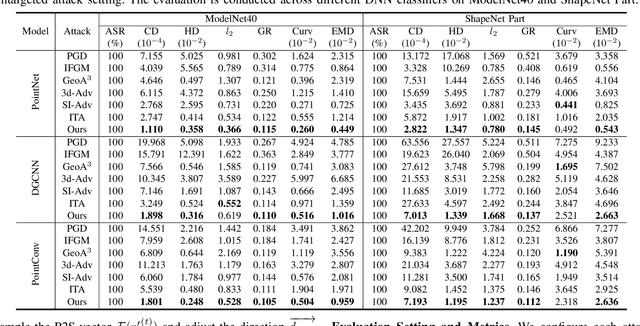
Adversarial attacks on point clouds are crucial for assessing and improving the adversarial robustness of 3D deep learning models. Traditional solutions strictly limit point displacement during attacks, making it challenging to balance imperceptibility with adversarial effectiveness. In this paper, we attribute the inadequate imperceptibility of adversarial attacks on point clouds to deviations from the underlying surface. To address this, we introduce a novel point-to-surface (P2S) field that adjusts adversarial perturbation directions by dragging points back to their original underlying surface. Specifically, we use a denoising network to learn the gradient field of the logarithmic density function encoding the shape's surface, and apply a distance-aware adjustment to perturbation directions during attacks, thereby enhancing imperceptibility. Extensive experiments show that adversarial attacks guided by our P2S field are more imperceptible, outperforming state-of-the-art methods.