 Add to Chrome
 Add to Firefox
 Add to Edge
Fedcompass: Federated Clustered and Periodic Aggregation Framework for Hybrid Classical-Quantum Models
Feb 03, 2026
Federated learning enables collaborative model training across decentralized clients under privacy constraints. Quantum computing offers potential for alleviating computational and communication burdens in federated learning, yet hybrid classical-quantum federated learning remains susceptible to performance degradation under non-IID data. To address this,we propose FEDCOMPASS, a layered aggregation framework for hybrid classical-quantum federated learning. FEDCOMPASS employs spectral clustering to group clients by class distribution similarity and performs cluster-wise aggregation for classical feature extractors. For quantum parameters, it uses circular mean aggregation combined with adaptive optimization to ensure stable global updates. Experiments on three benchmark datasets show that FEDCOMPASS improves test accuracy by up to 10.22% and enhances convergence stability under non-IID settings, outperforming six strong federated learning baselines.

Hermes: Memory-Efficient Pipeline Inference for Large Models on Edge Devices
Sep 09, 2024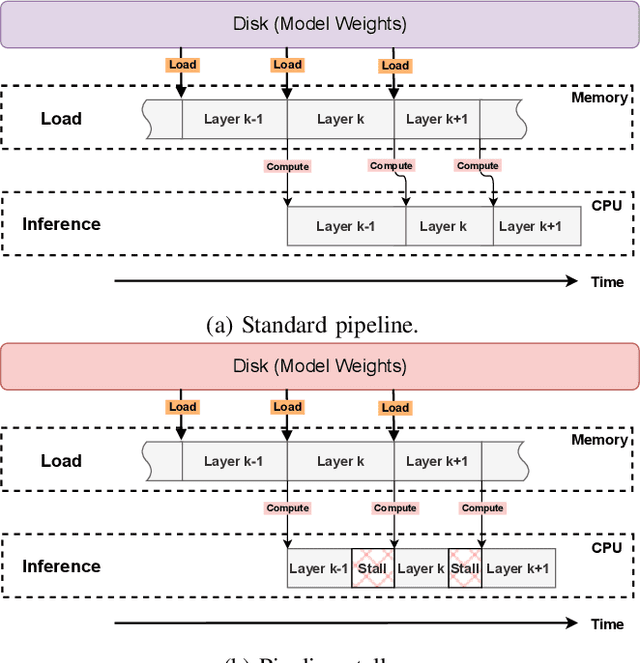
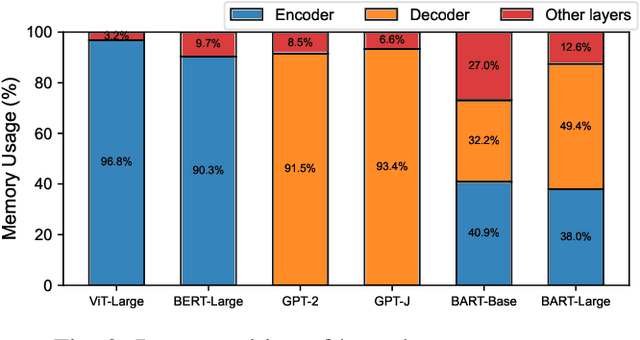
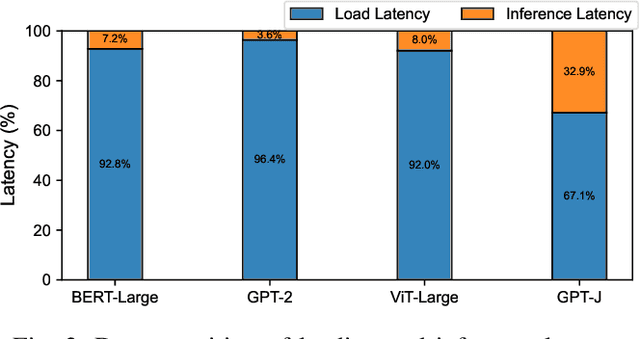
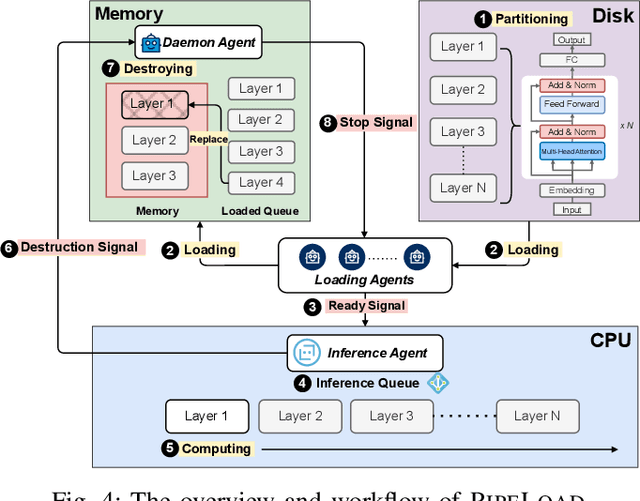
The application of Transformer-based large models has achieved numerous success in recent years. However, the exponential growth in the parameters of large models introduces formidable memory challenge for edge deployment. Prior works to address this challenge mainly focus on optimizing the model structure and adopting memory swapping methods. However, the former reduces the inference accuracy, and the latter raises the inference latency. This paper introduces PIPELOAD, a novel memory-efficient pipeline execution mechanism. It reduces memory usage by incorporating dynamic memory management and minimizes inference latency by employing parallel model loading. Based on PIPELOAD mechanism, we present Hermes, a framework optimized for large model inference on edge devices. We evaluate Hermes on Transformer-based models of different sizes. Our experiments illustrate that Hermes achieves up to 4.24 X increase in inference speed and 86.7% lower memory consumption than the state-of-the-art pipeline mechanism for BERT and ViT models, 2.58 X increase in inference speed and 90.3% lower memory consumption for GPT-style models.