 Add to Chrome
 Add to Firefox
 Add to Edge
Matterhorn: Efficient Analog Sparse Spiking Transformer Architecture with Masked Time-To-First-Spike Encoding
Jan 30, 2026
Spiking neural networks (SNNs) have emerged as a promising candidate for energy-efficient LLM inference. However, current energy evaluations for SNNs primarily focus on counting accumulate operations, and fail to account for real-world hardware costs such as data movement, which can consume nearly 80% of the total energy. In this paper, we propose Matterhorn, a spiking transformer that integrates a novel masked time-to-first-spike (M-TTFS) encoding method to reduce spike movement and a memristive synapse unit (MSU) to eliminate weight access overhead. M-TTFS employs a masking strategy that reassigns the zero-energy silent state (a spike train of all 0s) to the most frequent membrane potential rather than the lowest. This aligns the coding scheme with the data distribution, minimizing spike movement energy without information loss. We further propose a `dead zone' strategy that maximizes sparsity by mapping all values within a given range to the silent state. At the hardware level, the MSU utilizes compute-in-memory (CIM) technology to perform analog integration directly within memory, effectively removing weight access costs. On the GLUE benchmark, Matterhorn establishes a new state-of-the-art, surpassing existing SNNs by 1.42% in average accuracy while delivering a 2.31 times improvement in energy efficiency.

SWAT: Scalable and Efficient Window Attention-based Transformers Acceleration on FPGAs
May 27, 2024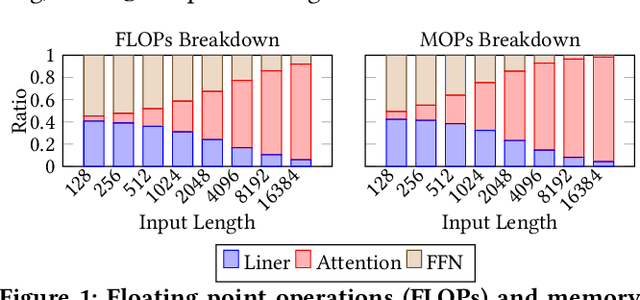
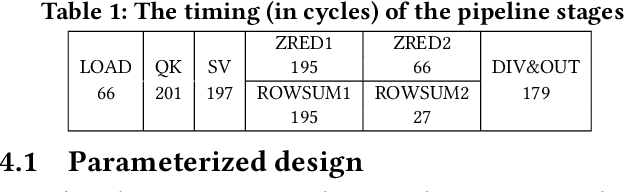
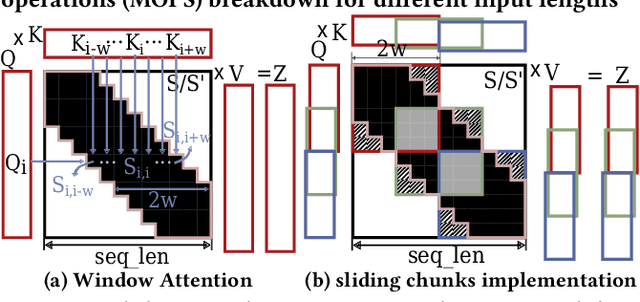
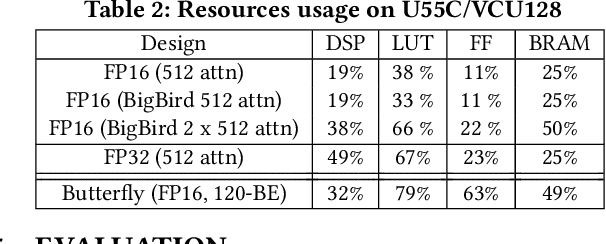
Efficiently supporting long context length is crucial for Transformer models. The quadratic complexity of the self-attention computation plagues traditional Transformers. Sliding window-based static sparse attention mitigates the problem by limiting the attention scope of the input tokens, reducing the theoretical complexity from quadratic to linear. Although the sparsity induced by window attention is highly structured, it does not align perfectly with the microarchitecture of the conventional accelerators, leading to suboptimal implementation. In response, we propose a dataflow-aware FPGA-based accelerator design, SWAT, that efficiently leverages the sparsity to achieve scalable performance for long input. The proposed microarchitecture is based on a design that maximizes data reuse by using a combination of row-wise dataflow, kernel fusion optimization, and an input-stationary design considering the distributed memory and computation resources of FPGA. Consequently, it achieves up to 22$\times$ and 5.7$\times$ improvement in latency and energy efficiency compared to the baseline FPGA-based accelerator and 15$\times$ energy efficiency compared to GPU-based solution.