 Add to Chrome
 Add to Firefox
 Add to Edge
ASTER: Agentic Scaling with Tool-integrated Extended Reasoning
Feb 01, 2026
Reinforcement learning (RL) has emerged as a dominant paradigm for eliciting long-horizon reasoning in Large Language Models (LLMs). However, scaling Tool-Integrated Reasoning (TIR) via RL remains challenging due to interaction collapse: a pathological state where models fail to sustain multi-turn tool usage, instead degenerating into heavy internal reasoning with only trivial, post-hoc code verification. We systematically study three questions: (i) how cold-start SFT induces an agentic, tool-using behavioral prior, (ii) how the interaction density of cold-start trajectories shapes exploration and downstream RL outcomes, and (iii) how the RL interaction budget affects learning dynamics and generalization under varying inference-time budgets. We then introduce ASTER (Agentic Scaling with Tool-integrated Extended Reasoning), a framework that circumvents this collapse through a targeted cold-start strategy prioritizing interaction-dense trajectories. We find that a small expert cold-start set of just 4K interaction-dense trajectories yields the strongest downstream performance, establishing a robust prior that enables superior exploration during extended RL training. Extensive evaluations demonstrate that ASTER-4B achieves state-of-the-art results on competitive mathematical benchmarks, reaching 90.0% on AIME 2025, surpassing leading frontier open-source models, including DeepSeek-V3.2-Exp.

MODULI: Unlocking Preference Generalization via Diffusion Models for Offline Multi-Objective Reinforcement Learning
Aug 28, 2024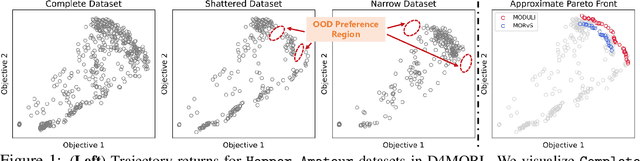
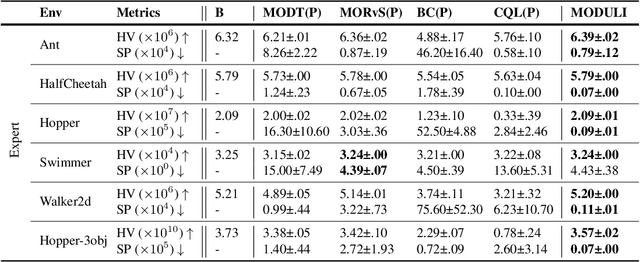

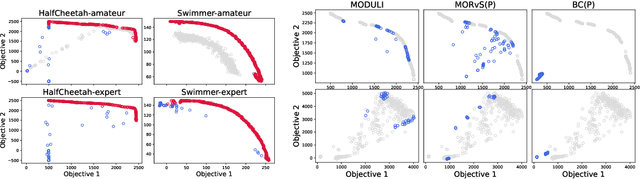
Multi-objective Reinforcement Learning (MORL) seeks to develop policies that simultaneously optimize multiple conflicting objectives, but it requires extensive online interactions. Offline MORL provides a promising solution by training on pre-collected datasets to generalize to any preference upon deployment. However, real-world offline datasets are often conservatively and narrowly distributed, failing to comprehensively cover preferences, leading to the emergence of out-of-distribution (OOD) preference areas. Existing offline MORL algorithms exhibit poor generalization to OOD preferences, resulting in policies that do not align with preferences. Leveraging the excellent expressive and generalization capabilities of diffusion models, we propose MODULI (Multi-objective Diffusion Planner with Sliding Guidance), which employs a preference-conditioned diffusion model as a planner to generate trajectories that align with various preferences and derive action for decision-making. To achieve accurate generation, MODULI introduces two return normalization methods under diverse preferences for refining guidance. To further enhance generalization to OOD preferences, MODULI proposes a novel sliding guidance mechanism, which involves training an additional slider adapter to capture the direction of preference changes. Incorporating the slider, it transitions from in-distribution (ID) preferences to generating OOD preferences, patching, and extending the incomplete Pareto front. Extensive experiments on the D4MORL benchmark demonstrate that our algorithm outperforms state-of-the-art Offline MORL baselines, exhibiting excellent generalization to OOD preferences.