 Add to Chrome
 Add to Firefox
 Add to Edge
RelayGR: Scaling Long-Sequence Generative Recommendation via Cross-Stage Relay-Race Inference
Jan 05, 2026
Real-time recommender systems execute multi-stage cascades (retrieval, pre-processing, fine-grained ranking) under strict tail-latency SLOs, leaving only tens of milliseconds for ranking. Generative recommendation (GR) models can improve quality by consuming long user-behavior sequences, but in production their online sequence length is tightly capped by the ranking-stage P99 budget. We observe that the majority of GR tokens encode user behaviors that are independent of the item candidates, suggesting an opportunity to pre-infer a user-behavior prefix once and reuse it during ranking rather than recomputing it on the critical path. Realizing this idea at industrial scale is non-trivial: the prefix cache must survive across multiple pipeline stages before the final ranking instance is determined, the user population implies cache footprints far beyond a single device, and indiscriminate pre-inference would overload shared resources under high QPS. We present RelayGR, a production system that enables in-HBM relay-race inference for GR. RelayGR selectively pre-infers long-term user prefixes, keeps their KV caches resident in HBM over the request lifecycle, and ensures the subsequent ranking can consume them without remote fetches. RelayGR combines three techniques: 1) a sequence-aware trigger that admits only at-risk requests under a bounded cache footprint and pre-inference load, 2) an affinity-aware router that co-locates cache production and consumption by routing both the auxiliary pre-infer signal and the ranking request to the same instance, and 3) a memory-aware expander that uses server-local DRAM to capture short-term cross-request reuse while avoiding redundant reloads. We implement RelayGR on Huawei Ascend NPUs and evaluate it with real queries. Under a fixed P99 SLO, RelayGR supports up to 1.5$\times$ longer sequences and improves SLO-compliant throughput by up to 3.6$\times$.

P/D-Serve: Serving Disaggregated Large Language Model at Scale
Aug 15, 2024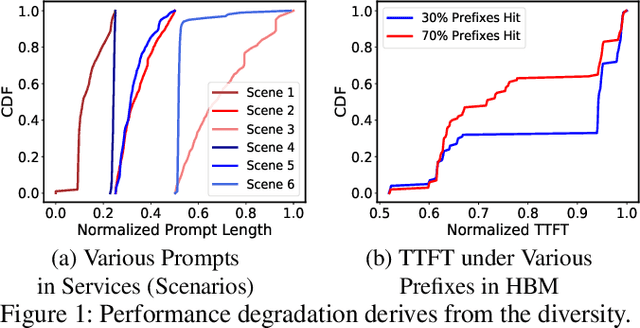
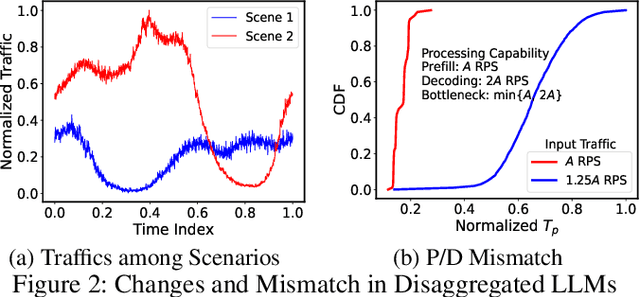
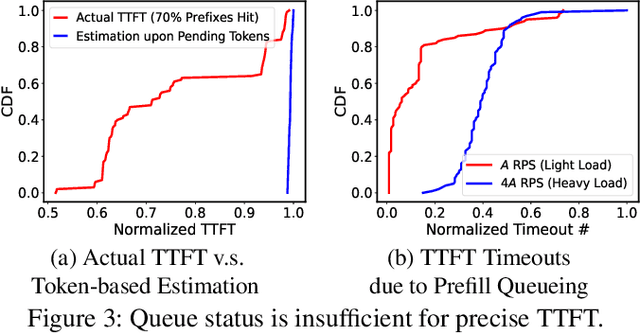
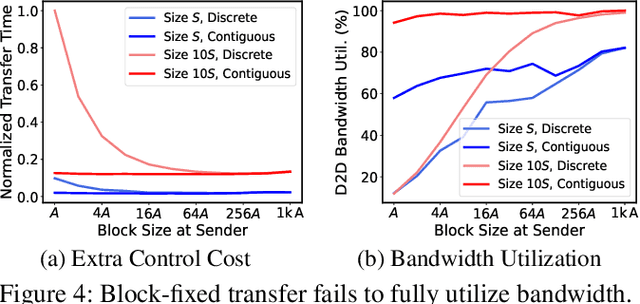
Serving disaggregated large language models (LLMs) over tens of thousands of xPU devices (GPUs or NPUs) with reliable performance faces multiple challenges. 1) Ignoring the diversity (various prefixes and tidal requests), treating all the prompts in a mixed pool is inadequate. To facilitate the similarity per scenario and minimize the inner mismatch on P/D (prefill and decoding) processing, fine-grained organization is required, dynamically adjusting P/D ratios for better performance. 2) Due to inaccurate estimation on workload (queue status or maintained connections), the global scheduler easily incurs unnecessary timeouts in prefill. 3) Block-fixed device-to-device (D2D) KVCache transfer over cluster-level RDMA (remote direct memory access) fails to achieve desired D2D utilization as expected. To overcome previous problems, this paper proposes an end-to-end system P/D-Serve, complying with the paradigm of MLOps (machine learning operations), which models end-to-end (E2E) P/D performance and enables: 1) fine-grained P/D organization, mapping the service with RoCE (RDMA over converged ethernet) as needed, to facilitate similar processing and dynamic adjustments on P/D ratios; 2) on-demand forwarding upon rejections for idle prefill, decoupling the scheduler from regular inaccurate reports and local queues, to avoid timeouts in prefill; and 3) efficient KVCache transfer via optimized D2D access. P/D-Serve is implemented upon Ascend and MindSpore, has been deployed over tens of thousands of NPUs for more than eight months in commercial use, and further achieves 60\%, 42\% and 46\% improvements on E2E throughput, time-to-first-token (TTFT) SLO (service level objective) and D2D transfer time. As the E2E system with optimizations, P/D-Serve achieves 6.7x increase on throughput, compared with aggregated LLMs.