 Add to Chrome
 Add to Firefox
 Add to Edge
AIPatient Arena: EHR-grounded evaluation of large language models in end-to-end clinical consultation workflows
Jun 16, 2026
Large language models (LLMs) are increasingly considered for use in clinical consultation tasks, yet most medical evaluations remain static, single-turn, or narrowly outcome-based, limiting their ability to reflect the sequential, uncertain, and interactive nature of real-world care. Here, we propose AIPatient Arena, an EHRs-grounded evaluation framework for assessing the clinical utility of LLMs across eight dimensions of clinical competence. The framework integrates EHR data into patient-specific knowledge graphs, enabling multi-turn physician-patient interactions. We applied AIPatient Arena on a primary cohort of 437 patients and two out-of-distribution validation cohorts of 119 and 67 patients. We observe that LLMs performed well in medical interview questioning skills (QS; mean scores, 4.43-4.99/5), ethical and professional conduct (ET; 4.38-4.93/5), and clarity and transparency of clinical explanations (EX; 3.80-4.72/5). Performance was moderate in information integration (II; 3.19-4.21/5) and medication safety and justification (MS; 3.13-3.78/5), but persistent weaknesses were observed in handling of ambiguous patient responses (HR; 2.57-3.32/5), information coverage (IC; 2.08-3.02/5), and diagnostic accuracy and reasoning (Dx; 2.63-3.55/5). Process-based evaluation revealed recurrent interaction failures, including repetitive questioning, omission of past medical history, and inadequate handling of uncertainty. Richer conversational context improved diagnostic reasoning but yielded limited gains in treatment planning. These findings indicate that final-answer accuracy alone is insufficient for evaluating clinical readiness and highlight the importance of assessing how models gather, interpret, and communicate information throughout a consultation. AIPatient Arena provides an EHR-grounded framework for workflow-oriented pre-deployment evaluation of medical LLMs.

Evaluating an evidence-guided reinforcement learning framework in aligning light-parameter large language models with decision-making cognition in psychiatric clinical reasoning
Feb 06, 2026Large language models (LLMs) hold transformative potential for medical decision support yet their application in psychiatry remains constrained by hallucinations and superficial reasoning. This limitation is particularly acute in light-parameter LLMs which are essential for privacy-preserving and efficient clinical deployment. Existing training paradigms prioritize linguistic fluency over structured clinical logic and result in a fundamental misalignment with professional diagnostic cognition. Here we introduce ClinMPO, a reinforcement learning framework designed to align the internal reasoning of LLMs with professional psychiatric practice. The framework employs a specialized reward model trained independently on a dataset derived from 4,474 psychiatry journal articles and structured according to evidence-based medicine principles. We evaluated ClinMPO on a unseen subset of the benchmark designed to isolate reasoning capabilities from rote memorization. This test set comprises items where leading large-parameter LLMs consistently fail. We compared the ClinMPO-aligned light LLM performance against a cohort of 300 medical students. The ClinMPO-tuned Qwen3-8B model achieved a diagnostic accuracy of 31.4% and surpassed the human benchmark of 30.8% on these complex cases. These results demonstrate that medical evidence-guided optimization enables light-parameter LLMs to master complex reasoning tasks. Our findings suggest that explicit cognitive alignment offers a scalable pathway to reliable and safe psychiatric decision support.
Data-Efficient Model for Psychological Resilience Prediction based on Neurological Data
Feb 03, 2025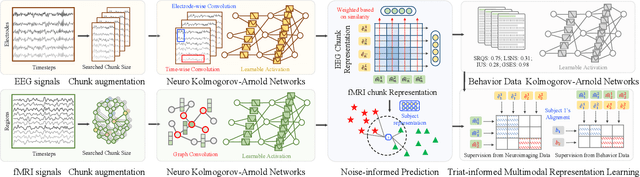
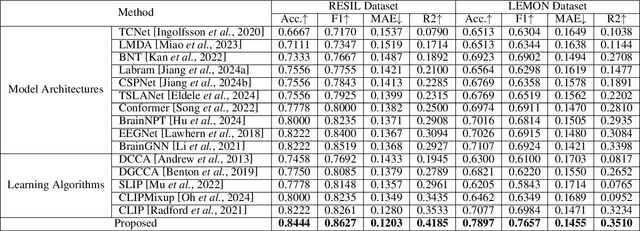
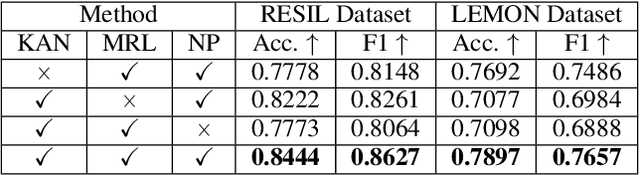
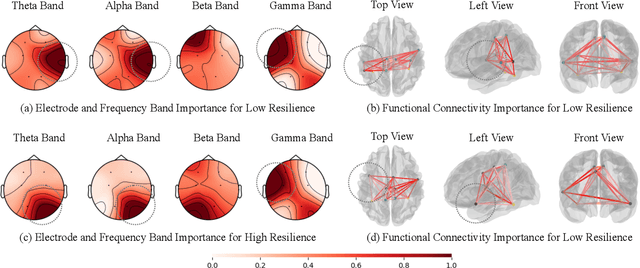
Psychological resilience, defined as the ability to rebound from adversity, is crucial for mental health. Compared with traditional resilience assessments through self-reported questionnaires, resilience assessments based on neurological data offer more objective results with biological markers, hence significantly enhancing credibility. This paper proposes a novel data-efficient model to address the scarcity of neurological data. We employ Neuro Kolmogorov-Arnold Networks as the structure of the prediction model. In the training stage, a new trait-informed multimodal representation algorithm with a smart chunk technique is proposed to learn the shared latent space with limited data. In the test stage, a new noise-informed inference algorithm is proposed to address the low signal-to-noise ratio of the neurological data. The proposed model not only shows impressive performance on both public datasets and self-constructed datasets but also provides some valuable psychological hypotheses for future research.