 Add to Chrome
 Add to Firefox
 Add to Edge
SynthRM: A Synthetic Data Platform for Vision-Aided Mobile System Simulation
Jan 27, 2026
Vision-aided wireless sensing is emerging as a cornerstone of 6G mobile computing. While data-driven approaches have advanced rapidly, establishing a precise geometric correspondence between ego-centric visual data and radio propagation remains a challenge. Existing paradigms typically either associate 2D topology maps and auxiliary information with radio maps, or provide 3D perspective views limited by sparse radio data. This spatial representation flattens the complex vertical interactions such as occlusion and diffraction that govern signal behavior in urban environments, rendering the task of cross-view signal inference mathematically ill-posed. To resolve this geometric ambiguity, we introduce SynthRM, a scalable synthetic data platform. SynthRM implements a Visible-Aligned-Surface simulation strategy: rather than probing a global volumetric grid, it performs ray-tracing directly onto the geometry exposed to the sensor. This approach ensures pixel-level consistency between visual semantics and electromagnetic response, transforming the learning objective into a physically well-posed problem. We demonstrate the platform's capabilities by presenting a diverse, city-scale dataset derived from procedurally generated environments. By combining efficient procedural synthesis with high-fidelity electromagnetic modeling, SynthRM provides a transparent, accessible foundation for developing next-generation mobile systems for environment-aware sensing and communication.

Deep Reinforcement Learning-aided Transmission Design for Energy-efficient Link Optimization in Vehicular Communications
Apr 19, 2024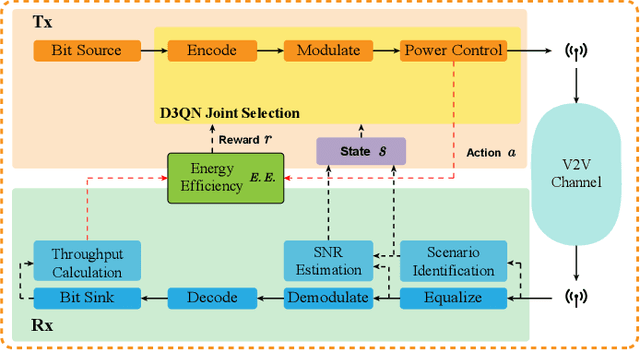
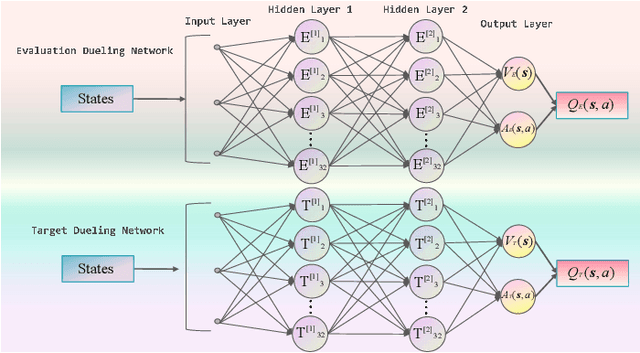
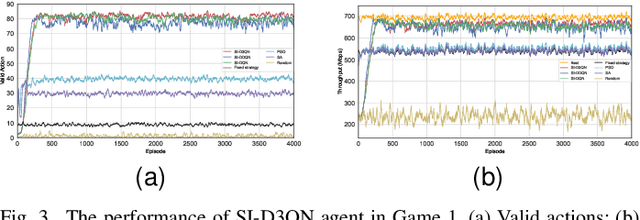
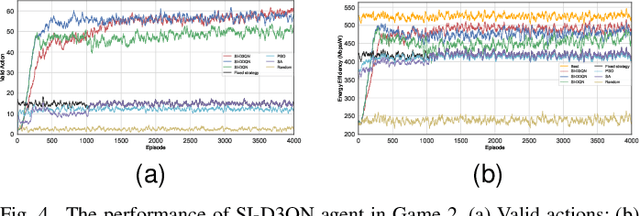
This letter presents a deep reinforcement learning (DRL) approach for transmission design to optimize the energy efficiency in vehicle-to-vehicle (V2V) communication links. Considering the dynamic environment of vehicular communications, the optimization problem is non-convex and mathematically difficult to solve. Hence, we propose scenario identification-based double and Dueling deep Q-Network (SI-D3QN), a DRL algorithm integrating both double deep Q-Network and Dueling deep Q-Network, for the joint design of modulation and coding scheme (MCS) selection and power control. To be more specific, we employ SI techique to enhance link performance and assit the D3QN agent in refining its decision-making processes. The experiment results demonstrate that, across various optimization tasks, our proposed SI-D3QN agent outperforms the benchmark algorithms in terms of the valid actions and link performance metrics. Particularly, while ensuring significant improvement in energy efficiency, the agent facilitates a 29.6% enhancement in the link throughput under the same energy consumption.