 Add to Chrome
 Add to Firefox
 Add to Edge
Resisting Manipulative Bots in Meme Coin Copy Trading: A Multi-Agent Approach with Chain-of-Thought Reasoning
Jan 26, 2026
Copy trading has become the dominant entry strategy in meme coin markets. However, due to the market's extreme illiquid and volatile nature, the strategy exposes an exploitable attack surface: adversaries deploy manipulative bots to front-run trades, conceal positions, and fabricate sentiment, systematically extracting value from naïve copiers at scale. Despite its prevalence, bot-driven manipulation remains largely unexplored, and no robust defensive framework exists. We propose a manipulation-resistant copy-trading system based on a multi-agent architecture powered by a multi-modal, explainable large language model (LLM). Our system decomposes copy trading into three specialized agents for coin evaluation, wallet selection, and timing assessment. Evaluated on historical data from over 6,000 meme coins, our approach outperforms zero-shot and most statistic-driven baselines in prediction accuracy as well as all baselines in economic performance, achieving an average return of 14% for identified smart-money trades and an estimated copier return of 3% per trade under realistic market frictions. Overall, our results demonstrate the effectiveness of agent-based defenses and predictability of trader profitability in adversarial meme coin markets, providing a practical foundation for robust copy trading.

Resisting Manipulative Bots in Memecoin Copy Trading: A Multi-Agent Approach with Chain-of-Thought Reasoning
Jan 13, 2026The launch of \$Trump coin ignited a wave in meme coin investment. Copy trading, as a strategy-agnostic approach that eliminates the need for deep trading knowledge, quickly gains widespread popularity in the meme coin market. However, copy trading is not a guarantee of profitability due to the prevalence of manipulative bots, the uncertainty of the followed wallets' future performance, and the lag in trade execution. Recently, large language models (LLMs) have shown promise in financial applications by effectively understanding multi-modal data and producing explainable decisions. However, a single LLM struggles with complex, multi-faceted tasks such as asset allocation. These challenges are even more pronounced in cryptocurrency markets, where LLMs often lack sufficient domain-specific knowledge in their training data. To address these challenges, we propose an explainable multi-agent system for meme coin copy trading. Inspired by the structure of an asset management team, our system decomposes the complex task into subtasks and coordinates specialized agents to solve them collaboratively. Employing few-shot chain-of-though (CoT) prompting, each agent acquires professional meme coin trading knowledge, interprets multi-modal data, and generates explainable decisions. Using a dataset of 1,000 meme coin projects' transaction data, our empirical evaluation shows that the proposed multi-agent system outperforms both traditional machine learning models and single LLMs, achieving 73% and 70% precision in identifying high-quality meme coin projects and key opinion leader (KOL) wallets, respectively. The selected KOLs collectively generated a total profit of \$500,000 across these projects.
LLM-Powered Multi-Agent System for Automated Crypto Portfolio Management
Jan 07, 2025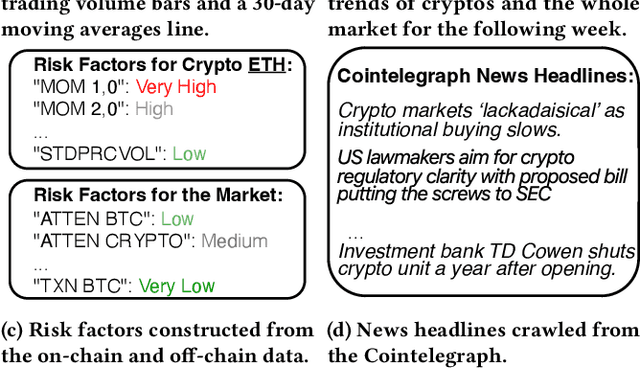
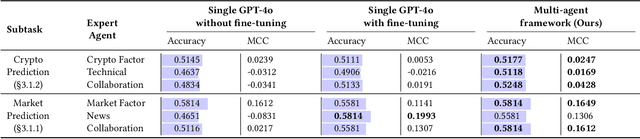
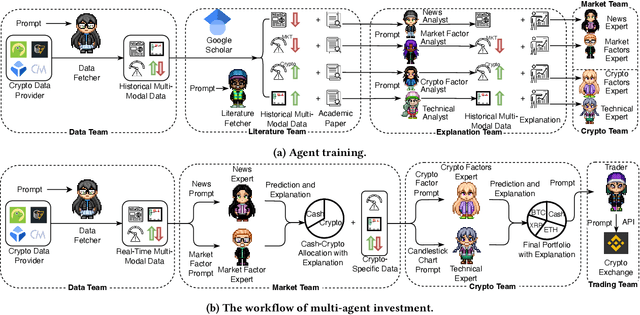
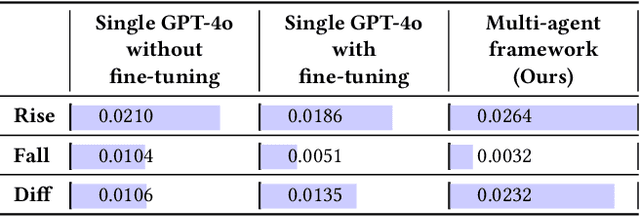
Cryptocurrency investment is inherently difficult due to its shorter history compared to traditional assets, the need to integrate vast amounts of data from various modalities, and the requirement for complex reasoning. While deep learning approaches have been applied to address these challenges, their black-box nature raises concerns about trust and explainability. Recently, large language models (LLMs) have shown promise in financial applications due to their ability to understand multi-modal data and generate explainable decisions. However, single LLM faces limitations in complex, comprehensive tasks such as asset investment. These limitations are even more pronounced in cryptocurrency investment, where LLMs have less domain-specific knowledge in their training corpora. To overcome these challenges, we propose an explainable, multi-modal, multi-agent framework for cryptocurrency investment. Our framework uses specialized agents that collaborate within and across teams to handle subtasks such as data analysis, literature integration, and investment decision-making for the top 30 cryptocurrencies by market capitalization. The expert training module fine-tunes agents using multi-modal historical data and professional investment literature, while the multi-agent investment module employs real-time data to make informed cryptocurrency investment decisions. Unique intrateam and interteam collaboration mechanisms enhance prediction accuracy by adjusting final predictions based on confidence levels within agent teams and facilitating information sharing between teams. Empirical evaluation using data from November 2023 to September 2024 demonstrates that our framework outperforms single-agent models and market benchmarks in classification, asset pricing, portfolio, and explainability performance.