 Add to Chrome
 Add to Firefox
 Add to Edge
GaMO: Geometry-aware Multi-view Diffusion Outpainting for Sparse-View 3D Reconstruction
Dec 31, 2025
Recent advances in 3D reconstruction have achieved remarkable progress in high-quality scene capture from dense multi-view imagery, yet struggle when input views are limited. Various approaches, including regularization techniques, semantic priors, and geometric constraints, have been implemented to address this challenge. Latest diffusion-based methods have demonstrated substantial improvements by generating novel views from new camera poses to augment training data, surpassing earlier regularization and prior-based techniques. Despite this progress, we identify three critical limitations in these state-of-the-art approaches: inadequate coverage beyond known view peripheries, geometric inconsistencies across generated views, and computationally expensive pipelines. We introduce GaMO (Geometry-aware Multi-view Outpainter), a framework that reformulates sparse-view reconstruction through multi-view outpainting. Instead of generating new viewpoints, GaMO expands the field of view from existing camera poses, which inherently preserves geometric consistency while providing broader scene coverage. Our approach employs multi-view conditioning and geometry-aware denoising strategies in a zero-shot manner without training. Extensive experiments on Replica and ScanNet++ demonstrate state-of-the-art reconstruction quality across 3, 6, and 9 input views, outperforming prior methods in PSNR and LPIPS, while achieving a $25\times$ speedup over SOTA diffusion-based methods with processing time under 10 minutes. Project page: https://yichuanh.github.io/GaMO/

Voxify3D: Pixel Art Meets Volumetric Rendering
Dec 08, 2025Voxel art is a distinctive stylization widely used in games and digital media, yet automated generation from 3D meshes remains challenging due to conflicting requirements of geometric abstraction, semantic preservation, and discrete color coherence. Existing methods either over-simplify geometry or fail to achieve the pixel-precise, palette-constrained aesthetics of voxel art. We introduce Voxify3D, a differentiable two-stage framework bridging 3D mesh optimization with 2D pixel art supervision. Our core innovation lies in the synergistic integration of three components: (1) orthographic pixel art supervision that eliminates perspective distortion for precise voxel-pixel alignment; (2) patch-based CLIP alignment that preserves semantics across discretization levels; (3) palette-constrained Gumbel-Softmax quantization enabling differentiable optimization over discrete color spaces with controllable palette strategies. This integration addresses fundamental challenges: semantic preservation under extreme discretization, pixel-art aesthetics through volumetric rendering, and end-to-end discrete optimization. Experiments show superior performance (37.12 CLIP-IQA, 77.90\% user preference) across diverse characters and controllable abstraction (2-8 colors, 20x-50x resolutions). Project page: https://yichuanh.github.io/Voxify-3D/
AuraFusion360: Augmented Unseen Region Alignment for Reference-based 360° Unbounded Scene Inpainting
Feb 07, 2025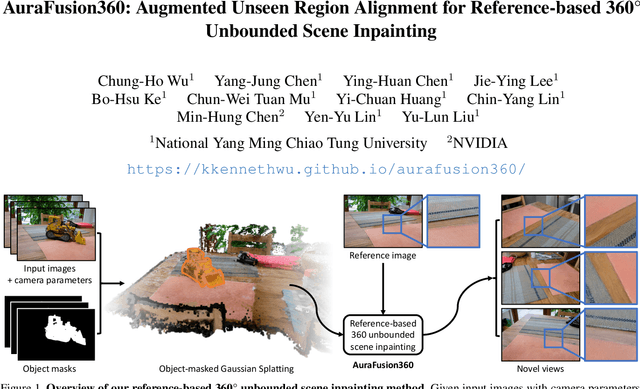
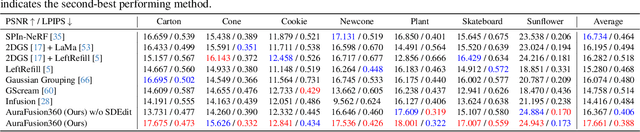
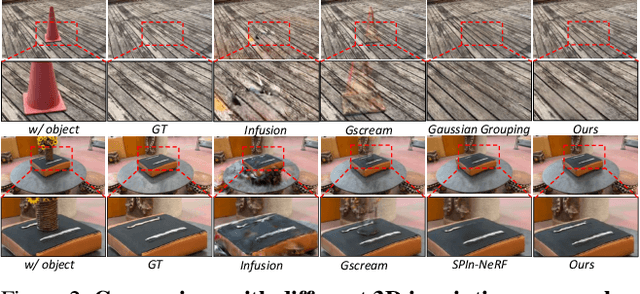
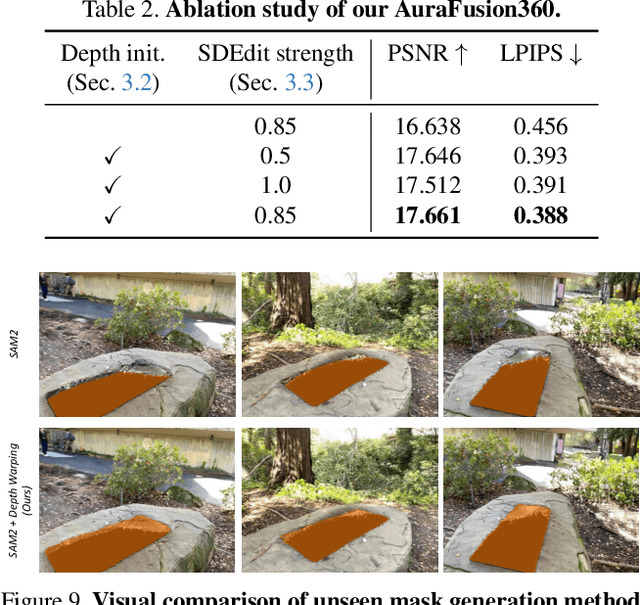
Three-dimensional scene inpainting is crucial for applications from virtual reality to architectural visualization, yet existing methods struggle with view consistency and geometric accuracy in 360{\deg} unbounded scenes. We present AuraFusion360, a novel reference-based method that enables high-quality object removal and hole filling in 3D scenes represented by Gaussian Splatting. Our approach introduces (1) depth-aware unseen mask generation for accurate occlusion identification, (2) Adaptive Guided Depth Diffusion, a zero-shot method for accurate initial point placement without requiring additional training, and (3) SDEdit-based detail enhancement for multi-view coherence. We also introduce 360-USID, the first comprehensive dataset for 360{\deg} unbounded scene inpainting with ground truth. Extensive experiments demonstrate that AuraFusion360 significantly outperforms existing methods, achieving superior perceptual quality while maintaining geometric accuracy across dramatic viewpoint changes. See our project page for video results and the dataset at https://kkennethwu.github.io/aurafusion360/.