 Add to Chrome
 Add to Firefox
 Add to Edge
Tight Regret Bounds for Bilateral Trade under Semi Feedback
Jan 23, 2026
The study of \textit{regret minimization in fixed-price bilateral trade} has received considerable attention in recent research. Previous works [CCC+24a, CCC+24b, AFF24, BCCF24, CJLZ25, LCM25a, GDFS25] have acquired a thorough understanding of the problem, except for determining the tight regret bound for GBB semi-feedback fixed-price mechanisms under adversarial values. In this paper, we resolve this open question by devising an $\widetilde{O}(T^{2 / 3})$-regret mechanism, matching the $Ω(T^{2 / 3})$ lower bound from [CJLZ25] up to polylogarithmic factors.

Tight Regret Bounds for Fixed-Price Bilateral Trade
Apr 06, 2025
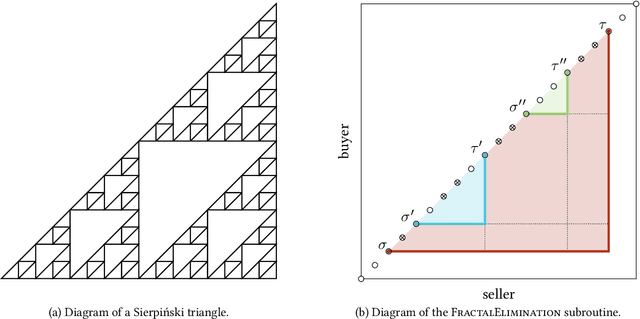
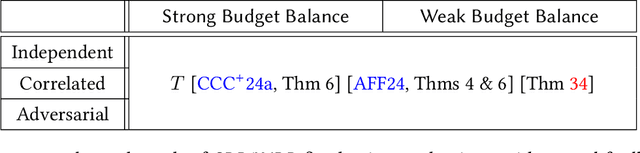
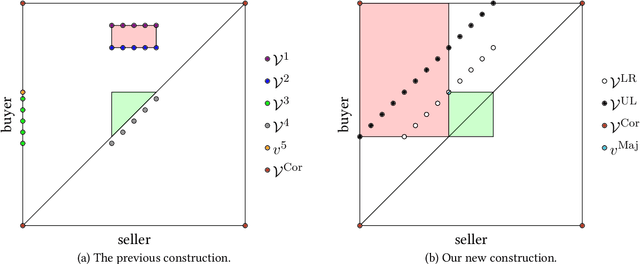
We examine fixed-price mechanisms in bilateral trade through the lens of regret minimization. Our main results are twofold. (i) For independent values, a near-optimal $\widetilde{\Theta}(T^{2/3})$ tight bound for $\textsf{Global Budget Balance}$ fixed-price mechanisms with two-bit/one-bit feedback. (ii) For correlated/adversarial values, a near-optimal $\Omega(T^{3/4})$ lower bound for $\textsf{Global Budget Balance}$ fixed-price mechanisms with two-bit/one-bit feedback, which improves the best known $\Omega(T^{5/7})$ lower bound obtained in the work \cite{BCCF24} and, up to polylogarithmic factors, matches the $\widetilde{\mathcal{O}}(T^{3 / 4})$ upper bound obtained in the same work. Our work in combination with the previous works \cite{CCCFL24mor, CCCFL24jmlr, AFF24, BCCF24} (essentially) gives a thorough understanding of regret minimization for fixed-price bilateral trade. En route, we have developed two technical ingredients that might be of independent interest: (i) A novel algorithmic paradigm, called $\textit{{fractal elimination}}$, to address one-bit feedback and independent values. (ii) A new $\textit{lower-bound construction}$ with novel proof techniques, to address the $\textsf{Global Budget Balance}$ constraint and correlated values.