 Add to Chrome
 Add to Firefox
 Add to Edge
AWaRe-SAC: Proactive Slice Admission Control under Weather-Induced Capacity Uncertainty
Jan 09, 2026
As emerging applications demand higher throughput and lower latencies, operators are increasingly deploying millimeter-wave (mmWave) links within x-haul transport networks, spanning fronthaul, midhaul, and backhaul segments. However, the inherent susceptibility of mmWave frequencies to weather-related attenuation, particularly rain fading, complicates the maintenance of stringent Quality of Service (QoS) requirements. This creates a critical challenge: making admission decisions under uncertainty regarding future network capacity. To address this, we develop a proactive slice admission control framework for mmWave x-haul networks subject to rain-induced fluctuations. Our objective is to improve network performance, ensure QoS, and optimize revenue, thereby surpassing the limitations of standard reactive approaches. The proposed framework integrates a deep learning predictor of future network conditions with a proactive Q-learning-based slice admission control mechanism. We validate our solution using real-world data from a mmWave x-haul deployment in a dense urban area, incorporating realistic models of link capacity attenuation and dynamic slice demands. Extensive evaluations demonstrate that our proactive solution achieves 2-3x higher long-term average revenue under dynamic link conditions, providing a scalable and resilient framework for adaptive admission control.

Collective Mobile Sequential Recommendation: A Recommender System for Multiple Taxicabs
Jun 22, 2019
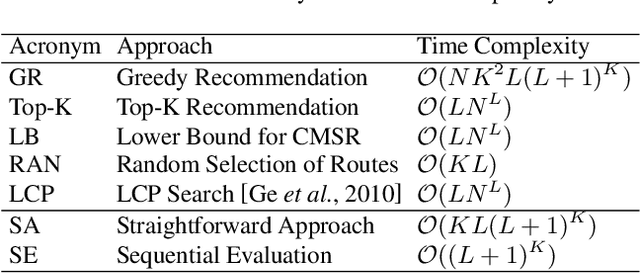


Mobile sequential recommendation was originally designed to find a promising route for a single taxicab. Directly applying it for multiple taxicabs may cause an excessive overlap of recommended routes. The multi-taxicab recommendation problem is challenging and has been less studied. In this paper, we first formalize a collective mobile sequential recommendation problem based on a classic mathematical model, which characterizes time-varying influence among competing taxicabs. Next, we propose a new evaluation metric for a collection of taxicab routes aimed to minimize the sum of potential travel time. We then develop an efficient algorithm to calculate the metric and design a greedy recommendation method to approximate the solution. Finally, numerical experiments show the superiority of our methods. In trace-driven simulation, the set of routes recommended by our method significantly outperforms those obtained by conventional methods.