 Add to Chrome
 Add to Firefox
 Add to Edge
Breaking the Reversal Curse in Autoregressive Language Models via Identity Bridge
Feb 02, 2026
Autoregressive large language models (LLMs) have achieved remarkable success in many complex tasks, yet they can still fail in very simple logical reasoning such as the "reversal curse" -- when trained on forward knowledge data of the form "$A \rightarrow B$" (e.g., Alice's husband is Bob), the model is unable to deduce the reversal knowledge "$B \leftarrow A$" (e.g., Bob's wife is Alice) during test. Extensive prior research suggests that this failure is an inherent, fundamental limit of autoregressive causal LLMs, indicating that these models tend to memorize factual-level knowledge rather than capture higher-level rules. In this paper, we challenge this view by showing that this seemingly fundamental limit can be mitigated by slightly tweaking the training data with a simple regularization data recipe called the Identity Bridge of the form "$A \to A$" (e.g., The name of Alice is Alice). Theoretically, we prove that under this recipe, even a one-layer transformer can break the reversal curse by analyzing the implicit bias of gradient descent. Empirically, we show that a 1B pretrained language model finetuned with the proposed data recipe achieves a 40% success rate on reversal tasks, in stark contrast to a near-zero success rate when trained solely on forward-knowledge data. Our work provides a novel theoretical foundation for the reversal curse and offers a principled, low-cost path to encouraging LLMs to learn higher-level rules from data.

Differentiable Distributionally Robust Optimization Layers
Jun 24, 2024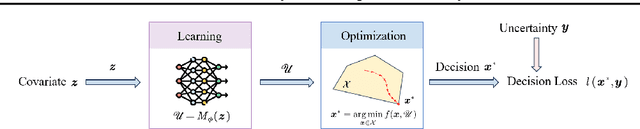
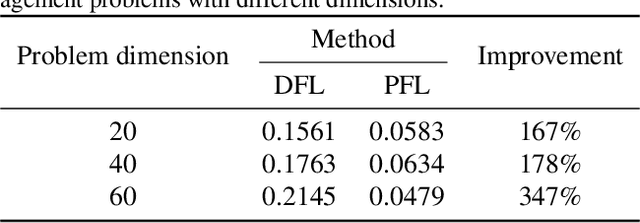
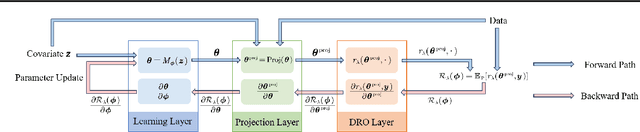
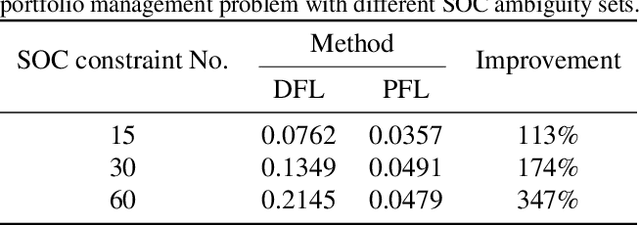
In recent years, there has been a growing research interest in decision-focused learning, which embeds optimization problems as a layer in learning pipelines and demonstrates a superior performance than the prediction-focused approach. However, for distributionally robust optimization (DRO), a popular paradigm for decision-making under uncertainty, it is still unknown how to embed it as a layer, i.e., how to differentiate decisions with respect to an ambiguity set. In this paper, we develop such differentiable DRO layers for generic mixed-integer DRO problems with parameterized second-order conic ambiguity sets and discuss its extension to Wasserstein ambiguity sets. To differentiate the mixed-integer decisions, we propose a novel dual-view methodology by handling continuous and discrete parts of decisions via different principles. Specifically, we construct a differentiable energy-based surrogate to implement the dual-view methodology and use importance sampling to estimate its gradient. We further prove that such a surrogate enjoys the asymptotic convergency under regularization. As an application of the proposed differentiable DRO layers, we develop a novel decision-focused learning pipeline for contextual distributionally robust decision-making tasks and compare it with the prediction-focused approach in experiments.