 Add to Chrome
 Add to Firefox
 Add to Edge
Beyond Cosine Similarity
Feb 05, 2026
Cosine similarity, the standard metric for measuring semantic similarity in vector spaces, is mathematically grounded in the Cauchy-Schwarz inequality, which inherently limits it to capturing linear relationships--a constraint that fails to model the complex, nonlinear structures of real-world semantic spaces. We advance this theoretical underpinning by deriving a tighter upper bound for the dot product than the classical Cauchy-Schwarz bound. This new bound leads directly to recos, a similarity metric that normalizes the dot product by the sorted vector components. recos relaxes the condition for perfect similarity from strict linear dependence to ordinal concordance, thereby capturing a broader class of relationships. Extensive experiments across 11 embedding models--spanning static, contextualized, and universal types--demonstrate that recos consistently outperforms traditional cosine similarity, achieving higher correlation with human judgments on standard Semantic Textual Similarity (STS) benchmarks. Our work establishes recos as a mathematically principled and empirically superior alternative, offering enhanced accuracy for semantic analysis in complex embedding spaces.

Multi-Scale DenseNet-Based Electricity Theft Detection
May 24, 2018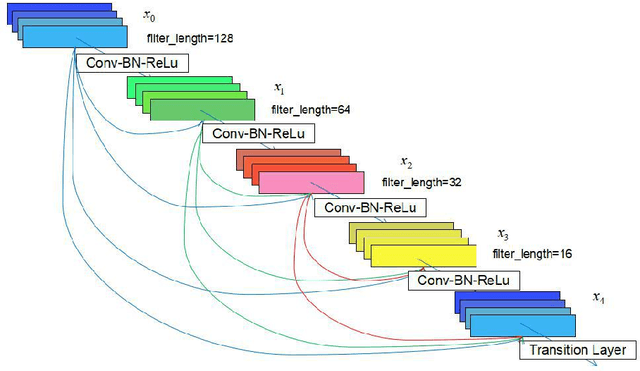
Electricity theft detection issue has drawn lots of attention during last decades. Timely identification of the electricity theft in the power system is crucial for the safety and availability of the system. Although sustainable efforts have been made, the detection task remains challenging and falls short of accuracy and efficiency, especially with the increase of the data size. Recently, convolutional neural network-based methods have achieved better performance in comparison with traditional methods, which employ handcrafted features and shallow-architecture classifiers. In this paper, we present a novel approach for automatic detection by using a multi-scale dense connected convolution neural network (multi-scale DenseNet) in order to capture the long-term and short-term periodic features within the sequential data. We compare the proposed approaches with the classical algorithms, and the experimental results demonstrate that the multiscale DenseNet approach can significantly improve the accuracy of the detection. Moreover, our method is scalable, enabling larger data processing while no handcrafted feature engineering is needed.