 Add to Chrome
 Add to Firefox
 Add to Edge
$κ$-Explorer: A Unified Framework for Active Model Estimation in MDPs
Feb 23, 2026
In tabular Markov decision processes (MDPs) with perfect state observability, each trajectory provides active samples from the transition distributions conditioned on state-action pairs. Consequently, accurate model estimation depends on how the exploration policy allocates visitation frequencies in accordance with the intrinsic complexity of each transition distribution. Building on recent work on coverage-based exploration, we introduce a parameterized family of decomposable and concave objective functions $U_κ$ that explicitly incorporate both intrinsic estimation complexity and extrinsic visitation frequency. Moreover, the curvature $κ$ provides a unified treatment of various global objectives, such as the average-case and worst-case estimation error objectives. Using the closed-form characterization of the gradient of $U_κ$, we propose $κ$-Explorer, an active exploration algorithm that performs Frank-Wolfe-style optimization over state-action occupancy measures. The diminishing-returns structure of $U_κ$ naturally prioritizes underexplored and high-variance transitions, while preserving smoothness properties that enable efficient optimization. We establish tight regret guarantees for $κ$-Explorer and further introduce a fully online and computationally efficient surrogate algorithm for practical use. Experiments on benchmark MDPs demonstrate that $κ$-Explorer provides superior performance compared to existing exploration strategies.

From Relative Entropy to Minimax: A Unified Framework for Coverage in MDPs
Jan 17, 2026Targeted and deliberate exploration of state--action pairs is essential in reward-free Markov Decision Problems (MDPs). More precisely, different state-action pairs exhibit different degree of importance or difficulty which must be actively and explicitly built into a controlled exploration strategy. To this end, we propose a weighted and parameterized family of concave coverage objectives, denoted by $U_ρ$, defined directly over state--action occupancy measures. This family unifies several widely studied objectives within a single framework, including divergence-based marginal matching, weighted average coverage, and worst-case (minimax) coverage. While the concavity of $U_ρ$ captures the diminishing return associated with over-exploration, the simple closed form of the gradient of $U_ρ$ enables an explicit control to prioritize under-explored state--action pairs. Leveraging this structure, we develop a gradient-based algorithm that actively steers the induced occupancy toward a desired coverage pattern. Moreover, we show that as $ρ$ increases, the resulting exploration strategy increasingly emphasizes the least-explored state--action pairs, recovering worst-case coverage behavior in the limit.
Trojan Cleansing with Neural Collapse
Nov 19, 2024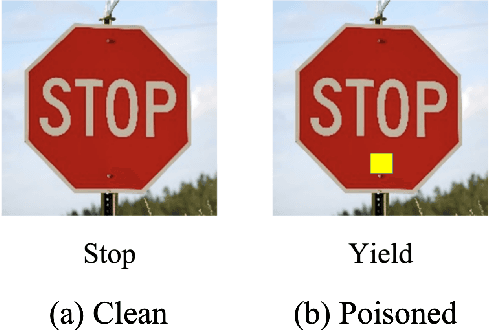
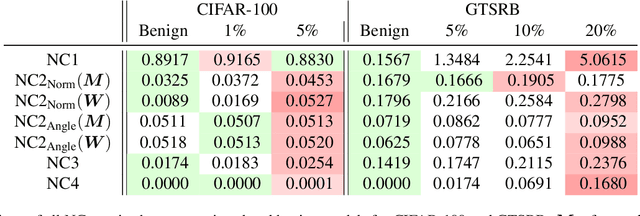
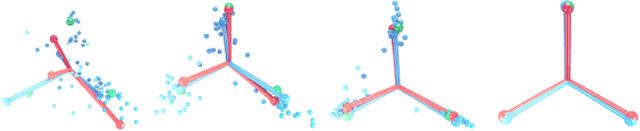
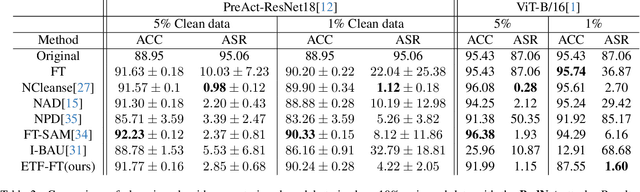
Trojan attacks are sophisticated training-time attacks on neural networks that embed backdoor triggers which force the network to produce a specific output on any input which includes the trigger. With the increasing relevance of deep networks which are too large to train with personal resources and which are trained on data too large to thoroughly audit, these training-time attacks pose a significant risk. In this work, we connect trojan attacks to Neural Collapse, a phenomenon wherein the final feature representations of over-parameterized neural networks converge to a simple geometric structure. We provide experimental evidence that trojan attacks disrupt this convergence for a variety of datasets and architectures. We then use this disruption to design a lightweight, broadly generalizable mechanism for cleansing trojan attacks from a wide variety of different network architectures and experimentally demonstrate its efficacy.