 Add to Chrome
 Add to Firefox
 Add to Edge
IF-GEO: Conflict-Aware Instruction Fusion for Multi-Query Generative Engine Optimization
Jan 20, 2026
As Generative Engines revolutionize information retrieval by synthesizing direct answers from retrieved sources, ensuring source visibility becomes a significant challenge. Improving it through targeted content revisions is a practical strategy termed Generative Engine Optimization (GEO). However, optimizing a document for diverse queries presents a constrained optimization challenge where heterogeneous queries often impose conflicting and competing revision requirements under a limited content budget. To address this challenge, we propose IF-GEO, a "diverge-then-converge" framework comprising two phases: (i) mining distinct optimization preferences from representative latent queries; (ii) synthesizing a Global Revision Blueprint for guided editing by coordinating preferences via conflict-aware instruction fusion. To explicitly quantify IF-GEO's objective of cross-query stability, we introduce risk-aware stability metrics. Experiments on multi-query benchmarks demonstrate that IF-GEO achieves substantial performance gains while maintaining robustness across diverse retrieval scenarios.

WinMamba: Multi-Scale Shifted Windows in State Space Model for 3D Object Detection
Nov 17, 2025


3D object detection is critical for autonomous driving, yet it remains fundamentally challenging to simultaneously maximize computational efficiency and capture long-range spatial dependencies. We observed that Mamba-based models, with their linear state-space design, capture long-range dependencies at lower cost, offering a promising balance between efficiency and accuracy. However, existing methods rely on axis-aligned scanning within a fixed window, inevitably discarding spatial information. To address this problem, we propose WinMamba, a novel Mamba-based 3D feature-encoding backbone composed of stacked WinMamba blocks. To enhance the backbone with robust multi-scale representation, the WinMamba block incorporates a window-scale-adaptive module that compensates voxel features across varying resolutions during sampling. Meanwhile, to obtain rich contextual cues within the linear state space, we equip the WinMamba layer with a learnable positional encoding and a window-shift strategy. Extensive experiments on the KITTI and Waymo datasets demonstrate that WinMamba significantly outperforms the baseline. Ablation studies further validate the individual contributions of the WSF and AWF modules in improving detection accuracy. The code will be made publicly available.
Caption Injection for Optimization in Generative Search Engine
Nov 06, 2025Generative Search Engines (GSEs) leverage Retrieval-Augmented Generation (RAG) techniques and Large Language Models (LLMs) to integrate multi-source information and provide users with accurate and comprehensive responses. Unlike traditional search engines that present results in ranked lists, GSEs shift users' attention from sequential browsing to content-driven subjective perception, driving a paradigm shift in information retrieval. In this context, enhancing the subjective visibility of content through Generative Search Engine Optimization (G-SEO) methods has emerged as a new research focus. With the rapid advancement of Multimodal Retrieval-Augmented Generation (MRAG) techniques, GSEs can now efficiently integrate text, images, audio, and video, producing richer responses that better satisfy complex information needs. Existing G-SEO methods, however, remain limited to text-based optimization and fail to fully exploit multimodal data. To address this gap, we propose Caption Injection, the first multimodal G-SEO approach, which extracts captions from images and injects them into textual content, integrating visual semantics to enhance the subjective visibility of content in generative search scenarios. We systematically evaluate Caption Injection on MRAMG, a benchmark for MRAG, under both unimodal and multimodal settings. Experimental results show that Caption Injection significantly outperforms text-only G-SEO baselines under the G-Eval metric, demonstrating the necessity and effectiveness of multimodal integration in G-SEO to improve user-perceived content visibility.
Season-Independent PV Disaggregation Using Multi-Scale Net Load Temporal Feature Extraction and Weather Factor Fusion
May 24, 2025With the advancement of energy Internet and energy system integration, the increasing adoption of distributed photovoltaic (PV) systems presents new challenges on smart monitoring and measurement for utility companies, particularly in separating PV generation from net electricity load. Existing methods struggle with feature extraction from net load and capturing the relevance between weather factors. This paper proposes a PV disaggregation method that integrates Hierarchical Interpolation (HI) and multi-head self-attention mechanisms. By using HI to extract net load features and multi-head self-attention to capture the complex dependencies between weather factors, the method achieves precise PV generation predictions. Simulation experiments demonstrate the effectiveness of the proposed method in real-world data, supporting improved monitoring and management of distributed energy systems.
Smart Energy Guardian: A Hybrid Deep Learning Model for Detecting Fraudulent PV Generation
May 24, 2025With the proliferation of smart grids, smart cities face growing challenges due to cyber-attacks and sophisticated electricity theft behaviors, particularly in residential photovoltaic (PV) generation systems. Traditional Electricity Theft Detection (ETD) methods often struggle to capture complex temporal dependencies and integrating multi-source data, limiting their effectiveness. In this work, we propose an efficient ETD method that accurately identifies fraudulent behaviors in residential PV generation, thus ensuring the supply-demand balance in smart cities. Our hybrid deep learning model, combining multi-scale Convolutional Neural Network (CNN), Long Short-Term Memory (LSTM), and Transformer, excels in capturing both short-term and long-term temporal dependencies. Additionally, we introduce a data embedding technique that seamlessly integrates time-series data with discrete temperature variables, enhancing detection robustness. Extensive simulation experiments using real-world data validate the effectiveness of our approach, demonstrating significant improvements in the accuracy of detecting sophisticated energy theft activities, thereby contributing to the stability and fairness of energy systems in smart cities.
FedCRL: Personalized Federated Learning with Contrastive Shared Representations for Label Heterogeneity in Non-IID Data
Apr 27, 2024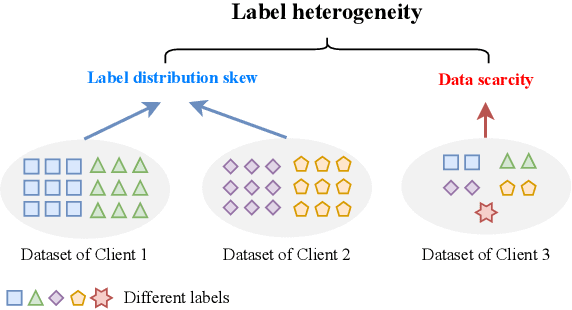
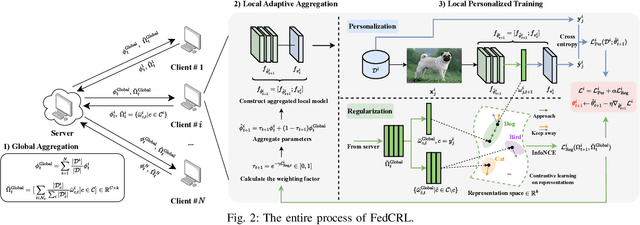
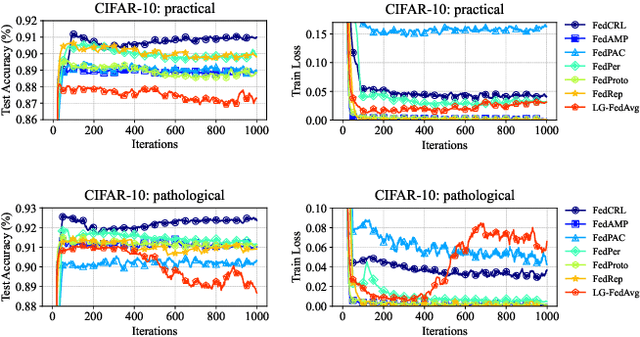
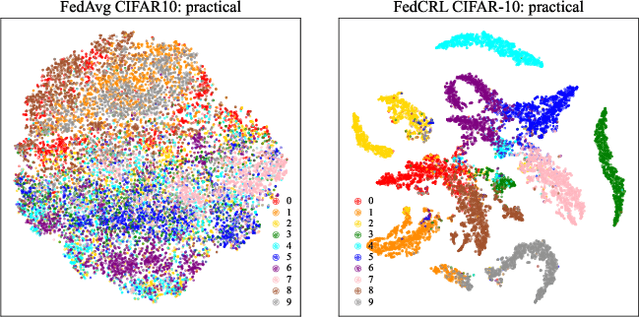
To deal with heterogeneity resulting from label distribution skew and data scarcity in distributed machine learning scenarios, this paper proposes a novel Personalized Federated Learning (PFL) algorithm, named Federated Contrastive Representation Learning (FedCRL). FedCRL introduces contrastive representation learning (CRL) on shared representations to facilitate knowledge acquisition of clients. Specifically, both local model parameters and averaged values of local representations are considered as shareable information to the server, both of which are then aggregated globally. CRL is applied between local representations and global representations to regularize personalized training by drawing similar representations closer and separating dissimilar ones, thereby enhancing local models with external knowledge and avoiding being harmed by label distribution skew. Additionally, FedCRL adopts local aggregation between each local model and the global model to tackle data scarcity. A loss-wise weighting mechanism is introduced to guide the local aggregation using each local model's contrastive loss to coordinate the global model involvement in each client, thus helping clients with scarce data. Our simulations demonstrate FedCRL's effectiveness in mitigating label heterogeneity by achieving accuracy improvements over existing methods on datasets with varying degrees of label heterogeneity.