 Add to Chrome
 Add to Firefox
 Add to Edge
A New Dataset and Framework for Robust Road Surface Classification via Camera-IMU Fusion
Jan 29, 2026
Road surface classification (RSC) is a key enabler for environment-aware predictive maintenance systems. However, existing RSC techniques often fail to generalize beyond narrow operational conditions due to limited sensing modalities and datasets that lack environmental diversity. This work addresses these limitations by introducing a multimodal framework that fuses images and inertial measurements using a lightweight bidirectional cross-attention module followed by an adaptive gating layer that adjusts modality contributions under domain shifts. Given the limitations of current benchmarks, especially regarding lack of variability, we introduce ROAD, a new dataset composed of three complementary subsets: (i) real-world multimodal recordings with RGB-IMU streams synchronized using a gold-standard industry datalogger, captured across diverse lighting, weather, and surface conditions; (ii) a large vision-only subset designed to assess robustness under adverse illumination and heterogeneous capture setups; and (iii) a synthetic subset generated to study out-of-distribution generalization in scenarios difficult to obtain in practice. Experiments show that our method achieves a +1.4 pp improvement over the previous state-of-the-art on the PVS benchmark and an +11.6 pp improvement on our multimodal ROAD subset, with consistently higher F1-scores on minority classes. The framework also demonstrates stable performance across challenging visual conditions, including nighttime, heavy rain, and mixed-surface transitions. These findings indicate that combining affordable camera and IMU sensors with multimodal attention mechanisms provides a scalable, robust foundation for road surface understanding, particularly relevant for regions where environmental variability and cost constraints limit the adoption of high-end sensing suites.

VWise: A novel benchmark for evaluating scene classification for vehicular applications
Jun 05, 2024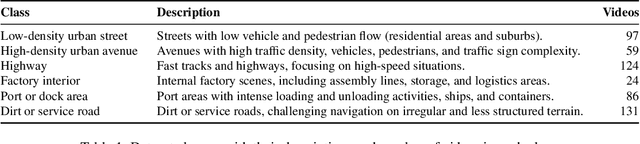
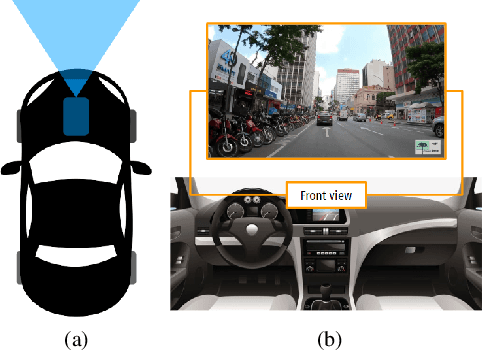
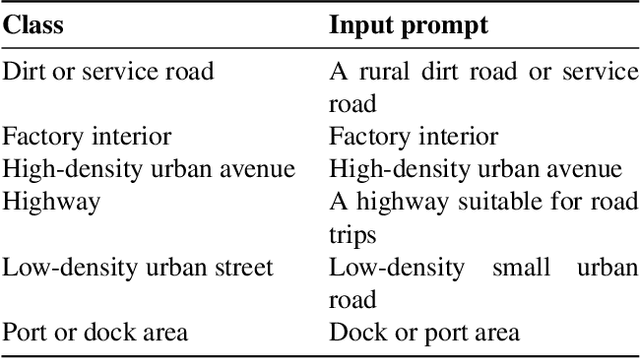
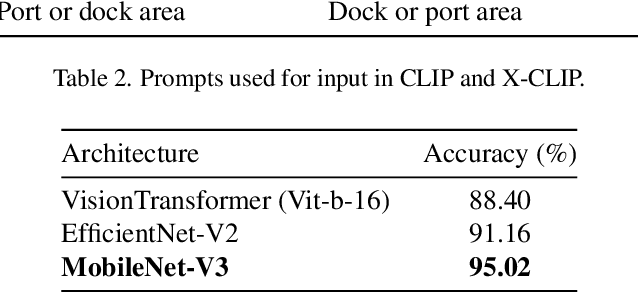
Current datasets for vehicular applications are mostly collected in North America or Europe. Models trained or evaluated on these datasets might suffer from geographical bias when deployed in other regions. Specifically, for scene classification, a highway in a Latin American country differs drastically from an Autobahn, for example, both in design and maintenance levels. We propose VWise, a novel benchmark for road-type classification and scene classification tasks, in addition to tasks focused on external contexts related to vehicular applications in LatAm. We collected over 520 video clips covering diverse urban and rural environments across Latin American countries, annotated with six classes of road types. We also evaluated several state-of-the-art classification models in baseline experiments, obtaining over 84% accuracy. With this dataset, we aim to enhance research on vehicular tasks in Latin America.