 Add to Chrome
 Add to Firefox
 Add to Edge
In-Context Source and Channel Coding
Jan 15, 2026
Separate Source-Channel Coding (SSCC) remains attractive for text transmission due to its modularity and compatibility with mature entropy coders and powerful channel codes. However, SSCC often suffers from a pronounced cliff effect in low Signal-to-Noise Ratio (SNR) regimes, where residual bit errors after channel decoding can catastrophically break lossless source decoding, especially for Arithmetic Coding (AC) driven by Large Language Models (LLMs). This paper proposes a receiver-side In-Context Decoding (ICD) framework that enhances SSCC robustness without modifying the transmitter. ICD leverages an Error Correction Code Transformer (ECCT) to obtain bit-wise reliability for the decoded information bits. Based on the context-consistent bitstream, ICD constructs a confidence-ranked candidate pool via reliability-guided bit flipping, samples a compact yet diverse subset of candidates, and applies an LLM-based arithmetic decoder to obtain both reconstructions and sequence-level log-likelihoods. A reliability-likelihood fusion rule then selects the final output. We further provide theoretical guarantees on the stability and convergence of the proposed sampling procedure. Extensive experiments over Additive White Gaussian Noise (AWGN) and Rayleigh fading channels demonstrate consistent gains compared with conventional SSCC baselines and representative Joint Source-Channel Coding (JSCC) schemes.

Separate Source Channel Coding Is Still What You Need: An LLM-based Rethinking
Jan 08, 2025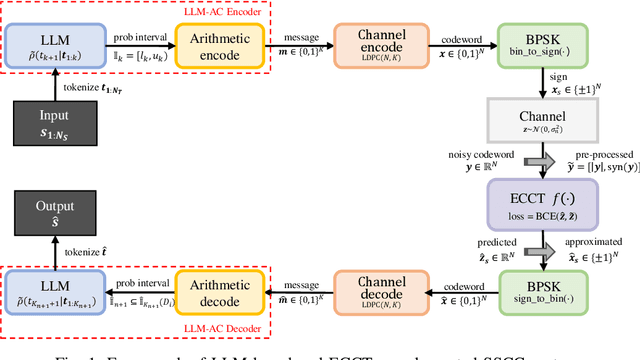
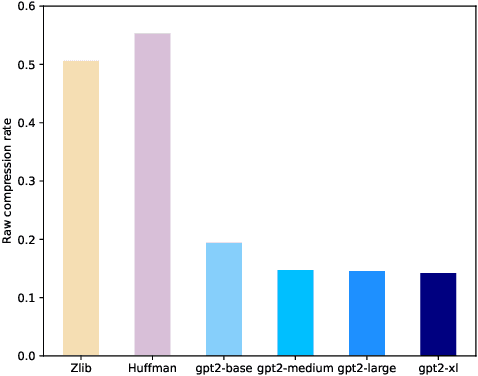
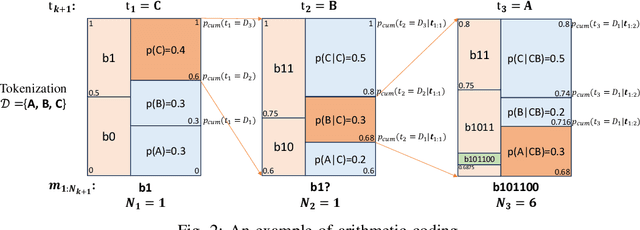
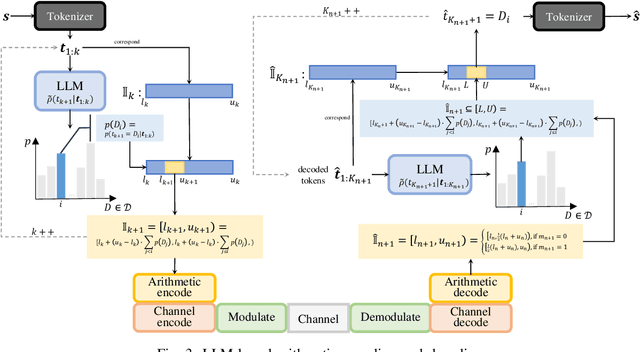
Along with the proliferating research interest in Semantic Communication (SemCom), Joint Source Channel Coding (JSCC) has dominated the attention due to the widely assumed existence in efficiently delivering information semantics. %has emerged as a pivotal area of research, aiming to enhance the efficiency and reliability of information transmission through deep learning-based methods. Nevertheless, this paper challenges the conventional JSCC paradigm, and advocates for adoption of Separate Source Channel Coding (SSCC) to enjoy the underlying more degree of freedom for optimization. We demonstrate that SSCC, after leveraging the strengths of Large Language Model (LLM) for source coding and Error Correction Code Transformer (ECCT) complemented for channel decoding, offers superior performance over JSCC. Our proposed framework also effectively highlights the compatibility challenges between SemCom approaches and digital communication systems, particularly concerning the resource costs associated with the transmission of high precision floating point numbers. Through comprehensive evaluations, we establish that empowered by LLM-based compression and ECCT-enhanced error correction, SSCC remains a viable and effective solution for modern communication systems. In other words, separate source and channel coding is still what we need!