 Add to Chrome
 Add to Firefox
 Add to Edge
Group Selection as a Safeguard Against AI Substitution
Feb 03, 2026
Reliance on generative AI can reduce cultural variance and diversity, especially in creative work. This reduction in variance has already led to problems in model performance, including model collapse and hallucination. In this paper, we examine the long-term consequences of AI use for human cultural evolution and the conditions under which widespread AI use may lead to "cultural collapse", a process in which reliance on AI-generated content reduces human variation and innovation and slows cumulative cultural evolution. Using an agent-based model and evolutionary game theory, we compare two types of AI use: complement and substitute. AI-complement users seek suggestions and guidance while remaining the main producers of the final output, whereas AI-substitute users provide minimal input, and rely on AI to produce most of the output. We then study how these use strategies compete and spread under evolutionary dynamics. We find that AI-substitute users prevail under individual-level selection despite the stronger reduction in cultural variance. By contrast, AI-complement users can benefit their groups by maintaining the variance needed for exploration, and can therefore be favored under cultural group selection when group boundaries are strong. Overall, our findings shed light on the long-term, population-level effects of AI adoption and inform policy and organizational strategies to mitigate these risks.

Expertise elevates AI usage: experimental evidence comparing laypeople and professional artists
Jan 21, 2025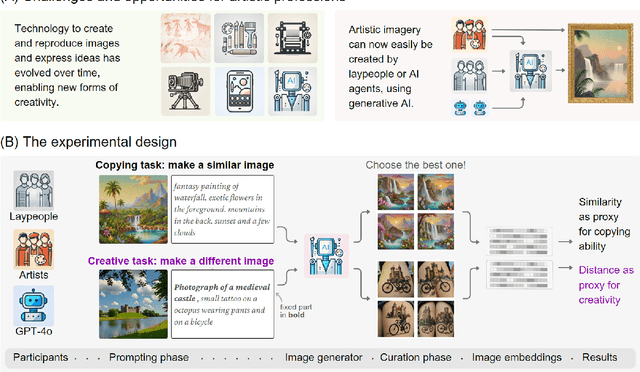
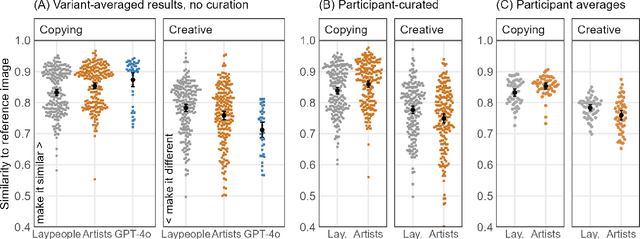
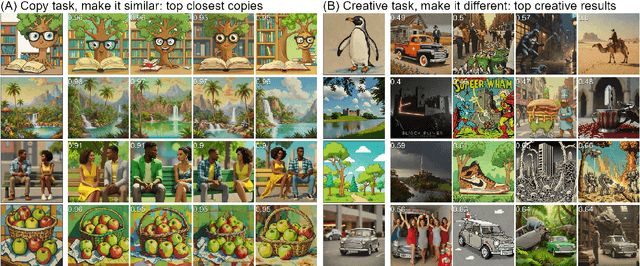
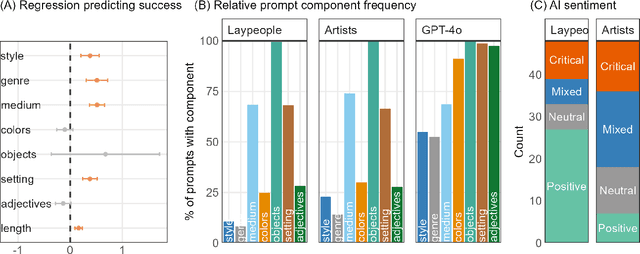
Novel capacities of generative AI to analyze and generate cultural artifacts raise inevitable questions about the nature and value of artistic education and human expertise. Has AI already leveled the playing field between professional artists and laypeople, or do trained artistic expressive capacity, curation skills and experience instead enhance the ability to use these new tools? In this pre-registered study, we conduct experimental comparisons between 50 active artists and a demographically matched sample of laypeople. We designed two tasks to approximate artistic practice for testing their capabilities in both faithful and creative image creation: replicating a reference image, and moving as far away as possible from it. We developed a bespoke platform where participants used a modern text-to-image model to complete both tasks. We also collected and compared participants' sentiments towards AI. On average, artists produced more faithful and creative outputs than their lay counterparts, although only by a small margin. While AI may ease content creation, professional expertise is still valuable - even within the confined space of generative AI itself. Finally, we also explored how well an exemplary vision-capable large language model (GPT-4o) would complete the same tasks, if given the role of an image generation agent, and found it performed on par in copying but outperformed even artists in the creative task. The very best results were still produced by humans in both tasks. These outcomes highlight the importance of integrating artistic skills with AI training to prepare artists and other visual professionals for a technologically evolving landscape. We see a potential in collaborative synergy with generative AI, which could reshape creative industries and education in the arts.