 Add to Chrome
 Add to Firefox
 Add to Edge
Bridging the Applicator Gap with Data-Doping:Dual-Domain Learning for Precise Bladder Segmentation in CT-Guided Brachytherapy
Jan 28, 2026
Performance degradation due to covariate shift remains a major challenge for deep learning models in medical image segmentation. An open question is whether samples from a shifted distribution can effectively support learning when combined with limited target domain data. We investigate this problem in the context of bladder segmentation in CT guided gynecological brachytherapy, a critical task for accurate dose optimization and organ at risk sparing. While CT scans without brachytherapy applicators (no applicator: NA) are widely available, scans with applicators inserted (with applicator: WA) are scarce and exhibit substantial anatomical deformation and imaging artifacts, making automated segmentation particularly difficult. We propose a dual domain learning strategy that integrates NA and WA CT data to improve robustness and generalizability under covariate shift. Using a curated assorted dataset, we show that NA data alone fail to capture the anatomical and artifact related characteristics of WA images. However, introducing a modest proportion of WA data into a predominantly NA training set leads to significant performance improvements. Through systematic experiments across axial, coronal, and sagittal planes using multiple deep learning architectures, we demonstrate that doping only 10 to 30 percent WA data achieves segmentation performance comparable to models trained exclusively on WA data. The proposed approach attains Dice similarity coefficients of up to 0.94 and Intersection over Union scores of up to 0.92, indicating effective domain adaptation and improved clinical reliability. This study highlights the value of integrating anatomically similar but distribution shifted datasets to overcome data scarcity and enhance deep learning based segmentation for brachytherapy treatment planning.

Federated Self-Supervised Learning for One-Shot Cross-Modal and Cross-Imaging Technique Segmentation
Mar 30, 2025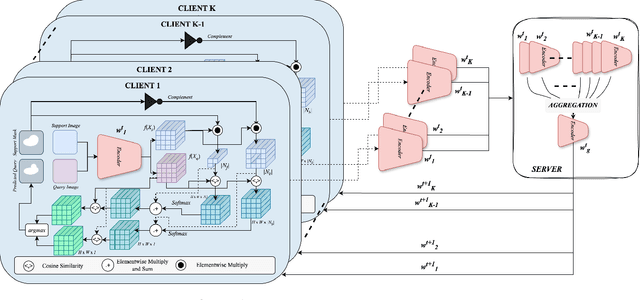
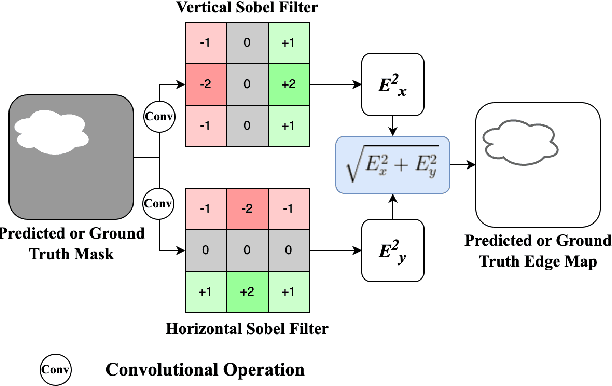
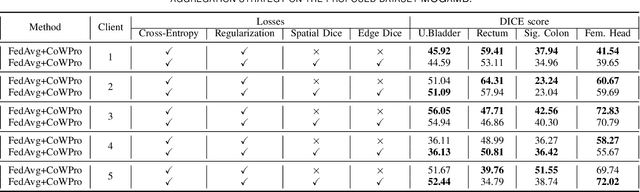
Decentralized federated learning enables learning of data representations from multiple sources without compromising the privacy of the clients. In applications like medical image segmentation, where obtaining a large annotated dataset from a single source is a distressing problem, federated self-supervised learning can provide some solace. In this work, we push the limits further by exploring a federated self-supervised one-shot segmentation task representing a more data-scarce scenario. We adopt a pre-existing self-supervised few-shot segmentation framework CoWPro and adapt it to the federated learning scenario. To the best of our knowledge, this work is the first to attempt a self-supervised few-shot segmentation task in the federated learning domain. Moreover, we consider the clients to be constituted of data from different modalities and imaging techniques like MR or CT, which makes the problem even harder. Additionally, we reinforce and improve the baseline CoWPro method using a fused dice loss which shows considerable improvement in performance over the baseline CoWPro. Finally, we evaluate this novel framework on a completely unseen held-out part of the local client dataset. We observe that the proposed framework can achieve performance at par or better than the FedAvg version of the CoWPro framework on the held-out validation dataset.