 Add to Chrome
 Add to Firefox
 Add to Edge
TextME: Bridging Unseen Modalities Through Text Descriptions
Feb 03, 2026
Expanding multimodal representations to novel modalities is constrained by reliance on large-scale paired datasets (e.g., text-image, text-audio, text-3D, text-molecule), which are costly and often infeasible in domains requiring expert annotation such as medical imaging and molecular analysis. We introduce TextME, the first text-only modality expansion framework, to the best of our knowledge, projecting diverse modalities into LLM embedding space as a unified anchor. Our approach exploits the geometric structure of pretrained contrastive encoders to enable zero-shot cross-modal transfer using only text descriptions, without paired supervision. We empirically validate that such consistent modality gaps exist across image, video, audio, 3D, X-ray, and molecular domains, demonstrating that text-only training can preserve substantial performance of pretrained encoders. We further show that our framework enables emergent cross-modal retrieval between modality pairs not explicitly aligned during training (e.g., audio-to-image, 3D-to-image). These results establish text-only training as a practical alternative to paired supervision for modality expansion.

Infusing Environmental Captions for Long-Form Video Language Grounding
Aug 06, 2024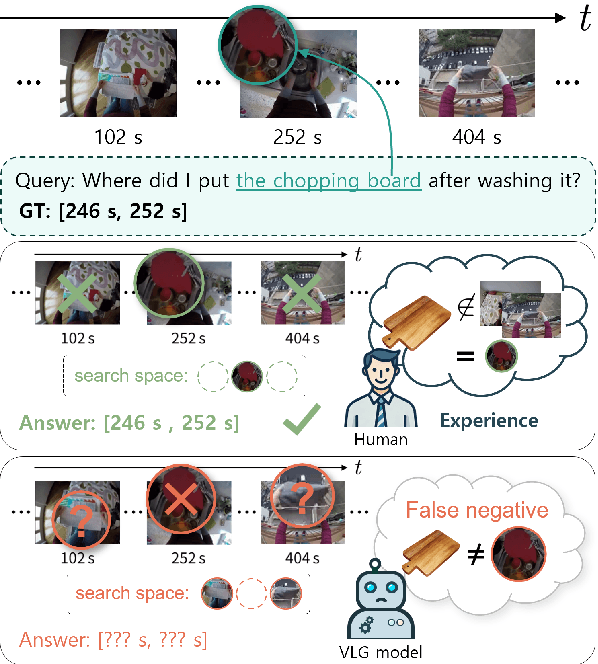
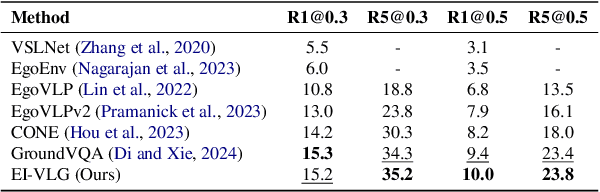
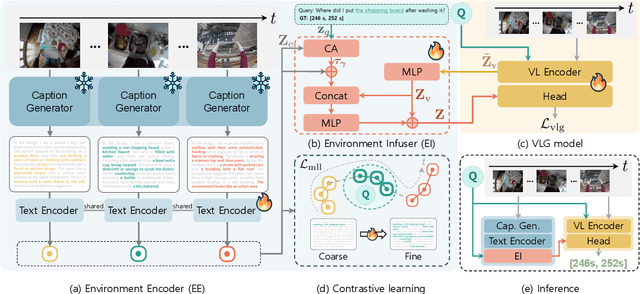
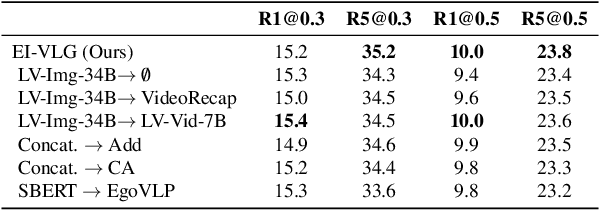
In this work, we tackle the problem of long-form video-language grounding (VLG). Given a long-form video and a natural language query, a model should temporally localize the precise moment that answers the query. Humans can easily solve VLG tasks, even with arbitrarily long videos, by discarding irrelevant moments using extensive and robust knowledge gained from experience. Unlike humans, existing VLG methods are prone to fall into superficial cues learned from small-scale datasets, even when they are within irrelevant frames. To overcome this challenge, we propose EI-VLG, a VLG method that leverages richer textual information provided by a Multi-modal Large Language Model (MLLM) as a proxy for human experiences, helping to effectively exclude irrelevant frames. We validate the effectiveness of the proposed method via extensive experiments on a challenging EgoNLQ benchmark.