 Add to Chrome
 Add to Firefox
 Add to Edge
Look Forward to Walk Backward: Efficient Terrain Memory for Backward Locomotion with Forward Vision
Mar 03, 2026
Legged robots with egocentric forward-facing depth cameras can couple exteroception and proprioception to achieve robust forward agility on complex terrain. When these robots walk backward, the forward-only field of view provides no preview. Purely proprioceptive controllers can remain stable on moderate ground when moving backward but cannot fully exploit the robot's capabilities on complex terrain and must collide with obstacles. We present Look Forward to Walk Backward (LF2WB), an efficient terrain-memory locomotion framework that uses forward egocentric depth and proprioception to write a compact associative memory during forward motion and to retrieve it for collision-free backward locomotion without rearward vision. The memory backbone employs a delta-rule selective update that softly removes then writes the memory state along the active subspace. Training uses hardware-efficient parallel computation, and deployment runs recurrent, constant-time per-step inference with a constant-size state, making the approach suitable for onboard processors on low-cost robots. Experiments in both simulations and real-world scenarios demonstrate the effectiveness of our method, improving backward agility across complex terrains under limited sensing.

MOVE: Multi-skill Omnidirectional Legged Locomotion with Limited View in 3D Environments
Dec 04, 2024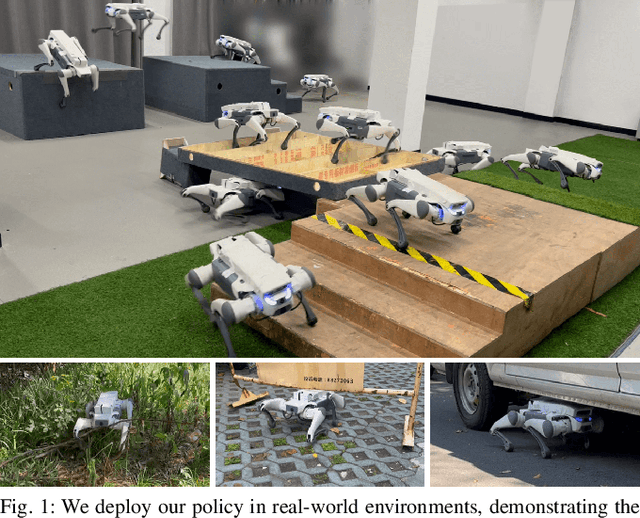
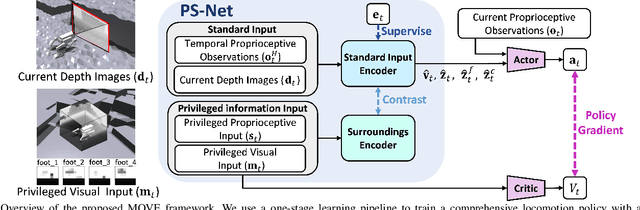
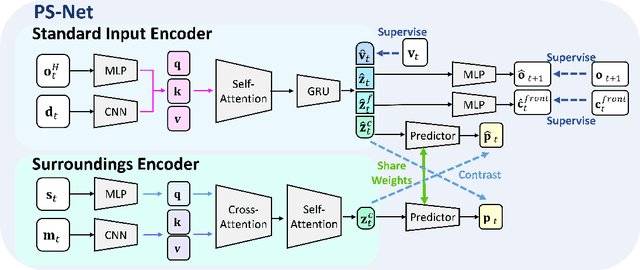
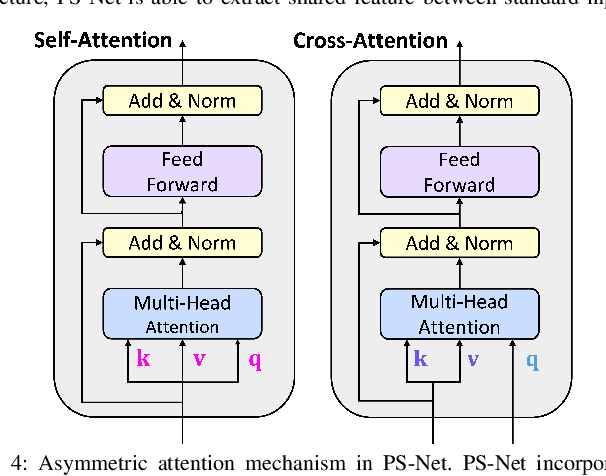
Legged robots possess inherent advantages in traversing complex 3D terrains. However, previous work on low-cost quadruped robots with egocentric vision systems has been limited by a narrow front-facing view and exteroceptive noise, restricting omnidirectional mobility in such environments. While building a voxel map through a hierarchical structure can refine exteroception processing, it introduces significant computational overhead, noise, and delays. In this paper, we present MOVE, a one-stage end-to-end learning framework capable of multi-skill omnidirectional legged locomotion with limited view in 3D environments, just like what a real animal can do. When movement aligns with the robot's line of sight, exteroceptive perception enhances locomotion, enabling extreme climbing and leaping. When vision is obstructed or the direction of movement lies outside the robot's field of view, the robot relies on proprioception for tasks like crawling and climbing stairs. We integrate all these skills into a single neural network by introducing a pseudo-siamese network structure combining supervised and contrastive learning which helps the robot infer its surroundings beyond its field of view. Experiments in both simulations and real-world scenarios demonstrate the robustness of our method, broadening the operational environments for robotics with egocentric vision.
PIE: Parkour with Implicit-Explicit Learning Framework for Legged Robots
Aug 27, 2024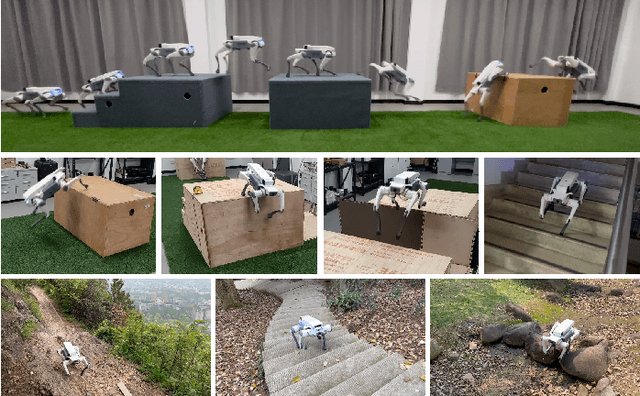
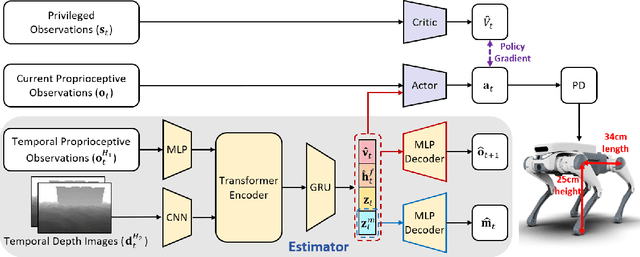

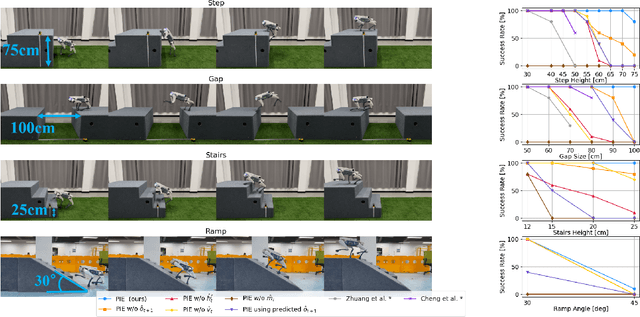
Parkour presents a highly challenging task for legged robots, requiring them to traverse various terrains with agile and smooth locomotion. This necessitates comprehensive understanding of both the robot's own state and the surrounding terrain, despite the inherent unreliability of robot perception and actuation. Current state-of-the-art methods either rely on complex pre-trained high-level terrain reconstruction modules or limit the maximum potential of robot parkour to avoid failure due to inaccurate perception. In this paper, we propose a one-stage end-to-end learning-based parkour framework: Parkour with Implicit-Explicit learning framework for legged robots (PIE) that leverages dual-level implicit-explicit estimation. With this mechanism, even a low-cost quadruped robot equipped with an unreliable egocentric depth camera can achieve exceptional performance on challenging parkour terrains using a relatively simple training process and reward function. While the training process is conducted entirely in simulation, our real-world validation demonstrates successful zero-shot deployment of our framework, showcasing superior parkour performance on harsh terrains.